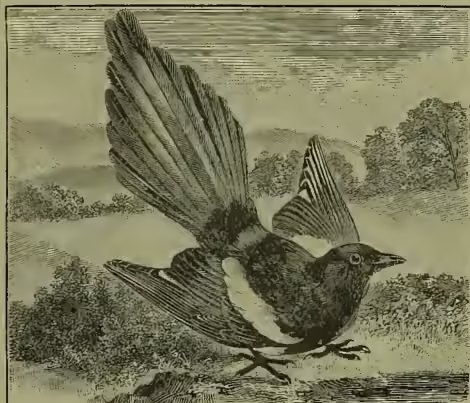
Magpie, or PIE (Pica), a genus of birds of the family Corvidæ (q.v.), distinguished from the true crows by their small size, long tail, short wings, and variegated plumage. The only British species is the Common Magpie (P. rustica), common in Britain, very abundant in Ireland, and found in almost all parts of Europe, in Asia as far as India, China, and Japan, and in the northern parts of North America from the Pacific to Michigan. It is from 16 to 18 inches long, the longest tail-feathers sometimes measuring 11 inches in length. It is of a glossy-black plumage, slightly greenish and violet on the crown and back, with a slightly coppery tinge on the head; rump gray; shoulder-feathers and under-surface of body white; wings and tail blue, green, and white; bill, legs, and feet black. The female is slightly smaller than the male and less brilliant in plumage. The magpie is a shy, mischievous bird, extremely vigilant and cunning, both in eluding enemies and in seeking its own food. It is generally seen in pairs, but occasionally in large flocks. Its note is a harsh chatter, kept up as long as any obnoxious person or animal is near its haunts. In diet it is almost omnivorous, living on snails, slugs, worms, frogs, rats, mice, and the eggs and young of poultry. It builds its nest usually in the fork of a tree at some distance from the ground, but sometimes on low hedges and thorn bushes, or even on the ground. In Norway and Sweden, where it is favoured, it may be found nesting near houses on low goose-berry bushes. Its nest is large and dome-shaped, made of sticks cemented with clay and lined with fine roots and dried grass. It is strongly fortified with rough thorns, so as to resist the attacks of other animals, and even the action of the small shot which gamekeepers fire into it when they suspect it to contain young birds. The eggs are from six to nine in number, of a pale bluish green or yellowish-white, spotted with olive-brown. The mother shows great attachment to her progeny. The magpie is easily tamed, becomes impudently familiar, and learns to articulate a few words. Both in its wild and tame state it has a propensity to seize and carry off bright and glittering articles and hide them. The genus Pica consists of nine species, very widely distributed in Europe, Northern Africa, Asia north of the Himalayas, in Arctic America, and California.
A great wealth of popular superstition has clustered round the magpie or pyet, and almost universally it is considered as in a special sense a bird of evil omen. In Germany, Sweden, and Brittany it is closely connected with witches and with the devil, and it is unlucky to kill one, except during the twelve days between Christmas and Epiphany in Sweden and North Germany, and during the month of March in Thuringia. Popular reasons for the bird's persistent wickedness, in the north of England, are: because it was the only bird that would not go into the ark with Noah; because it is a hybrid between the raven and the dove; because after the crucifixion it alone of all the birds did not go into full mourning. Its appearance and the numbers seen at one time are always significant. There are many variants (some even contradictory), but the following is in good belief in the north of England:
One is sorrow, two is mirth,
Three a wedding, four a birth,
Five heaven, six hell,
Seven the deil's ain sel.
Wordsworth, in the Excursion, has alluded to the auspicious omen of seeing two magpies cross one's path, and Sir Humphry Davy, in Salmonia, has made it reasonable by linking the fact with the goodness of the weather.