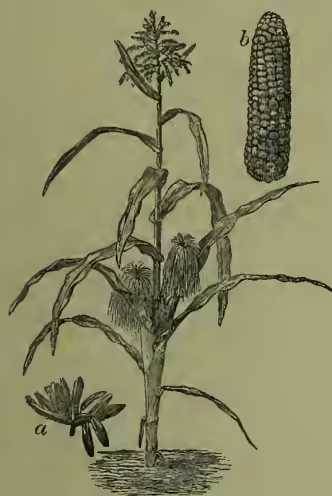
a, flower; b, ear.
Maize, or INDIAN CORN, is the produce of Zea mays, a species of cereal having monococious flowers, the features of which are well illustrated in the accompanying cut. The stem, which is filled with a pithy, fibrous structure, is divided at irregular intervals by nodes, and its strength and solidity is increased by a siliceous outside covering. From the lowest, and sometimes also the second and third node, it sends out 'brace' roots, and these help to support the plant, which sometimes grows to 18 feet in height, the minimum being generally 3 feet. The ears—which are developed within the leaf-sheath at the nodes, and consist of a 'cob' with the grains disposed upon it in regular rows of from eight to twenty, and long 'silk' threads attached to each embryo, which usually extend beyond the closely-folded tip of the mass of imbricated leaves ('husk') that wraps the whole—are from half an inch to 3 inches in diameter, and from 2 to 17 inches in length. The stem is topped by a 'tassel,' producing an abundance of light, dry, loosely-attached pollen. Maize is hardly a less staple article of food to the inhabitants of tropical and subtropical countries than rice, and is rapidly becoming popular in various forms in temperate and colder climates. It is held to be superior in nutriment to barley, buckwheat, and rye. By analysis it gives 77 per cent. of starch; 3 of zein, a principle analogous to gluten; 2.5 of albumen; 1.45 of sugar; .8 of extractive; 1.75 of gum; 1.5 of sulphate and phosphate of lime; 3 of lignin; and 9 of water. It is more generally used in America (North and South) than in the other continents—in the United States the crop is over 2000 million bushels, or about two-thirds of all the grains grown; but in the Mediterranean countries, Germany, &c., it is also highly valued. The green ears of the sweet varieties are boiled and eaten from the kernel or served in milk. When coarsely ground maize forms the hominy of the southern states of America, and finer ground it furnishes the mush or porridge of the northern states; while the whole grains with the cuticle covering removed after being loosened by boiling in a weak lye, are the hulled corn of the states generally. Popcorn is a variety whose grains can be roasted and turned and shaken smartly over a brisk fire till they swell and burst, turning inside out; in this state they are coated with syrup and pressed into a ball, or the separate grains are simply sprinkled with salt. The deficiency of gluten in the meal of maize renders it ill adapted to bread-making; but johnny-cakes made from it are popular along with bacon, &c., and mixed with rye-meal it forms the common brown bread of New England. Large quantities of starch are manufactured from maize, both for laundry purposes and for making puddings, custards, and blanc-mange; and the starch, by treatment with acid, is converted into glucose or grape sugar (see SUGAR). The canning of green sweet corn is also an important industry in some states. By the Mexicans the small young shoots of thickly-sown crops are served at table like asparagus and as dessert. The stems of the sugar corn when full grown yield by pressure a thin sweet juice, which unfermented gives a pleasant syrup and from five to fifteen per cent. of sugar, fermented a beer called chica, and distilled an excellent spirit resembling brandy. In countries where maize does not ripen well it is sometimes sown to afford food for poultry, or to be mown as green fodder for cattle. Where it is cultivated for its grain the dried leaves are used as winter fodder. The stalks are used for thatch and for fuel, and for making baskets.
The fibres of the culm and leaves afford a durable kind of yarn; and the husks are elastic, and can be applied to the stuffing of chairs, saddles, &c., and to the manufacture of good durable mattresses, which have become a profitable article of trade in Paris and Strasburg. The husks are also much used for packing oranges and lemons, and in South America for making cigarettes; and good paper has been manufactured from them. Hollowed corn-cobs make homely but serviceable pipe-heads for smoking tobacco. There are few plants of which the uses are more various than maize, and few which are of greater importance to man.—Another species of maize, called Chili Maize or Valparaiso Corn (Z. Curagua), is distinguished by its serrated leaves. It is a smaller plant, a native of Chili, and has won a superstitious regard because its grains when roasted split in the form of a cross. Formerly in England maize was known by the name Turkey wheat, being then solely an article of trade from the East; but the name Indian corn, which was given it by the early settlers in America, gradually supplanted the earlier name as the supply from that country ousted that of the earlier sources from the British market. In America it is simply called corn. The native country of maize is uncertain. Humboldt and De Candolle are of opinion that it was introduced from the West Indies and the continent of America, but other authorities adduce good grounds for the contention that the plant is indigenous to or at least was known and cultivated in Asia and Africa before the discovery of America. In an ancient Chinese encyclopædia in the royal library at Paris is an excellent representation of the plant; so that while it was undoubtedly first introduced to Europe about the year 1520 by Columbus from America, there are good grounds for the conclusion that it was known and cultivated in the ancient world long before that time.