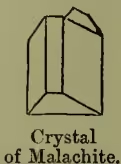
Malachite, a mineral, essentially a carbonate of copper, of a green colour, occurs generally massive, with a globular reniform, botryoidal or stalactitic surface; frequently fibrous and showing irregular bands of colour; sometimes earthy in texture. More rarely it is met with crystallised in rather oblique four-sided prisms, bevelled on the extremities, or with the bevelled planes truncated so as to form six-sided prisms. It is valuable as an ore of copper, although seldom smelted alone, not only because it is found along with other ores, but because the metal is apt to be carried off with the carbonic acid. It is sometimes passed off in jewellery as turquoise, although easily distinguished by its colour and much inferior hardness. It is used for many ornamental purposes; slabs of it—chiefly from the mines of Siberia—are made into tables, mantel-pieces, &c. of exquisite beauty. In 1835 a mass of solid malachite was found in the Ural Mountains of more than 17 feet in length, and weighing about 25 tons. By the ancients it was used as a charm to protect infants from witchcraft and sorceries.