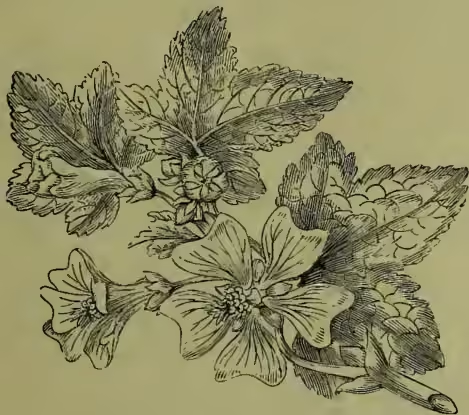
Mallow (Malva), a genus of plants of the natural order Malvaceæ, whose species are herbaceous plants, or more rarely shrubs. The Common Mallow (M. sylvestris) is plentiful over most of Europe, and in Britain on waysides and heaps of rubbish. It is a perennial, with rather large bluish-red flowers on erect stalks. The Dwarf Mallow (M. rotundifolia), also a common native of Britain, has smaller whitish or reddish-white flowers. These two plants have a mucilaginous and somewhat bitter taste, and the leaves are used as an emollient and demulcent medicine, a decoction of them being employed in cases of irritation of the pulmonary and of the urinary organs; and poultices made of them are very frequently employed to allay external inflammation. Other species have similar properties. The Musk Mallow (M. moschata), not unfrequent in England, but rare in Scotland, has a faint musk-like smell. The fibre of M. crispa is used in Syria for textile purposes, and the fibres of many species are probably fit for similar use, and for the manufacture of paper. The young leaves of some are boiled as vegetables. A Mallow (Lavatera arborea) grows on the Bass Rock and Haddingtonshire. The Marsh-mallow (q.v.) belongs to another genus.