Mammals (Mammalia, Lat. mamma, 'a teat') form what is usually considered the highest class of backboned animals, including numerous orders, of which horse, elephant, and whale, dog, beaver, and bat, anthropoid ape, and man himself are in different ways prominent illustrative types. Compared with birds, mammals are most notably characterised by the greater development of their brains, and by the close connection between mother and offspring; but in both these respects there are grades of excellence. Thus, the Monotremes (see ORNITHORHYNCHUS, and ECHIDNA) have simple brains and lay eggs; the Marsupials (q.v.) have also lagged behind in cerebral development and bring forth their young precociously after a short gestation; while in the higher orders there are many steps in the perfecting of brains and wits, and in the evolution of the organic connection between the unborn young and the mother. The habitats are also very varied, for though the great majority are terrestrial—burrowers, runners, leapers, and climbers, a thoroughly aquatic habit is exhibited by the cetaceans, the sea-cows, the seals and walruses, and many genera here and there, while the bats have the power of true flight, and many swooping forms, such as the flying opossums, squirrels, and lemurs are more or less aërial (see FLYING ANIMALS). Similarly as regards food there is great variety, for fruit and insects, fish and herbs, roots and flesh, are all utilised, and the diversity of diet is associated with marked differences in Dentition (q.v.). About 2300 living species have been recorded, varying in size from the smallest harvest-mouse, which is scarcely the weight of a halfpenny, to the giant whales, which approach 100 feet in length.
General Characters.—It will be useful to refer to the article BIRDS, where the three highest classes of vertebrates are contrasted; but a more detailed summary is now necessary. Female mammals always nourish their young for some time after birth with the milk produced by the mammary glands. Except in the oviparous Monotremes, the young are born viviparously; and in all mammals above Marsupials the embryo in the womb is organically connected with the mother by means of a Placenta (q.v.). The skin always bears at least some hairs, and these usually cover the whole body, so that most mammals may be justly called furred quadrupeds. In body-temperature, which is some index to the pitch of the life, mammals, though inferior to birds, are emphatically warm-blooded; and in this connection we may notice that a complete muscular partition (midriff or diaphragm) separates the breast from the abdominal cavity. The lungs lie freely and are invested by (pleural) sacs; the heart is four-chambered and gives off a single aortic arch to the left side (to the right in birds); the red blood-corpuscles are non-nucleated when fully formed. The parts of the adult brain show a greater curvature than in lower forms, while the cerebral hemispheres predominate, become more and more convoluted, and are united by an important bridge called the corpus callosum. Except in Monotremes, the rectal and the urino-genital apertures are separate; and, with the same exception, the ova are small and poor in yolk, and undergo total segmentation. The skeletal characteristics are necessarily more technical, but it is important to notice that the skull moves not on one condyle as in birds and reptiles, but on two as in amphibians; the lower jaw is a single bone on each side, and articulates not with the quadrate as in Sauropsida but with the squamosal; a chain of three ear-ossicles (malleus, incus, and stapes, probably equivalent to the articular, quadrate, and columella or hyo-mandibular of lower forms) connects the drum with the internal ear; the teeth, rarely quite absent, are set in distinct sockets; the vertebrae of the neck are (with three exceptions) seven in number; the coracoid bone (except in Monotremes) is a mere process of the scapula; and so on. As the various systems are dealt with in special articles (see BRAIN, CIRCULATION, HAIR, SKULL, &c.), it seems unnecessary to expand the above summary.
The Sub-classes of Mammals.—In 1816 De Blainville divided mammals into three sub-classes, which subsequent investigation has firmly established. The two orders of Monotremes (duckmole and Echidna) and of Marsupials (kangaroo, opossum, &c.) he raised to the rank of sub-classes under the titles Ornithodelphia (lit. 'bird-womb'd') and Didelphia (lit. 'double-womb'd'), in contrast to all the other mammals, which he termed Monodelphia.
For these three sub-classes, which are distinct enough to be regarded as separate branches of the primitive mammalian stock, Huxley proposed the less objectionable titles Prototheria, Metatheria, and Eutheria, which are now generally adopted.
The most important contrasts between them may be summarised in the following tabular scheme, which ought to be expanded and vivified by reference to the articles ORNITHORHYNCHUS, ECHIDNA, KANGAROO, MARSUPIAL, &c.
| Prototheria. Ornithodelphia. Monotremes. |
Metatheria. Didelphia. Marsupials. |
Eutheria. Monodelphia. Placentals. |
|
|---|---|---|---|
| PARTURITION..... | Oviparous; obviously no placenta; (a temporary pouch in Echidna). | Precociously viviparous; placenta incipient; (a pouch for the young except in some opossums). | Viviparous; placenta established in various forms. |
| OVA..... | Large, rich in yolk, with a slight shell, with partial segmentation. | Small, with total segmentation and relatively large yolk-sac. | Small, with total segmentation. The yolk-sac is small except in Rodents, Insectivora, and Bats. |
| MAMM.E..... | None; the glands open on a bare patch of the skin, whence the secretion is licked off by the young. | Teats lie within the pouch, if that be present, and the milk is forced into the mouth of the young. | The well-developed teats are sucked by the young. |
| BRAIN..... | Small corpus callosum. Large anterior commissure Cerebellum uncovered. 25°-23° C. |
Small. Large. Uncovered. 32°-36° C. |
Large. Small. Increasingly covered. 35°-40° C. |
| TEMPERATURE..... | |||
| SKELETON..... | The sutures of the skull-bones close, and the surface is polished. The rami of the lower jaw are free and without an ascending process. The three ear-ossicles have primitive characters—e.g. large malleus, small incus, rod-like stapes. The vertebrae have no terminal caps or epiphyses (as also in Sirenia). The pectoral girdle is reptilian-like, with coracoids reaching sternum, with 'interclavicle,' &c. There are marsupial or epipubic bones. No teeth in adults. | The angle of the lower jaw is inflected sharply inwards. There are the usual epiphyses, much reduced coracoids (mere processes of the scapulae), and almost always epipubic bones. The dentition is in most cases peculiar. | The typical characters of mammalia already noted. One epipubic bone, or at most slight rudiments of them; no marked inflection of the angle of the lower jaw. |
| OTHER PECULIARITIES... | Heart somewhat bird-like. Cloaca persists. Oviducts very simple and quite separate. The testes abdominal, and the ureters open into cloaca. Vasa deferentia are not continuous with the penis. | The urinogenital aperture is separate from the rectal, but there is a slight cloaca. Ureters open into bladder. There are two uteri and two vaginæ. The scrotum lies in front of the penis. | Ureters open into bladder; one vagina, and usually one uterus. Scrotum, if present, lies behind the penis. |
Orders of Mammals.—Leaving the MONOTREMATA (1)—duckmole and Echidna—and MARSUPIALIA (2)—kangaroo, opossum, &c.—by themselves in marked contrast to one another and to the placental series, we begin the latter with two orders in many ways more primitive than the rest—viz. the EDENTATA (3)—sloths, ant-eaters, armadillos, &c.—and the SIRENIA (4)—dugong and manatee. It seems possible to group the other
orders along three definite lines. One of these is especially marked by the CARNIVORA (5)—cats, dogs, bears, and seals—to which the INSECTIVORA (6)—hedgehogs, moles, shrews—are apparently allied, while these in turn lead to the divergent CHIROPTERA (7) or bats, and to an aberrant genus—the flying lemur or Galeopithecus, for which some would erect a special order. Another line is especially characterised by the great order UNGULATA (8), including (a) Odd-toed or Perissodactyle forms—horse, rhinoceros, tapir, &c.—(b) Proboscideans or elephants, (c) the unique genus Hyrax, and (d) the Even-toed or Artiodactyle forms—sheep and cattle, chevrotains, camels, hippopotamus, and pigs. But with the Ungulates there are many reasons for connecting two other orders, the CETACEA (9)—whales and the dolphins—and the RODENTIA (10)—rats, hares, squirrels, &c. Finally, along a third branch, which probably had its origin in a stock common to the Ungulates on the one hand, to the Carnivores and Insectivores on the other, we have to place the LEMUROIDEA (11)—lemurs—and the PRIMATES (12), the latter including the marmosets, the New-World monkeys, the Old-World monkeys, and man himself.
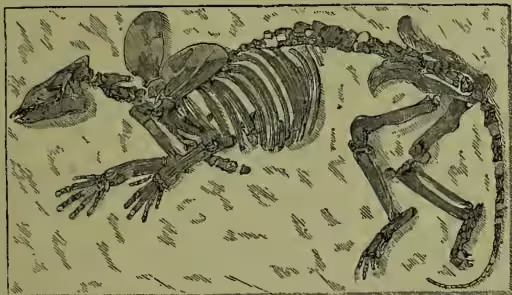
Extinct Mammals.—(a) The oldest mammalian remains date from the Upper Trias—i.e. from near the beginning of the Mesozoic or Secondary system. Thus, fragments of a small animal known as Dromatherium suggest a primitive type, possibly ancestral to the Monotremes. (b) In Jurassic strata remains of small mammals are locally abundant, and represent more than one type of Marsupial. (c) From the next or Cretaceous period, the beds of which are mostly of marine origin, other small types have recently rewarded the unwearying researches of Professor Marsh. (d) In the beginning of the Tertiary period, however, most of the modern orders of mammals have put in an appearance, and, as one would expect, there are remains of many types which form the common base of branches now widely divergent. Thus, the Crocodonta (e.g. Hyaenodon and Proviverra) are primitive Carnivora, which show skeletal affinities with Marsupials and Insectivores. Not less remarkably generalised are the Condylarthra (e.g. Phenacodus and Periptychus), primitive Ungulates showing affinities with Artiodactyles and Perissodactyles, with Hyracoidæa and (through the Creodonta) with Carnivores, and (according to Cope) even with the Lemurs. In the same way the palæontologists find transitions between Insectivorous, Lemuroid, and Creodont types, between Perissodactyles and Proboscidea (Dinocerata and Coryphodonts), between Rodents and Ungulates (Mesotherium and Toxodon). So, too, a common base has been found for dogs and bears, for pigs and sheep, for deer and chevrotains; but it is enough for our purpose to emphasise the fact, which rapidly progressive research continually corroborates, that in early Tertiary times there persisted numerous generalised mammals which united many of the characteristics of our extant orders.
Distribution in Space.—Referring to the article on GEOGRAPHICAL DISTRIBUTION for the general results reached by the labours of Murray, Wallace, Sclater, and others, we shall content ourselves with a few illustrations showing the importance of the inquiry in regard to mammals. Perhaps the most striking of these concerns the great insular region of Australasia, where, with the exception of some bats and marine mammals which transcend the usual limits, of some rats and mice, and of forms introduced by man, the whole mammalian fauna consists of Marsupials and Monotremes. As all extant Marsupials, with the exception of the American opossums, are now Australasian, and as fossil remains of the sub-class are found as far away as Europe, we have here one of the most remarkable cases of gradual restriction and of the saving results of geological changes. For, whatever the precise details may be, there seems no doubt that geological insulation saved the Marsupial immigrants to Australia from the jaws of their pursuers.
In the Lemuroid group, again, we find 'one of the most singular phenomena in geographical distribution.' For out of a total of fifty species thirty are confined to the one island of Madagascar, the remainder occurring through tropical Africa and in restricted portions of India and the Malay Islands—facts from which it is fairly concluded that in the insulated Madagascar 'the lowly organised Lemuroids diverged into specialised forms of their own peculiar type, while on the continents they have to a great extent become exterminated, or have maintained their existence in a few cases in islands or in mountain-ranges.'
The Edentata (sloths and ant-eaters) have also a very restricted distribution in modern times, for, with the exception of the scaly ant-eaters or Manidae
(Ethiopian and oriental in range) and the African aardvark, the home of the order is in South America, where, moreover, in Pliocene times there flourished a giant race 'rivalling in bulk the rhinoceros and hippopotamus.'
Just as naturally as terrestrial mammals are absent from Oceanic islands, so the aquatic Cetaceans have a world-wide distribution, and the Sirenians almost as wide as required conditions of temperature will admit. But it must be clearly noted that when we follow in detail the distribution even of bats, whose great powers of flight free them from the limitations imposed on terrestrial mammals, we find that the inhabitants of special regions are usually marked off with perfect definiteness. The same local definiteness holds true of the world-wide (Australia always excepted) distribution of Ungulates, Rodents, and Carnivores, and is signally illustrated, for instance, in the complete absence of Insectivora from South America alone, or in the striking differences between Old and New World monkeys.
Development.—The ova, which are small and poor in yolk except in Monotremes, burst from the ovaries into the upper ends of the oviducts, may be fertilised by ascending spermatozoa, and with the above exception develop in the lower portion of the female duct known as the uterus. In the oviparous Monotremes the segmentation is partial, like that of birds and reptiles; in all the others the egg segments completely. The development proceeds in a fashion somewhat different in detail from that of the other vertebrates, but it is more important to notice that in the Placentals a close vascular connection is speedily established between the embryo and the wall of the uterus. In the hedgehog, which is a remarkably central type, this connection is first of all maintained simply by the outermost layer of the developing egg; but this is soon abetted by a union between the yolk-sac and the maternal wall, which in turn gives place to the true placenta, mainly due to the Allantois (q.v.). The final result is an interlocking of the maternal tissue with that of the fetal membranes, and the whole life of the embryo depends on the intimacy of this interlocking, by which the blood of the mother is vitally though not directly united with that of the offspring. At birth the union is severed, and the embryonic part of the placenta, with more or less of the associated lining of the uterus, is discharged. The form and structure of the placenta vary considerably in different orders, and have furnished important aid in determining relationship. Of mammals as of other animals it is true that the individual development recapitulates, in general outline, the history of the race, for the life begins at the beginning again in a single cell, divides into a ball of cells, acquires a layered body, and passes from stage to stage presenting successively the general features of a vertebrate, of a reptilian (?), of a simple mammal, of an insectivore, and finally of a young hedgehog. Nursing remains somewhat crude in the oviparous Monotremes, which are destitute of teats, but the embryos have a considerable store of yolk which serves as preliminary capital. The eggs of the duckmole are laid in a nest, those of the Echidna seem to be borne in a temporary pouch suggesting that of Marsupials. In both cases the young lick the bare patch of skin on which the mammary glands open. The non-placental Marsupials are, in a sense, as Professor Flower says, 'the most mammalian of mammals,' since most of them carry their prematurely-born young in an external pouch surrounding the teats, whence the milk is forced into their passive mouths. In the placental mammals the young are born in a more advanced state, though still requiring much care. They are able to suck the mammae actively, and their hitherto unused food-canals, gently tutored by the readily-digested milk, more or less rapidly acquire what Sollas has happily termed a 'gastric education,' which makes more substantial diet possible.
Origin of Mammals.—Though the duckmole and the Echidna lay eggs, and from the nature of their genital ducts have been termed Ornithodelphia, their affinities are rather with reptiles than with birds. For mammals and birds represent divergent branches, the common stem of which is exceedingly remote. Recognising this, the theories as to the origin of mammals are mainly concerned with the probabilities in favour of a reptilian or of an amphibian ancestry. In support of the latter it has been urged that mammals and amphibians have two skull condyles, while birds and reptiles have one; that the quadrate is small in the amphibians and mammals, large in Sauropsida; that some other parts of the mammalian skeleton (such as the pelvis) suggest affinities with amphibians rather than Sauropsida; and even that the amphibians in their varied reproductive experiments are as likely as reptiles to have originated the characteristic mammalian parturition. On the other hand, the a priori probabilities are in favour of the reptilian origin of mammals, for the reptiles are in general differentiation more evolved. Among the numerous extinct Saurians the Theriomorpha distinctly approach mammalia in some of their skeletal characters, the large partially-segmenting ovum of the Monotremes seems much liker that of reptiles than that of amphibians (which exhibits total segmentation), while it is not without interest that two lizards show an incipient form of yolk-sac placenta. A compromise between the rival theories has been proposed by St George Mivart, who suggests a dual origin of mammals, deriving the Monotremes from Anomodont or allied reptilian types, the Marsupials from a distinct and earlier source, perhaps amphibian. Another compromise, equally problematical, would derive mammals from a primitive stock of fingered quadrupeds, the common ancestors of amphibians and reptiles. On the whole, however, the balance of probabilities seems in favour of the origin of mammals from extinct Saurians, such as those which Cope has grouped as Theriomorpha. A few zoologists, who maintain the reptilian ancestry of mammals, and regard Cetaceans as a very primitive order, would derive these from the Ichthyopterygian reptiles; but this view has been received with virtually fatal criticism.
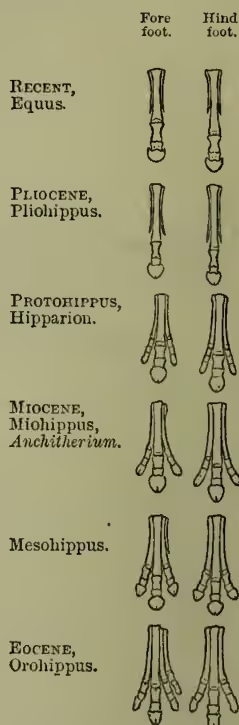
Evolution of Mammals.—Deeper than the problem of determining whether mammals had their origin from amphibians or reptiles is that which inquires into the factors which actually contributed to their rise. That this must have been very gradual both the fossil forms and the grades which still persist plainly show, and it is important to realise what is indeed a general truth in regard to evolution, that many of the characteristic features of mammals are not so much new acquisitions as reconstructions and elaborations of what is old. The all-important mammary glands seem to be but modifications of the sebaceous glands diffused over the skin; the placenta is chiefly composed of the allantois, which all young reptiles and birds possess; the corpus callosum, which forms a bridge between the cerebral hemispheres, is already represented in reptiles and amphibians. So, too, there is ample evidence of the very gradual evolution of special types and structures—witness the long series which connects the Eocene Eohippus, a five-fingered, three-toed ungulate, about the size of a fox, with the modern Horse (q.v.; see also FOOT); or the evolution of brains from the small casts found inside the skulls of some of the early giants to such types as are exhibited by Monotreme and Marsupial, and from these upwards to the climax in man; or the gradual growth of Antlers (q.v.) from Miocene times onwards, a history rapidly recapitulated in the life of modern stags. But after realising the gradual development of types and structures, and appreciating the influence of natural selection in determining distribution, in eliminating giants, in fostering swiftness and strength, and in justifying big brains, many naturalists still find the problem of the evolution of mammals incompletely solved. It seems necessary to follow the school of Lamarck in recognising the inheritable effects of use and effort, and the influence of a changeful environment on the progressive growth of the organism in definite directions. Furthermore, an account of the evolution of mammals has to take account of one of the most prominent characteristics, the maternal sacrifice expressed in the placental union, in the prolonged gestation (emphasised many years ago by Robert Chambers), and in the lacteal nutrition after birth, a sacrifice which must have been one of the most important factors in the progress of mammals. After a while the mammalian maternity (perhaps pathological at first and always expensive) must have paid or justified itself; but its recognition as 'a subordination of self-preserving to species-maintaining, of nutritive struggle to reproductive sacrifice,' is a necessary corrective to the prevalent theory which tends to emphasise too exclusively the competitive struggle for individual existence.
Intelligence and General Life.—Through the mammalian series, from the 'frog-witted' duckmole to the highest of the Primates, there is a gradual increase in complexity of brains and quickness of wits. The remarkably docile intelligence of the dog, the cleverness of the highly-evolved elephant, the ingenuity of the social beavers, and the 'humanness' of the higher apes are crowning illustrations which become all the more remarkable when we recall the minute brains of early mammals. A contrast between those types which excel and those which lag behind will also illustrate Spencer's
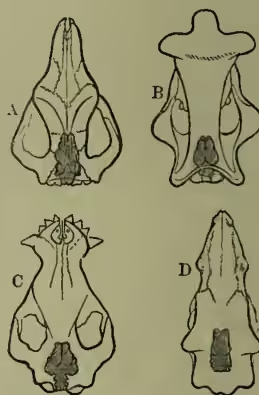
A, Tillotherium fodiens;
B, Brontotherium ingens;
C, Coryphodon hamatus;
D, Dinoceros mirabile.
(After Marsh.)
conclusion that the rate of reproduction varies inversely with the degree of individuation, for in the more highly-developed forms the number of offspring tends to diminish, while the parental care and love proportionally increase. The adaptations to diverse habits and diets, the varying length of life and the means of avoiding death, the migrations of some and the liberations of others, the struggle for mates as well as for food, the evolution of family-life and even of social sympathies are subjects of inquiry which will well repay observation and further study of mammals.
For general works on mammals, see British Museum Catalogues; Bronn's Thierreich—'Mammalia,' by Giebel and Leche; Flower in Ency. Brit.; Lydekker's British Mammals (1895); Bell's British Quadrupeds (2d ed. Lond. 1874); Vogt and Specht, Mammals (trans. Edin. 1887); Cassell's Nat. Hist., vols. i.-iii., ed. by P. Martin Duncan; The Riverside or Standard Natural History, vol. v., ed. by J. S. Kingsley (Lond. and New York, 1888). The last mentioned has a general bibliography. A treasury both of information and illustration is to be found in Brehm's Thierleben (new ed. 1890). For general structure, see the text-books of Owen, Huxley, Gegenbaur, Wiedersheim, Rolleston and Hatcher Jackson, and Flower's Osteology of the Mammalia (3d ed., along with Gadow, Lond. 1885). For history and evolution of mammals, see W. K. Parker, Mammalian Descent (Lond. 1884); O. Schmidt, Mammalia in relation to Primeval Times (Inter. Sc. Series, Lond. 1885); the papers of Cope and Marsh in the Reports of the U.S. Geol. Survey; Nicholson and Lydekker, Manual of Palæontology (Edin. 1889); the relevant works of Darwin, Wallace, Haeckel, &c.; Huxley, Proc. Zool. Soc. (Lond. 1880); Cope's Origin of the Fittest (New York, 1887). For distribution, see A. Murray, Geogr. Dist. of Mammals (Lond. 1866); A. R. Wallace, Geogr. Dist. of Animals (Lond. 1876); Heilprin (Inter. Sc. Series, Lond. 1888).