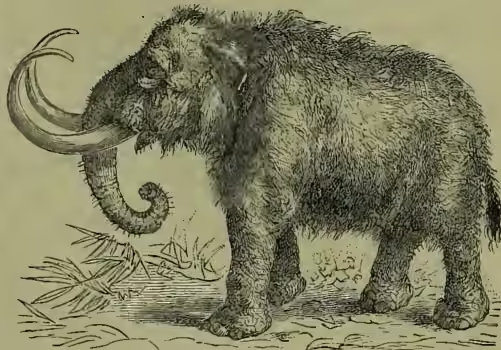
Mammoth, the name (originally Tartar, through the Russian) for an extinct elephant (Elephas primigenius), whose remains are sufficiently common in the recent deposits of northern Europe and Asia to afford a valuable supply of fossil ivory. In geological time, it is only as it were yesterday that the mammoth ceased to live, for its remains are often found along with those of man, and it seems to have persisted in Britain until after the Glacial Period. The cave-dwellers made use of its tusks, and on these too the prehistoric artists—the literal old masters—cut with no tyro hand the outlines of reindeer and various animals, including the mammoth itself. But the comparatively recent decease of this monster elephant has been repeatedly evidenced in a startling way by the discovery in Siberia of almost intact specimens, standing upright in the ice and frozen soil, with hair and skin, muscles and viscera, as well as bones, all well preserved. The first fairly complete mammoth recorded was disinterred from the ice near the mouth of the Lena in 1806; the fisherman who discovered it had overcome his awe to the extent of cutting off the tusks, wild animals had gnawed the muscles, but the hair was still on the uninjured parts of the skin, the brain in the skull, and the eyes still stared from their sockets. Others have since been disinterred, or washed out in great thaws, notably one in 1846 which was so marvelously preserved that the stomach still showed young shoots of fir and pine, and a quantity of chewed cones. Great numbers that we know nothing of must have been similarly thawed out, and their frozen corpses swept seaward to swell the accumulations of their remains found in the Arctic seas. Their disinterment after thaws explains the old Siberian opinion that the mammoths were monster burrowers, which died when they came to the surface, while the upright position in which the intact forms have been found suggests that they had been smothered where they were buried by sinking heavily into the tundra marsh. Though mammoths in complete preservation are rare, their tusks, teeth, and other bones have been found in great abundance from almost every county in England to Belring Strait, and thence into North America.
'The whole appearance of the animal,' one of the discoverers writes, 'was fearfully wild and strange. Our elephant is an awkward animal, but compared with this mammoth it is as an Arabian steed to a coarse ugly dray-horse.' It stood 13 feet high, 15 feet in length, with tusks 8 feet long; but some other specimens seem to have been larger. The dark skin was covered with yellowish to reddish soft wool about an inch long, with interspersed brownish hairs of 4 inches, and much sparser and longer black bristles. 'The giant was thus well protected against the cold.' The mammoth was liker the Indian than the African survivor, but it is only one of a crowd of fossil Proboscidea distributed in Tertiary deposits over all the great continents. Mammoth, Mastodon, and Dinotheirium are the three most prominent types. Most of them were giant animals, but there seem also to have been pigmies no larger than sheep. Once numerous and widespread, the elephants are now represented only by the two modern species of restricted distribution. To this result many factors, such as the voracity of Carnivores, the deforesting of countries, the changes of climate, and the expensiveness of great bulk, have contributed. The ivory exported in large quantities from Siberia is in great part collected from the islands, some of which are almost literally heaps of mammoth bones.
See ELEPHANT; also, for facts, not inferences, H. H. Howorth's Mammoth and the Flood (1887); Norden-skjöld's Voyage of the Vega; Boyd Dawkins, in Quart. Journ. Geol. Soc. XXXV. (1879).