Maple (Acer), the typical and the principal genus of the natural order Aceraceæ. The species are numerous, all are deciduous trees, and natives of the temperate parts of the northern hemisphere, and particularly numerous in North America and the north of India. They have opposite leaves without stipules, usually lobed or palmate. The flowers are in axillary corymbs or racemes of no beauty, but abound in honey, and are very attractive to bees. The fruit is formed of two small winged nuts, each with one or two seeds.—The
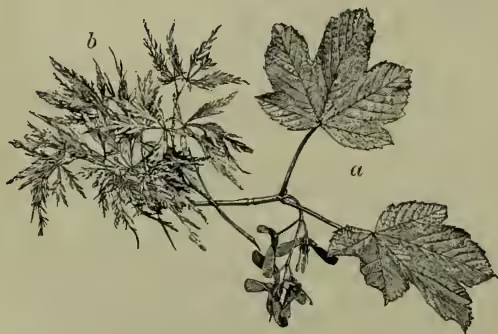
b, Japan Maple (Acer palmatum).
Common Maple (A. campestre), a small tree, is a native of Britain, and of many parts of Europe and Asia. The wood is compact, fine grained, and takes a high polish; hence it is much used by turners and for carved work, being frequently substituted for the wood of the Holly and Box by mathematical instrument makers. Several nearly-allied species are found in the south of Europe.—The Striped Bark Maple (A. striatum) of North
America, where it often forms great part of the undergrowth in woods, is so named because the smooth bark of the two-year-old branches are beautifully varied with green and white stripes; its wood, which is very white, is used for inlaying in cabinet-work.—The Greater Maple or Sycamore (A. pseudo-platanus), commonly called
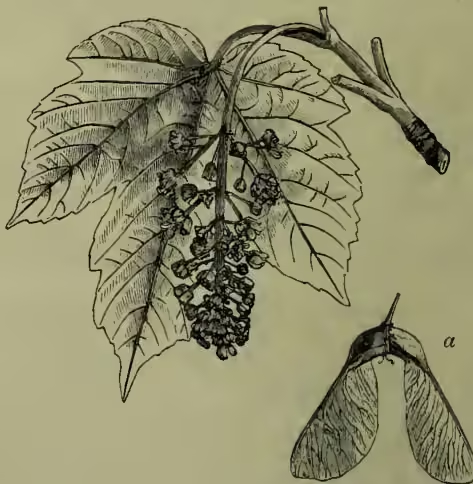
a, fruit.
Plane-tree in Scotland, is a native of various parts of Europe, but a doubtful native of Britain, in which, however, it has long been common. It attains a height of 70 to 90 feet, has a spreading umbrageous head, and large, palmate, coarsely-serrated leaves on long stalks. It is of quick growth, and succeeds well near the sea and in other exposed situations. The wood is white, compact, and firm, though not hard; it is capable of a fine polish, and is used by wheelwrights, turners, &c. It is not apt to warp. Stair-rails are often made of it, and pattern-blocks for manufactures, as well as bowls, bread-plates, &c. Sugar is sometimes made from the sap of this tree, as from that of several other maples; but the species which yields it most abundantly is the Sugar Maple (A. saccharinum) of North America, a species which much resembles the sycamore, and abounds in the northern parts of the United States and in the British possessions, where large quantities of sugar are made from it, although only for domestic use. To obtain the sap, the trees are tapped in February, March, and April, according to the locality and the season, and when warm days and frosty nights occur, which favour its flow. An incision is made in the trunk with an auger or axe, at first half an inch deep, and is increased by degrees to two inches. A spout of sumach or elder is then inserted, through which the sap flows into a trough, whence it is conveyed daily to a larger receiver; from this, after being strained, it is carried to the boiler. Being liable to ferment, it cannot be kept long after being collected. The boiling and refining processes are the same as those in the manufacture of cane-sugar. A single tree yields from two to six pounds in a season. Good vinegar is made from it, and a kind of molasses much superior to that from the sugar-cane, and much used in America with buckwheat cakes, &c. The wood of the Sugar Maple has a satiny appearance, and is used for cabinet-making; it is sometimes finely marked with undulations of fibre, and is then known as Bird's-eye Maple, and is used for veneers. The Sugar Maple is not so hardy in the climate of Britain as the sycamore, and seems to require a dry and sheltered situation.—The Norway Maple (A. platanoides), a native of the north of Europe, although not of Britain, is also found in North America; it much resembles the sycamore.—A Himalayan species (A. villosum), a noble tree, found with pines and birches at great elevations, is sometimes grown in Britain. A large number of interesting and remarkably beautiful forms of several Japan species of Acer, such as A. dissectum and A. palmatum, have been introduced within the last few years; they have proved hardy in many favoured districts of England and Ireland, but are unsuited to Scotland generally, though they are occasionally seen there in conservatories cultivated in pots.