Mastiff. The characteristics of the mastiff group of dogs are very marked and constant. One variety of the breed has been known from ancient times as the English, another as the Bordeaux or mastiff of Gaul. These may be classed as the European, while another kind is the Asiatic, of which the Tibetan is perhaps the most typical. No group of domestic dogs has more appearance of being an original and distinct species, although the English mastiff has been crossed and recrossed from time to time, principally with the object of increasing the size; and, while the blood of the Asiatic variety was very probably introduced at an early date, subsequently crosses with the Alpine mastiff, the St Bernard, the boarhound, and the bulldog have undoubtedly been introduced, and the modern English mastiff must be regarded as a composite breed.
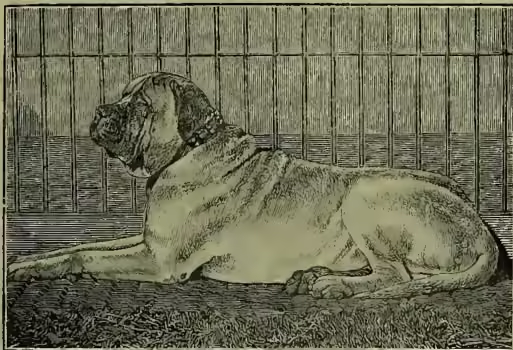
The English mastiff is thick-set and powerful, with a large head and broad, short, truncated muzzle, large, thick, pendulous lips, ears formerly often semi-erect, now hanging and of moderate size, smooth-coated, with frequently a full but not bushy tail. This variety formerly averaged from 25 to 28 inches at shoulder, but during the last half of the 19th century, owing to repeated crossing and selection, an average of from 30 to 32 inches at shoulder has been obtained, perhaps somewhat to the loss of muscular power and activity. The colours are all shades of fawn, tan, and black, with and without mixture of white. Formerly red and brindle were the commonest colours, but owing to selection fawn in all shades is now the most prevalent, with the muzzle, ears, and other extremities shaded with black or darker markings.
The mastiff was formerly very courageous, and would readily attack the lion or bear; now it is chiefly valued for exhibition purposes, and £70 is not an outside price for a really typical specimen. As a companion or watch-dog no other variety equals it, for, while faithfully protecting the property entrusted to it (at times with marvellous sagacity and discrimination), it has the additional merit of generally refraining from the infliction of personal injury on the invader, unless aggravatingly provoked. It becomes ardently and instinctively attached to its master, although not demonstratively affectionate. It has an excellent nose, but is of little or no use for sporting purposes, and dull at learning any kind of tricks.
The mastiff of Tibet was larger than the old English, but is smaller than the modern English mastiff, averaging from 27 to 30 inches at shoulder. The head is longer, narrower, and more elevated at the back or cone, the skin much looser, and forming a fold from the eyebrows which descends to the lips, these being more pendulous than in the English variety, and partaking more of the character of the bloodhound. The hair is rough and dense, the tail bushy and curled generally over the back, colour mostly black, with tan or fawn shadings over the eyes, on the paws, and under the belly; but fawn-coloured specimens are not uncommon. Dogs of this kind are found in Nepal, Bhutan, Tibet, Mongolia, and probably northward through Russia and Siberia, in a state of more or less purity; and dogs presenting the characteristics of the Asiatic mastiff and of vast size appear to have existed since the days of the Assyrian empire, 650 B.C. See the Rev. M. B. Wynn's History of the Mastiff (1886).