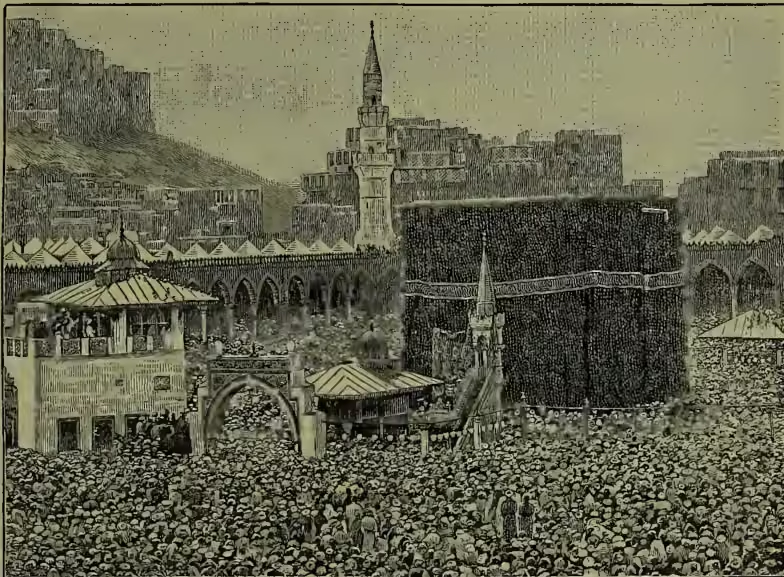
Mecca (also anciently called Becca), the Makoraba of Ptolemy, is one of the oldest cities of Arabia and the capital of the Hedjâz, and as a holy city and focus of pilgrimage it may be called the metropolis of Islam. It is situated in lat. and long., 245 miles S. of Medina and 65 E. of Jiddah, its port on the Red Sea, in a narrow barren valley, surrounded by bare hills penetrated by two passes, and so secluded from observation that it is not visible until closely approached. The barrenness of the soil compelled the inhabitants to go outside for provisions, and the command of the principal caravan roads, both from north to south and from the coast to the highlands, gave the Meccans unusual facilities for commerce, and thus from a very early period the city was a notable trading centre. But the chief cause of its prosperity was its reputation as a holy place, possessing sacred objects, which well repaid a pilgrimage; though whether the original attraction was the Black Stone or fetish of the Kâaba, or the medicinal spring Zemzem, is a matter of dispute. The city itself, which is mainly modern owing to the frequent devastations caused by the winter torrents from the hills around, is about 1500 paces long and 650 broad, and is divided into more than twenty chief quarters. Along and beyond it runs the celebrated sacred course, a broad road extending from Safa to Marwa, which is run over by all pilgrims, and also forms a frequented bazaar. The streets are broad and airy, but unpaved and filthy, and the houses, climbing the hills on either side, are of stone, and well built, sometimes three or four stories high, with flat roofs and overhanging lattice-windows. The interiors are well kept, since the greater part of Mecca is devoted to the annual pilgrimage which is the main support of a multitude of lodging-house keepers, guides, and the other attendants of a fashionable sanctuary. There are charitable lodgings for the poorer pilgrims, and also public baths, and a hospital. Drainage there is none, though there is plenty of water. Provisions, meat, fruit, &c. are readily procured from neighbouring parts of Arabia. The population, which is notorious for its vice and corruption of every sort, is probably under 60,000; but these are annually reinforced by at least an equal number of pilgrims. The latter, however, are not numerous enough to satisfy the natives, who fleece them without remorse, and are too idle to supplement their extortions by any industry more vigorous than the manufacture of sacred relics. The temple of Mecca, or the Great Mosque, stands in the broadest part of the valley, and consists of a large quadrangle, capable of holding 35,000 persons, surrounded by arcades or cloisters, with pillars of marble and granite, &c., and entered by nineteen gates surmounted by seven minarets. In the centre is the Kâaba (i.e. cube), which was the temple of Mecca ages before the time of Mohammed, and then attracted pagan pilgrims just as now it draws thousands of Moslems. It has been twice rebuilt in historical times, but the old form has been preserved. It is not quite square, nor properly orientated; and it measures about 18 paces by 14, and 35 or 40 feet high. When Mohammed converted the heathen shrine into a Mohammedan focus, the original notion of an idol temple with a miraculous fetish was abandoned, and the legend was invented that the Kâaba was built by Abraham on the occasion of the outcasting of Ishmael. The celebrated fetish, or Black Stone, is apparently a meteorite, about a span long, built into the south-east corner at the proper height for kissing. There is also a 'Southern Stone,' of only inferior sanctity. The pilgrim circumambulates the Kâaba seven times, kisses the Black and touches the Southern Stone, and also goes round the Hajar or semicircular enclosure containing the so-called graves of Hagar and Ishmael. The Kâaba has always been richly decorated, and has long been annually re-covered (leaving only apertures for the two stones) with handsome brocaded hangings presented by the Sultan of Turkey, and brought with much state, along with the traditional Mahmal or Holy Carpet, by the Egyptian Hajj (q.v.), or caravan of pilgrims. The other chief decorations are the silver-gilt door, seldom opened, the marble inlay and silver-gilt plating and silk hangings of the interior, which contains little of interest. Hard by, and also within the court, is the celebrated well of Zemzem, a deep shaft covered by a cupola; the tepid water of which may once have been mineral, and is still regarded as miraculous, although the largest item in its present of Ishmael. The celebrated fetish, or Black Stone, is apparently a meteorite, about a span long, built into the south-east corner at the proper height for kissing. There is also a 'Southern Stone,' of only inferior sanctity. The pilgrim circumambulates the Kâaba seven times, kisses the Black and touches the Southern Stone, and also goes round the Hajar or semicircular enclosure containing the so-called graves of Hagar and Ishmael. The Kâaba has always been richly decorated, and has long been annually re-covered (leaving only apertures for the two stones) with handsome brocaded hangings presented by the Sultan of Turkey, and brought with much state, along with the traditional Mahmal or Holy Carpet, by the Egyptian Hajj (q.v.), or caravan of pilgrims. The other chief decorations are the silver-gilt door, seldom opened, the marble inlay and silver-gilt plating and silk hangings of the interior, which contains little of interest. Hard by, and also within the court, is the celebrated well of Zemzem, a deep shaft covered by a cupola; the tepid water of which may once have been mineral, and is still regarded as miraculous, although the largest item in its present analysis consists of sewage matter. This important attraction for pilgrims was long lost, but was re-discovered by Mohammed's grandfather. Another object of veneration is 'Abraham's Stand,' the stone of which, with the imprint of his foot, is concealed from view. Outside the Kaaba are no sacred or antiquarian buildings of importance, though several houses are pointed out by the guides as dwellings of persons famous in the early days of Islam. In the time before Mohammed Mecca was under the control of the Kosaïtes, and then of the Koreish, from whom the Prophet reconquered it in 627, five years after his Flight or Hegira (q.v.) therefrom. It long remained under the rule of the califs, who spent large sums in its adornment. In 930 it was sacked by the Karmathians, who carried off the Black Stone, and kept it for twenty-two years. Mecca afterwards fell under the influence of whatever dynasty—Fatimite, Ayyûbite, or Mameluke—happened to rule in Egypt; and thus finally it came into the possession of the Ottoman sultans, whose power, however, is nominal, whilst the real governor is the shérif, or reputed head of the descendants of the Prophet, who has long held the chief authority in the Hedjâz, and has the support of a large following of retainers. Burckhardt, the first Christian to visit Mecca, has, owing to native fanaticism, found but few successors.
See Snouck Hurgronje, Mekka, mit Bilder-Atlas (1888); W. Robertson Smith in Ency. Brit. (1883); Wüstenfeld, Chroniken d. Stadt Mekka (1857-59); Sir Richard Burton's Pilgrimage (1855; new ed. 1880); Burckhardt's Travels in Arabia (1829).