Medal (the same word as metal, through a Low Latin medalla), a piece of metal in the form of a coin, not issued or circulated as money, but struck to preserve the portrait of some eminent person or the memory of some illustrious action or event. Large medals are termed medallions; and works rectangular in form are known as plaques or plaquettes according to their size. The study of medals, which forms a branch of the science of numismatics, is interesting in a historical and antiquarian point of view, and important as illustrating the contemporary state of art. Like coins, medals are made in gold, silver, and copper, and some also consist of lead and alloys of other base metals. As they are generally produced in very limited numbers only as compared with coins, other methods of preparing them than by striking are available; and while all classical medals, and the bulk of those of modern times, are made in the same way as contemporary coinage, many of the most important and valuable of the medieval medals were cast by the cire perdue process. Important medals have also been made by striking-up or répoussé work, and highly esteemed works are also made simply by engraving. The earliest medals are medallions of ancient Rome, existing examples of which are principally in bronze, though some are in silver and in gold. They vary in size, being mostly about inch in diameter, but in weight they are so diverse as to exclude the notion that they were ever circulated as money. Medallions, prior to the time of Hadrian, are rare and of great value, one of the most beautiful and most famous being a gold medallion of Caesar Augustus; from Hadrian to the close of the empire they are comparatively numerous. In some of them a ring or rim of lighter-coloured metal (brass or orichalchum) surrounds the centre of bronze, and the inscription extends over both metals.
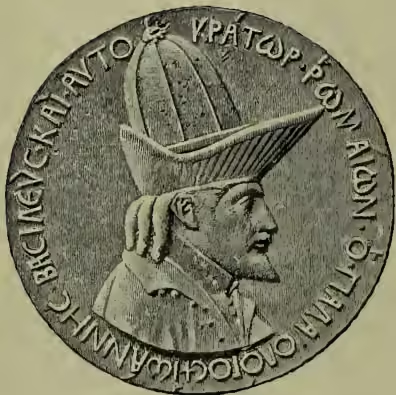
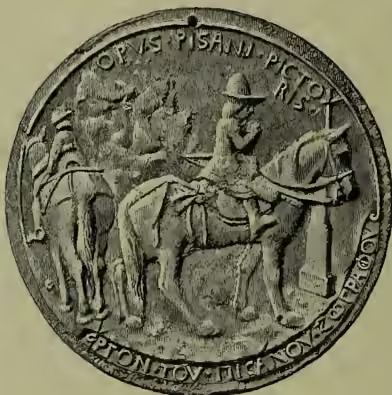
From the fall of the Roman empire till the end of the 14th century there is a blank in the production of medals. The revival of the medallistic art was one of the first fruits of the Renaissance movement, and practically its earliest, as for all times its greatest exponent was Vittore Pisano (c. 1380-1456), the painter of Verona. His medallions, generally marked Opus Pisani Pietoris, and those of his numerous followers, including Matteo de Pasti, Guacialotti, Sperandio, Sangallo, and many others, are distinguished by their vividness of sculptural portraiture, and their singular breadth and simplicity of treatment. Figures 1 and 2. show to a scale of one-half the original size the obverse and reverse of one of the most famous medals of Pisano. It celebrates the visit of the Eastern emperor, John VIII. Palæologus, to the Council of Florence in 1439; the legend on the obverse being in Greek, and the reverse inscription, Opus, Pisani, Pietoris, being also repeated in Greek. Generally speaking, it may be said that all medieval medals, previous to the 16th century, were made by casting in the cire perdue process; and it was not till the beginning of the 16th century that medals struck from engraved dies, like coins, were issued, the first so produced being the medal of Pope Julius II., by Francia, struck about 1506. The larger medals of the 16th century, however, continued to be cast. The most elaborate and beautiful of the struck medals of the 16th century were the work of Benvenuto Cellini; and it may be remarked that with the introduction of dies for medal-striking the work passed into the hands of gem-engravers and jewellers, whose methods and excellences lie in quite a different direction from those of the 15th-century artist-medallists. Next to Italy, Germany was the country in which the medallistic art flourished in medieval times, Nuremberg having been a centre from which many important works were issued.
Of the German school, Albert Dürer was the most famous of the early exponents. In Holland a remarkable series of jettons or medalets were issued in the 16th and early part of the 17th centuries, which give a record of the important events of which that country was then the theatre. In the 16th century the most important medals of French origin were produced by Jacques Primavera and Germain Pilon, and in the succeeding century Briot and Dupré were the great medallistic portrayers of contemporary personages and events. English medals begin only with Henry VIII., and from Edward VI. onwards there is an unbroken succession of coronation medals. The earlier medals are cast in a very inferior manner, and are certainly not the work of native artists; indeed, it is not till 18, 1815, and above, 'Wellington.' The Peninsular medal, for military services between 1793 and 1814, was issued only by the Queen in 1847, and conferred upon every surviving officer and private present at any battle or siege during these years. It carries no fewer than twenty-eight clasps for as many separate engagements, the first of which is Egypt, 1801. Long-service and good-conduct medals of silver were instituted in 1830 and 1831, and rules then formed for their distribution among meritorious soldiers, sailors, and marines. On the edge of each of these medals is engraved the name, rank, and regiment or ship of its recipient. The Victoria Cross (q.v.) was instituted in 1856. Similar medals for military and naval services are issued by foreign powers.
See A. Heiss, Les Médailleurs de la Renaissance (vol. viii. 1890); Grueber's Guide to the English Medals in King's Library, British Museum (1881); Cochran-Patrick's Catalogue of the Medals of Scotland (1884); Lonbat's Medallistic History of the United States (2 vols. 1878); D. Hastings Irwin's British War Medals and Decorations (1890); T. Carter's British War Medals (new ed. 1890); and a two-page illustration of medals of the preceding fifty years in the Graphic for 14th June 1890.
the period of Elizabeth that we find native talent developed in the direction of medal-working, and even thereafter it was largely to Dutch, French, and Italian artists that the principal English medals were due. The Scotch coronation medal of Charles I. is the first medal struck in Britain with a legend on the edge. The medal is the work of Briot, and around the edge it reads, Ex Auro ut in Scotia reperitur. The medals of the Commonwealth and Charles II. are principally by Rawlins and the brothers Simon, and under Charles II. the three brothers Rottier did important medallistic work in England. In the 18th century J. A. Dassier, a native of Geneva, executed a series of medals of English monarchs from the time of William I., and other important works were the production of Croker, Richard Yeo, and Thomas Pingo. Of 19th-century English medals the best are due to the Italian Pistrucci and to Thomas and William Wyon and their successors.
Official medals at the present day are principally issued for naval or military services. The first war medal given in England was the 'Ark in flood medal' bestowed by Queen Elizabeth in 1588 on naval heroes. The first English military medal was granted by Charles I. in 1643, and in 1650 an oval medal was executed by order of parliament for distribution amongst Cromwell's officers and soldiers engaged in the battle of Dunbar. Medals have been distributed to the troops in every victorious engagement and campaign since 1793 till the present time, but previous to the reign of Queen Victoria the Waterloo medal was the only one of this series struck. It was issued by order of the Prince Regent in 1816, and conferred on every officer and soldier present at the battle. The medal is of silver, with the head of the Prince Regent on the obverse, and on the reverse a figure of Victory seated on a pedestal, inscribed 'Waterloo,' with, beneath, the date June 18, 1815, and above, 'Wellington.' The Peninsular medal, for military services between 1793 and 1814, was issued only by the Queen in 1847, and conferred upon every surviving officer and private present at any battle or siege during these years. It carries no fewer than twenty-eight clasps for as many separate engagements, the first of which is Egypt, 1801. Long-service and good-conduct medals of silver were instituted in 1830 and 1831, and rules then formed for their distribution among meritorious soldiers, sailors, and marines. On the edge of each of these medals is engraved the name, rank, and regiment or ship of its recipient. The Victoria Cross (q.v.) was instituted in 1856. Similar medals for military and naval services are issued by foreign powers.
Medea, in Greek legend, a famous sorceress, the daughter of Æetes, king of Colchis, and of the Oceanid Idyia, or of Hecate. When Jason, the leader of the Argonauts, came to Colchis in search of the Golden Fleece, she fell in love with the young hero, helped him to obtain the Fleece, and fled with him. She prevented her father from pursuing by killing her brother Absyrtus and strewing the sea with his limbs. She avenged her husband upon the aged Pelias by persuading his daughters to cut him in pieces and boil him in order to make him young again. Being deserted by Jason for Glauce or Creusa, daughter of Creon, king of Corinth, she revenged her wrongs by sending to her rival a poisoned robe or diadem which destroyed both her and her father. Medea then slew the children she had borne to Jason, and fled to Athens in a chariot drawn by dragons, which she obtained from Helios. There she was received by Ægeus, to whom she bore Medos; but, afterwards being compelled to flee from Athens, she took Medos to Aria, the inhabitants of which were thenceforth called Medes. She finally became immortal, and the spouse of Achilles in the Elysian Fields. The story of Medea was a favourite theme of the tragedians, but only the masterpiece of Euripides has come down to us. It was treated by Corneille and Grillparzer, and gave Chernbini the theme for an opera.