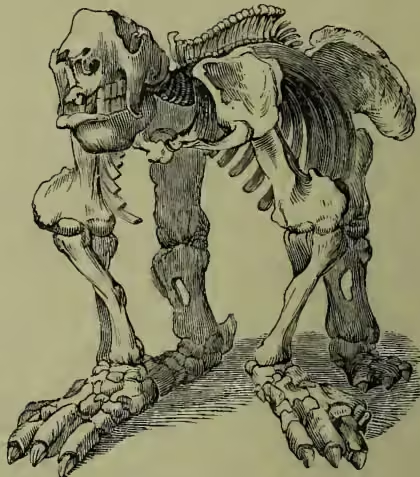
Megatherium (Gr., 'great beast'), a gigantic extinct quadruped of the order Edentata, nearly allied to the sloth, found in the Pleistocene deposits of South and North America, but more particularly in those of the South American pampas. In structure it is very near its modern representative, except that the whole skeleton is modified to suit the requirements of an immense heavy-boned and heavy-bodied animal, fully equal in bulk to the largest species of rhinoceros. The appellation tardigrade, which Cuvier applied to the sloth, cannot be given to the Megatherium: its limbs were comparatively short and very strong, and the feet adapted for walking on the ground, approach- ing in this respect nearer to the allied ant-eaters, but with this peculiarity, that the first toe of each of the hind-feet was furnished with a large and powerful claw, which was probably used as a digger to loosen roots from the soil, and enable the creature the more easily to overturn the trees on the foliage of which it browsed. The enormous development of the bones of the pelvis, the hind-legs, and the tail, gave the animal great power when, seated on its hind-legs and tail, as on a tripod, it raised its fore-legs against the trunk, and applied its force against a tree that had already been weakened by having its roots dug up. The structure of the lower jaw seems to indicate that the snout was prolonged and more or less flexible, and it seems probable that the Megatherium was furnished with a prehensile tongue like that of the giraffe, with which it stripped the foliage from the trees. The remains of several allied genera of huge Edentata are associated with the Megatherium in the deposits on the pampas. They form the family Megatheriidae of Owen, which includes Mylodon, Megalonyx, Scelidotherium, &c.—genera which are separated from Megatherium chiefly from peculiarities in the dentition. The modern sloth is a native of South America, and the fossil remains of these immense creatures, which represented it in the newer Tertiary, are found only in the American continent.