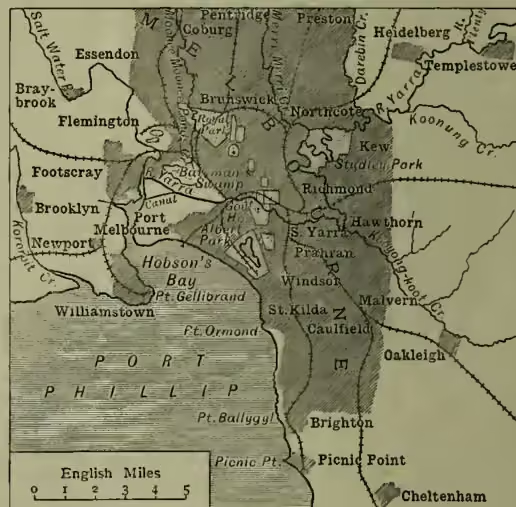
Melbourne, the metropolis of the Australian colony of Victoria, and the most important city of Australasia, stands at the northern extremity of Port Phillip Bay, and is bisected by the river Yarra; it is in 37° 49' S. lat. and 144° 58' E. long. To facilitate navigation and enable large vessels to discharge their cargoes almost at the doors of the warehouses, a canal was cut from a point near the mouth of the river to the Melbourne quays and opened in 1888. Williamstown and Port Melbourne, built on the shores of the bay, give extensive pier accommodation, and are thriving ports. Melbourne is a chessboard city, built on strict mathematical lines, its streets intersecting at right angles, the principal thoroughfares being of considerably greater width (99 feet) than is necessary or desirable in such a warm climate.
Collins Street is architecturally imposing, being lined on either side by tall, massive, and ornate buildings, chiefly banks, offices, warehouses, and hotels. Bourke Street corresponds to the London Strand, but it is three times as wide and four times as long. Here most of the theatres, music-halls, and retail shops are situated. An extensive system of cable tramway locomotion was inaugurated in 1886.
Melbourne has a flourishing university, founded in 1853 largely through the instrumentality of Mr Childers, its first vice-chancellor. There are three affiliated colleges in its immediate vicinity—Trinity (Episcopalian), Queen's (Wesleyan), and Ormond (Presbyterian). The last—one of the finest educational structures in the southern hemisphere—was built at the expense of the Hon.
Francis Ormond, to whom Melbourne is indebted also for its working-men's college, which is doing noble work in technical education, and its endowed chair of music in the university. The Wilson Hall, the gift of Sir Samuel Wilson, M.P., is also a noteworthy adjunct of the university. The Exhibition building in the Carlton Gardens and the General Post-office are two of the most conspicuous and ornamental of Melbourne's public buildings. The Houses of Parliament, completed in 1891, have cost nearly a million of money. They form a magnificent pile of buildings, the western facade being particularly striking and effective. The Trades Hall, a quadrangular structure founded in 1857, stands on the northern boundary of the city proper. Melbourne possesses an excellent and well-appointed public library of about 200,000 vols., and associated with it on the same reserve are a national art gallery and a technological museum. The three institutions are governed by a body of trustees, and are supported by a large state endowment. The town-hall has an immense assembly-room, largely used for concerts and public meetings, and also an organ of fine tone and colossal size. Crowning the summit of the western hill of Melbourne are the new law-courts, forming an extensive square, and topped by a lofty and graceful dome. Close by is the Melbourne branch of the Royal Mint, established in 1872. Other notable public institutions are the Melbourne and Alfred hospitals, the Benevolent Asylum, the Immigrants' Home, the Orphan Asylums, the Custom-house, the Treasury, and the Public Offices, the last-named being a vast and labyrinthine pile in which most of the government departments are housed. St Patrick's Roman Catholic cathedral, close to the Houses of Parliament, is a towering Gothic structure and the most conspicuous ecclesiastical edifice in Melbourne. The Anglican cathedral of St Paul suffers in appearance by its depressed site and by the fact that it is hemmed in by clustering warehouses. The Scots Church is the architectural gem of Collins Street. Its soaring spire, of more than 200 feet, is peculiarly graceful and harmonious in design.
Melbourne supports three morning and two evening journals, besides a host of weeklies and monthlies. Railways have been pushed on with energy in Victoria (whose railway-system connects with those of South Australia, New South Wales, and Queensland), and, as Melbourne is the converging point of all the systems, the western end of the city, where the railway department is quartered and the central station has been built, is a scene of incessant activity. Melbourne has grown with remarkable rapidity. In 1841 its population was 11,000; in 1851, the year of the gold discoveries, it was less than 25,000; in 1861, 191,000; in 1871, with suburbs, 206,780; in 1881, 282,907 (of whom 65,800 were in 'the city'); at the census of 1891, 490,986 (of whom 73,361 were in the city proper). This estimate includes all the suburbs within a radius of 10 miles from the General Post-office. During the commercial crisis of 1894-95 the city suffered severely, and its population was reduced by 60,000 or more. Protection to native industry is the fiscal policy of the colony, and Melbourne has developed into a considerable centre of manufacturing enterprise. Foundries, flour-mills, boot and clothing factories, &c. are numerous in the suburbs. The Royal Park, the Carlton, Fitzroy, Botanical, and Flagstaff Gardens are the principal popular recreation reserves. The water-supply of Melbourne, which is abundant, comes from the Yan-Yean reservoir in the Plenty Valley, and had cost up till 1876 about million sterling. The sanitary condition of Melbourne is not so good as might have been expected from the general mildness of its climate and the high average of prosperity of the inhabitants. Typhoid fever notably has been excessively prevalent, and of late years there has been increase rather than the steady diminution which has been the rule in the cities and towns of Europe and America. It is recognised that this is mainly due to defective drainage, and an unsatisfactory method of night soil disposal. An eminent London engineer reported in 1890 on the subject, suggesting a scheme for a complete system of underground drainage at a cost of over £5,000,000.
Port Phillip Bay, the maritime approach to Melbourne, is a spacious land-locked inlet of the South Pacific covering 800 sq. m., and mostly available for anchorage. The entrance, known as 'The Heads,' is very narrow, and strong fortifications were begun by the Victorian government in 1875. A well-equipped pilot station is maintained here.
Melbourne was first occupied by white men in 1835, and the infant settlement was originally known as Doutta-Galla, that being the name of the tribe of blacks who inhabited the neighbourhood. In 1837 it was christened after the reigning premier, Lord Melbourne, in 1842 it was incorporated, and in 1851 it was advanced to the dignity of a capital when the Port Phillip province was separated from New South Wales and erected into the autonomous colony of Victoria. Simultaneously with this latter event the Victorian goldfields were opened up, and the history of Melbourne has since mainly been one of marvellous strides in material progress and prosperity. On the centenary of the colonisation of Australia, an International Exhibition was held in Melbourne in 1888. It cost the colony a quarter of a million. A great conflict between labour and capital took place in 1890, and a strike by the labour-unionists took place on a very extensive scale both in Victoria and New South Wales. In 1892-93 Melbourne suffered severely from commercial depression, financial crises, and banking disasters. Wool and gold bulk most largely amongst the exports. See Victoria and its Metropolis, Past and Present (Melbourne, 2 vols. 1889).