Metallurgy. A brief account will be given here of ancient metallurgy and of that department of modern metallurgy relating to the mechanical treatment of ores. For the specific treatment of the ores of copper, gold, iron, silver, tin, zinc, &c., see the articles on those metals.
Ancient Metallurgy.—From an ethnological point of view one of the most interesting questions connected with the origin of the industrial arts is when, and under what circumstances, man first began to work metals by softening or melting them by means of a high heat. The art of smelting ores was probably discovered by observing the effect of a big fire on some rich ore that happened to be in the way. Gold is always found native, and silver and copper sometimes. The ancient Egyptians worked in gold, silver, and bronze with a degree of skill that could only have been reached by gradual steps extending over thousands of years. In the notes to his edition of Wilkinson's Ancient Egyptians, Dr Birch says that it is uncertain whether metallic tin was known to them, as Bronze (q.v.) may have been made by the use of tin ore along with copper. He also states that the question of the use of iron among them has been rendered doubtful by the few specimens of that metal found in the monuments and sepulchres. Some examples, however, have been met with, although only in one case apparently is the approximate age of the object known. It is iron wire in a bronze statue of the time of the Ramesids. In India and some other parts of Asia malleable iron is made directly from rich ores in furnaces scarcely bigger than chimney-cans, by a process in use from time immemorial; and by a similar process savages in some parts of Africa also smelt iron. It is supposed by some archaeologists that most parts of Africa passed directly from the stone to the iron age, but there seems to be evidence that in some places on that continent the making of various articles of the copper of the country has been long practised by aboriginal tribes.
Among the remains found in the lake-dwellings of central Europe are crucibles for melting metals, ingots of copper and tin, and in one crucible traces of gold were found. Bronze implements are abundant, but the considerable number of copper hatchets which have now been discovered has raised the question as to whether in prehistoric times a copper age has not preceded those of bronze and iron. Copper is more easily smelted than iron; and bronze, being an alloy of copper and tin, must somewhere have been preceded in its application to hatchets or other articles by unalloyed copper, although this may not have been the case in Europe. Some copper hatchets, and other implements of this metal, are the only evidence we have that the ancient Mexicans made any use of metal tools; though their artificers were skilled in casting gold and silver, and in hammered work and chasing, and tin as well as copper ore was mined, and the two combined as bronze. The early tribes inhabiting the country about Lake Superior, where native copper is plentifully found, made knives and ornaments of the metal by hammering it cold, in some cases, it is believed, with stone implements. Small chisels, rings, idols, and other objects made of gold and of ancient date, some of which are of thin, flat beaten plates, have been obtained in the republic of Colombia, South America. Silver articles of a rude archaic character appear to be rare. It is likely that the working of these native metals in the cold state in certain limited areas preceded the art of manipulating any metal by heat.
See Lubbock's Prehistoric Times, Munro's Lake-dwellings of Europe, Nadaillac's Prehistoric America, and various papers in the volumes of Contributions to Knowledge published by the Smithsonian Institution.
Modern Metallurgy.—As now understood this is the art of extracting metals from their ores. The operations are partly mechanical and partly chemical. Those processes which depend principally on chemical reactions for their results have reference chiefly to the roasting and smelting of ores, and are described under the heads of the different metals.
But there are certain preliminary operations of a mechanical kind which metallic ores undergo, such as crushing, jigging, washing, &c., which we shall describe here, as they are essentially the same for the ores of lead, copper, tin, zinc, and indeed most of the metals. Until comparatively recent times ore, or rather ore-gangue, as it came from the mine was in the first instance broken by hammers before being passed on to crushing-rollers or stamps to be reduced to smaller pieces or grains. In the year 1858 Mr E. W. Blake of New Haven, Connecticut, invented a stone or ore crusher which has become so extensively used that it has, except in special cases, superseded hand-labour for breaking up large pieces of ore. Fig. 1 shows in section a modification of Blake's ore-crusher, made by Marsden of
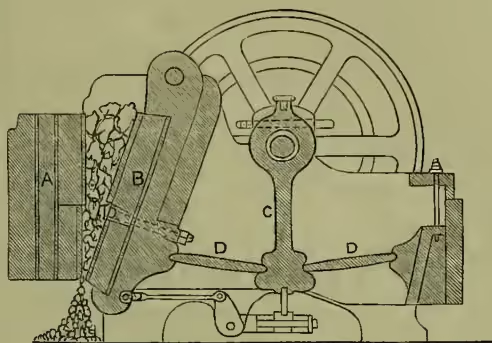
Lceds. The shaded portion shows the fixed jaw, A, and the movable jaw, B, between which the ore or stone is crushed. To the movable jaw a rapid biting movement (reaching 250 strokes per minute) is given by means of an eccentric lever and toggle-joints. C is the rod connecting the eccentric with the toggle-plates, DD. The machine is driven by a shaft and pulley, and has a balance-wheel. A spring or lever near the base of the machine aids the return movement of the jaw, B.
The vein-stuff or impure ore is next taken either to the crushing-rollers or to the stamping-mill. Fig. 2 shows a section of a crushing-mill of German
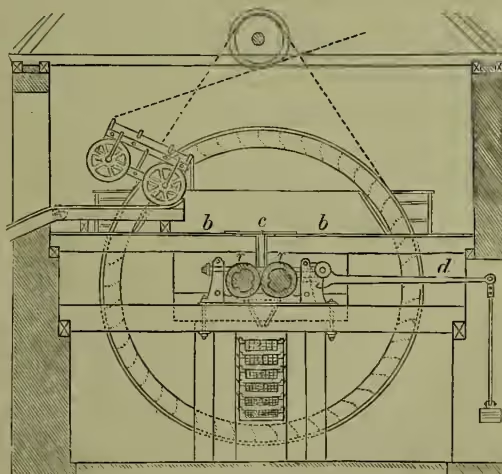
End view of the crushing-rollers, sieves, and bucket-wheel. design, but nearly resembling that in use in Cornwall for treating copper, lead, and zinc ores. The ore, already reduced by the Blake jaw-crusher to pieces roughly inch in diameter, is raised to the floor or platform, b, b, and by means of an opening at c passed down to the crushing-rollers, r, r. These are usually from 10 to 30 inches in diameter and at least 10 inches long, made of chilled cast-iron or steel, and with a lever at d to keep them in position. Below the rollers a shoot conveys the crushed ore to a series of sieves increasing in fineness from the top to the bottom, and what is separated by each sieve falls into a separate pit. Such pieces of ore-stuff as are too large to go through the top sieve or riddle fall into the raff-wheel or bucket-wheel, and are by it raised again to the floor to be recrushed. In Cornwall a sieve or riddle cylindrical in shape is used, and it slopes so that stuff too large to go through its meshes is raised by the raff-wheel to get a second crushing. Only about 13 per cent. of the ore-stuff crushed in the Cornish mill exceeds millimetres in size.
For pulverising some ores—tinstone and anriferous quartz, for example—a stamping-mill is used. It consists of a series of upright shafts with a weighty piece of iron at the bottom of each. They are raised by means of an axle with projecting cams, and then falling by their own weight act like hammers. Except in chlorination and amalgamation works (see GOLD), the wet process of stamping is generally adopted—that is, the cast-iron or steel shoes of the stamps work upon cast-iron or quartz bottoms placed in stamp-troughs filled with water.
Sizing apparatus or sorting machines are employed for dividing the crushed ore-stuff into grains of several sizes. A common hand-riddle is the simplest form of sizing implement. One kind of apparatus in use consists of a series of flat-bottomed sieves with graduated meshes placed on different levels and mechanically agitated so as to pass the stuff across the perforated bottoms. The first sieve separates the largest grains, the second the next in size, and so on. A rotating drum-sieve or trommel is, however, more frequently employed. It is placed horizontally, and is to some extent conical in shape. Sometimes it is one long continuous trommel in sections, in which case the finest stuff passes through the first section, the next larger through the second, and so on through, say, five or six divisions to the largest grains. In other cases a system of separate conical trommels, in which the sizing takes place from large to small grains, is employed. With the trommel water is used, and, although its axis may be quite level, the falling angle of its shell together with its motion impels the ore-stuff from the smaller to the larger end. Trommels are used for clearing off earthy matter and for draining off water from ore as well as for sizing.
After the ore-stuff has been sorted according to the size of the grains, the next step is to separate by specific gravity the pure ore from the gangue or non-metallic minerals associated with it. If the reduced particles be those of vein-stuff containing more than one kind of ore, these are also separated by gravity. If equal-sized grains of galena, blende, and quartz, whose respective densities are 7.5, 4, and 2.7, are allowed to fall freely in some depth of water, the three substances will separate into layers at the bottom, in which case the lead ore (galena) will form the lowest, the zinc ore (blende) the middle, and the quartz the top layer. But in hydraulic jiggers (some are pneumatic) the column of water, at most under 3 inches, is too shallow to admit of separation by simply dropping the grains. Consequently these are placed in a sieve immersed in water, and subjected to a repeated up-and-down motion, in which the ascent of the jigging stuff takes place by jerks, but in the descent it falls freely. In this way the pure ore, or at least the best ore, accumulates at the bottom, and is usually sufficiently rich for smelting. The gangue on the surface is skimmed off or otherwise removed. In hand-jigging the sieve is vigorously jerked in a tub of water; in the brake-jigger the jerking motion is produced by a hand-lever and connecting rod; and in continuous jiggers mechanical contrivances are used to carry into different receptacles the mineral grains separated upon the sieve in layers without interrupting the jigging process.
The dressing of fine sandy, mealy, or slimy ore-stuff, which is not suitable for jigging, is effected on buddles or sloping tables. Buddles are inclined planes, often circular, or rather conical in shape, over which the fine stuff suspended in water descends. In doing so the heavier metallic particles fall at the top of the table or cone while the lighter waste is carried down to the foot.
For detailed descriptions and illustrations of ore-dressing machines, see Hunt's British Mining (1884); an exhaustive report by E. F. Althaus in the Reports of the Philadelphia Exhibition, 1876; and works on Metallurgy by Roberts-Austen (1891) and A. J. Hiorns (1896).