Milan, the third in size of Italian cities, Naples ranking first and Rome second, stands in the great plain of Lombardy, 80 miles NE. of Turin, 155 W. of Venice, and 25 S. of Lake Como at the foot of the Alps. The city, nearly circular in shape, is surrounded on three sides by walls, has a circuit of nearly 8 miles, and is entered by 14 gates. Although a place of great antiquity, it does not possess many very old buildings: it has been too greatly ravaged by war. The modern city is a busy, enterprising, and wealthy community. The streets are broad and regular, and the houses substantial and roomy. The principal church is the cathedral of the archbishop, the foundation of which was laid, on a site where already two cathedrals had stood, by Gian Galeazzo Visconti in 1386; it was completed by order of Napoleon I. in 1803-13. It is built entirely of marble, and in the
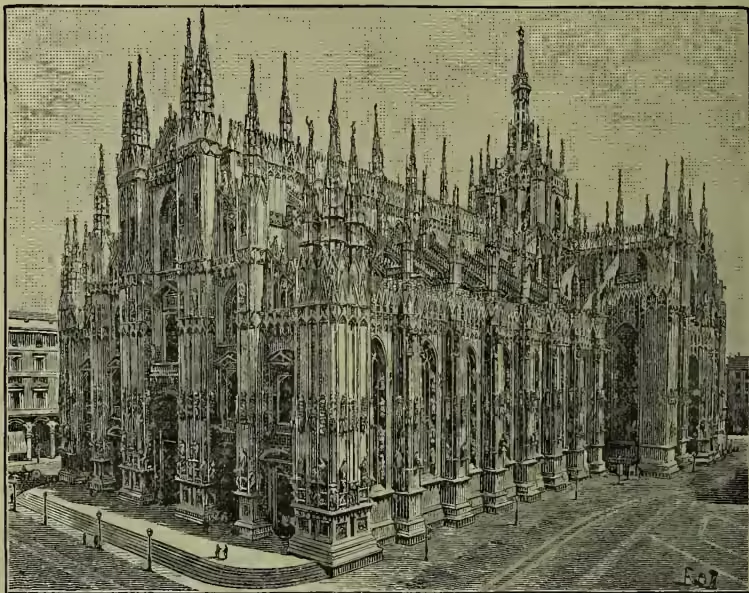
Gothic style, with an approach to Flamboyant in the ornamentation; but the windows and portals of the façade (16th century) are Italian. The exterior is adorned with some 6000 statues in niches and a vast number of pinnacles. Other noticeable churches are St Ambrose, founded in 868, on the site of one dedicated by the saint himself in 387—it has early mosaics, an altar with clever goldsmith's work, and other antiquities; St Eustorgius, dedicated in 320, with interesting sepulchral monuments; St George, founded in 750, but greatly modernised, with pictures by Luini and Ferrari; St Maria delle Grazie (built 1463), on the walls of whose refectory is Leonardo da Vinci's 'Last Supper'; and St Maurice the Greater (1497-1506), adorned with paintings by Luini and his school. The principal secular building is the Brera Palace (12th century), formerly a Jesuit college, now the palace of arts and sciences, which shelters within its precincts a very valuable gallery of paintings by such masters as Raphael, Da Vinci, Luini, Mantegna, the Bellinis, Titian, Vandyck, &c., an academy of art, a collection of casts for modelling, the magnificent monument of Gaston de Foix, the national library (1770) of 162,000 vols. and 3650 MSS., an archaeological museum, and an observatory. In Frederick Borromeo's creation, the famous Ambrosian Library (1609), there are 164,000 vols. and 8100 MSS., besides collections of drawings, engravings, and pictures. The city is adorned with numerous palaces, as that of the archbishop (1570); the royal palace, with fine modern frescoes; the Late Renaissance municipal palace (1558); the former castle of the Visconti (15th century), with frescoes by Luini; the Poldi-Pezzoli palace, with a collection of paintings of Leonardo da Vinci's school, armour, and artistic objects; and several others. The arched colonnade of Victor Emmanuel (1865-67), lined with fine shops, forms a favourite promenade of the people. The Arch of Peace, built of white marble (1807-38), commemorates the exploits of Napoleon. The Della Scala opera-house (1778) is the second largest (next after San Carlo at Naples) in Italy. Beccaria, Manzoni, the popes Pius IV. and Gregory XIV. were natives of Milan. The principal of the scientific and artistic institutions are an academy, a higher technical institute, several scientific societies, a museum of natural history, schools of veterinary practice, music, and a military geographical institute. The charitable institutions are numerous and splendidly endowed, having an aggregate property of £7,000,000 sterling; the Great Hospital (founded in 1448) can accommodate 2500 patients. Owing to its central situation in the upper valley of the Po, to the fact that it is the principal meeting-place of the north Italian railways and canals, and owing to its proximity to the Alpine passes, Milan has always been a place of much commerce. It now carries on a vast trade, much increased since the opening of the Gothard railway, in raw silk, cotton, grain, rice, and cheese, and manufactures silks, velvets, gold, silver, and iron wares, railway carriages, tobacco, porcelain, electric-light apparatus, and is an active centre of the printing-trade. Milan is the chief financial and banking city of North Italy. Pop. (1876) 283,225; (1881) 295,543. This is the pop. of the city (214,084 in 1881) and the suburbs; the commune had (1881) 321,839 inhabitants; (1890) 360,000.
Milan (Lat. Mediolanum) was originally a town of the Insubrian Gauls. It was conquered by the Romans, 222 B.C., and under them became a conspicuous centre of wealth and civic influence; its citizens were noted for their refined manners and literary tastes, and the public buildings for their beauty and elegance. In the beginning of the 4th century it was selected as the residence of the imperial court by Maximian. It was sacked by the Huns (under Attila) in 452, by the Goths in 539, and passed to the Longobards (569), and to the Franks previous to its subjection by the German empire. Here several of the German emperors were crowned with the Iron Crown. The city was in the 11th century the head of the Lombard League of towns that opposed Frederick I., who twice besieged it, and once razed it to the ground. Nevertheless it continued to prosper, notwithstanding that it was distracted by the intestine feuds of the Guelphs and Ghibellines. Supreme power became eventually (from 1277) vested in the Ghibelline Visconti, who extended the ascendancy of Milan over the whole of Lombardy, and in 1395 bought from the emperor the title of duke. The successors of the Visconti in the lordship of Milan were the Sforzas (1450-1535). From 1555 to 1713 Milan submitted to the predominance of Spain, and from Spain passed to Austria. Under Bonaparte it was declared the capital of the Cisalpine Republic, of the Italian Republic, and, finally, of the Kingdom of Italy. In 1815 Milan was restored to Austria, and continued the capital of the Anstro-Italian kingdom until the annexation of Lombardy to Piedmont in 1859 by the peace of Villafranca. The 1848 troubles in Italy originated in a revolt of the Milanese against the tyranny of the Austrians. —The province has an area of 1213 sq. m. and a pop. (1881) of 1,114,991; and (1889) 1,228,218. See Histories by Rosmini (4 vols. 1820), Cantù (2 vols. 1844), and Cusani (7 vols. 1862-67).