Mimicry. The fact that insects belonging to very different groups often bear an extremely close superficial resemblance to each other has been known for a long period of time. The names given to various species of British moths are sufficient proofs of this. Such names as Bombyliiformis, Apiformis, Bembeciformis, &c. imply a recognition of the resemblance between these species and others belonging to an entirely different order. The meaning of such likenesses was, however, unknown until the appearance of H. W. Bates's classical paper in 1862. In this essay the author shows that the species which has departed from the normal type of its group (the mimicker) is far rarer than the form which it resembles, while the latter (the mimicked) is abundant and well defended by some special protection, such as the possession of an unpleasant taste or smell or the power of stinging. Bates's observations were conducted in tropical America, where abundant, conspicuous, slow-flying, nauseous butterflies (Heliconiæ and Danaidæ) are closely mimicked by Pieridæ (the family containing our common garden white butterflies) and other butterflies, and in many cases by day-flying moths. Subsequent observation has confirmed Bates's suggestion. Wallace found numerous instances of mimicry among the Lepidoptera of India and the Malay Archipelago, and Trimen directed attention to similar facts among South African butterflies. The latter include the most remarkable instance of mimicry yet discovered. The male of a South African swallow-tailed butterfly (Papilio cenea) is typical in appearance and possesses the characteristic 'tails' on the hind-wings: the female is utterly unlike the male in the colouring and form of the wings, the 'tails' being entirely absent. While the female is so different from the male of its own species it appears in three well-marked varieties mimicking three different species of the nauseous genus Danaïs—viz. the black brown-spotted D. Echeria, the
Abyssinia (P. antinorii). This example strongly enforces a conclusion also arrived at by Bates and Wallace—viz. that the females are far more frequently mimetic than the males. Wallace has explained this because of the especial dangers incurred by the female during her slow flight when laden with eggs, and her exposure to attack during oviposition.
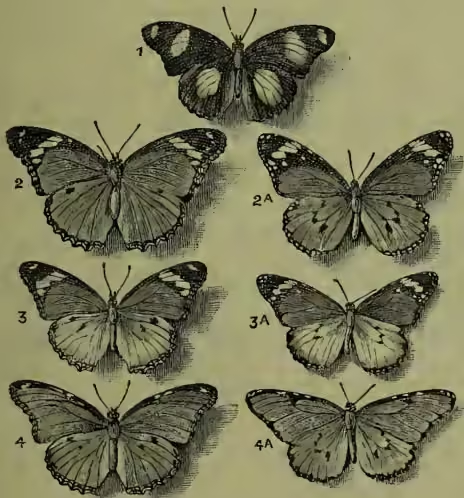
The examples selected for illustration were lent by Colonel Swinhoe; the figures are about half the natural size. Fig. 1 represents the male of the Indian and African Hypolimnas misippus: it is non-mimetic and very unlike the female, being distinctly marked with a large iridescent blue spot on each of the four wings. The iridescent spots on the right wings appear to be larger than those on the left, because they are seen at a different angle. The male remains unchanged in the localities where its female alters in correspondence with the form it mimics. Fig. 2 is the commonest form of female, which mimics the above-mentioned Danaïs chrysippus (fig. 2A), occurring nearly all over the Old World. In Aden and some parts of Africa the latter butterfly is represented by a variety or sub-species with white hind-wings (Danaïs alcippus); see fig. 3A. In the same localities there is a similar variety of the female Hypolimnas (the alcippoides form), shown in fig. 3. Finally, in Aden and certain African localities there is another variety or sub-species of the Danaïs (D. dorippus) without the black and white marks at the tip of the fore-wing, shown in fig. 4A; while the Hypolimnas follows with a similar form of female, seen in fig. 4. This latter is also common in the south-west of India, where it has been stated that the mimicked form (D. dorippus) does not occur. Colonel Swinhoe, however, felt sure that the existence of the mimicker implied the former presence of the mimicked species. He tested this hypothesis by examining large numbers of the Danaïs, and he found that the dorippus form does exist in that part of India, although it is extremely rare: he came across about a dozen in four or five years. It is probable that dorippus has been nearly supplanted by the dominant form chrysippus, the resemblance between the two being sufficiently close for the mimic of the former to be mistaken for the latter. The case forms a most interesting exception to Wallace's third law quoted below.
The butterflies which afford models for mimicry chiefly belong to the two families Danaidæ (including Euploea, Danaïs, and Hestia) and Acreidæ, in addition to the Heliconiæ of tropical America. There is some direct and much indirect evidence to show that all mimicked species are specially protected by an unpleasant taste or smell. Wallace has concisely stated the conditions under which mimicry occurs, as follows: '(1) That the imitative species occur in the same area and occupy the same station as the imitated. (2) That the imitators are always the more defenceless. (3) That the imitators are always less numerous in individuals. (4) That the imitators differ from the bulk of their allies. (5) That the imitation, however minute, is external and visible only, never extending to internal characters or to such as do not affect the external appearance.'
Examples of mimicry are also well known in other orders of insects. The formidable Hymenoptera (including the hornets, wasps, bees, and ants) are frequently resembled by defenceless insects belonging to other orders, such as moths (Lepidoptera), beetles (Coleoptera), flies (Diptera), &c. The most remarkable example yet described was discovered by W. L. Sclater in tropical America. The leaf-cutting ants (Ecdoma) are extremely abundant in this part of the world, and present a black and white D. niavius, and the black reddish-brown and white D. chrysippus (see fig. 2A). In West Africa a closely related swallow-tail (P. merope) has a very similar male, and females mimicking D. chrysippus and the West African form of D. niavius. While such remarkable changes have occurred on the mainland of Africa, the ancestral form from which these mimetic species have been developed has been preserved comparatively unchanged in the island of Madagascar, as the closely related Papilio meriones in which the female much resembles the male and is non-mimetic. Similar species with sexes almost alike have been found in the Comoro Islands (P. humbloti) and in very characteristic appearance, each homeward-bound ant carrying a piece of leaf vertically in its jaws. Sclater found a homopterous insect which faithfully resembled an ant together with its piece of leaf. The latter was suggested by the thin compressed green body of the insect, and its profile was precisely like that of the jagged edge of the fragment of leaf held over the back of the ant.
The mimicking may be separated from the mimicked species by a still wider interval. Spiders in many parts of the world are defended by resembling the aggressive and justly respected ants. Again, many large caterpillars intimidate their foes by resemblance to snakes. The extraordinary prevalence of mimicry among insects is probably to be explained by their usual defenceless condition, and by their immense fertility and the rate at which the generations succeed each other—conditions which strongly favour the rapid action of natural selection. Hence it is that other forms of protective resemblance are also especially characteristic of insects (see articles BUTTERFLY and CATERPILLAR in this work). Mimicry is, however, by no means unknown in other animals. Thus, the gaudy colours of the deadly coral snakes (Elaps) of tropical America are mimicked by harmless snakes; and the powerful friar-birds are resembled by defenceless orioles in various Malayan islands. All the instances cited above illustrate protective mimicry—a resemblance which serves to defend the imitator from attack. But there are other although far rarer examples of aggressive mimicry, in which the resemblance favours the attack of the imitator upon the mimicked species or upon species which accompany the latter. Thus, the larvæ of certain flies (Volucella) feed upon the larvæ of humble-bees and wasps. The parent fly resembles the humble-bee or wasp, and is thus less likely to arouse suspicion when engaged in laying its eggs in or near the nest.
Mimetic appearances are often combined with other methods of defence; thus, many large caterpillars are well concealed by protective resemblance, and only assume the terrifying snake-like appearance
| I. Colours which cause an animal to resemble some part of its environment, or to mimic the appearance of some other species (APATETIC COLOURS). | II. Warning and signalling colours which suggest something unpleasant to an enemy, or aid in the escape of other individuals of the same species (SEMATIC COLOURS). | III. Colours displayed in courtship (EPIGAMIC COLOURS). Ex.—Bright colours of male birds. |
|
|---|---|---|---|
| A. Colours which conceal an animal by causing it to resemble some part of its normal surroundings (protective and aggressive resemblance: CRYPTIC COLOURS). | B. False warning and signalling colours deceptively suggesting something unpleasant to enemies or attractive to prey (protective and aggressive mimicry and alluring colours: PSEUDOSEMATIC COLOURS). | ||
| 1. Concealment as a defence against enemies (protective resemblance: PROCRYPTIC COLOURS). Ex.—Colours by which palatable insects are concealed (see arts. Butterfly and Caterpillar). |
1. Colours which deceptively suggest something unpleasant or dangerous to an enemy (protective mimicry: PSEUDOAPOSEMATIC COLOURS). Ex.—Hornet-like moth, snake-like caterpillar. |
1. Colours which warn an enemy off by denoting something unpleasant or dangerous (warning colours: APOSEMATIC COLOURS). Ex.—Gaudy colours of nauseous or dangerous insects. |
|
| 2. Concealment enabling an enemy to catch its prey (aggressive resemblance: ANTICRYPTIC COLOURS). Ex.—Colours of tiger, lion, &c. |
2. Colours which deceptively suggest something attractive to prey, or enable an enemy to approach without exciting suspicion (alluring colours and aggressive mimicry: PSEUDEPISEMATIC COLOURS). Ex.—Mantis (Hymenopus), which attracts the other insects on which it feeds by resembling a pink flower, Volucella. |
2. Colours which enable individuals of the same species quickly to recognise and follow each other (recognition marks: EPISEMATIC COLOURS). Ex.—White tail of rabbit. |
|
when alarmed. It is of great interest to trace the relation of mimicry to the other uses of colour in animals. This relationship is shown in the above table. The difference between mimicry and protective resemblance (with which it is often confused) will be seen when A is compared with B.
The term mimicry has been criticised as seeming to imply conscious volition on the part of the imitator. Such a misapprehension is unlikely to arise in any one who has read the literature of the subject. Authorities are agreed that the resemblance has been gradually produced by the operation of natural selection which has ensured the persistence of all variations tending in the direction of some well-defended insect avoided by foes.
See H. W. Bates, 'Butterflies of the Amazon' (Trans. Linn. Soc., xxiii.); A. R. Wallace, 'Malayan Butterflies' (Trans. Linn. Soc., xxv.), Essays on Natural Selection, Tropical Nature, Darwinism; R. Trinen, 'South African Butterflies' (Trans. Linn. Soc., xxvi.); Belt, 'Naturalist in Nicaragua'; Poulton, 'Colours and Markings of Insects' (Proc. Zool. Soc., 1887), Colours of Animals (Inter. Sc. Series).