Mint (Mentha), a genus of plants, of the natural order Labiatae, with small, funnel-shaped, quadrifid, generally red corolla, and four straight stamens. The species are perennial herbaceous plants, varying considerably in appearance, but all with creeping root-stocks. The flowers are whorled, the whorls often grouped in spikes or heads. The species are widely distributed over the world. Some of them are very common in Britain, as Water Mint (M. aquatica), which grows in wet grounds and ditches, and Corn-mint (M. arvensis), which abounds as a weed in cornfields and gardens. All the species contain an aromatic essential oil, in virtue of which they are more or less medicinal. The most important species are Spearmint, Peppermint, and Pennyroyal.—Spearmint or Green Mint (M. viridis) is a native of almost all the temperate parts of the globe; it has erect smooth stems, from one foot to two feet high, with the whorls of flowers in loose cylindrical or oblong spikes at the top; the leaves lanceolate, acute, smooth, serrated, destitute of stalk, or nearly so. It has a very agreeable odour.—Peppermint (M. piperita), a plant of equally wide distribution in the temperate parts of the world, is very similar to spearmint, but has the leaves stalked, and the flowers in short spikes, the lower whorls somewhat distant from the rest. It is very readily recognised by the peculiar pungency of its odour and of its taste.—Pennyroyal (M. pulegium), also very cosmopolitan, has a much-branched prostrate stem, which sends down new roots as it extends in length; the leaves ovate, stalked; the flowers in distant globose whorls. Its smell resembles that of the other mints.—All these species, in a wild state, grow in ditches or wet places. All of them are cultivated in gardens; and peppermint largely for medicinal use and for flavouring lozenges. They are naturalised in America, where, however, the common species is M. canadensis, the Wild or Horse-mint. Mint Sauce is generally made of spearmint, which is also used for flavouring soups, &c. A kind of mint with lemon-scented leaves, called Bergamot Mint (M. citrata), is found in some parts of Europe, and is cultivated in gardens. Varieties of peppermint and Horse-mint (M. sylvestris), with crisped leaves, are much cultivated in Germany under the name of Curled Mint (Krause-minze); the leaves are dried and used as a domestic medicine, and in poultices and baths. All kinds of mint are easily propagated by parting the roots or by cuttings. It is said that mice have a great aversion to mint, and that a few leaves of it will keep them at a distance.
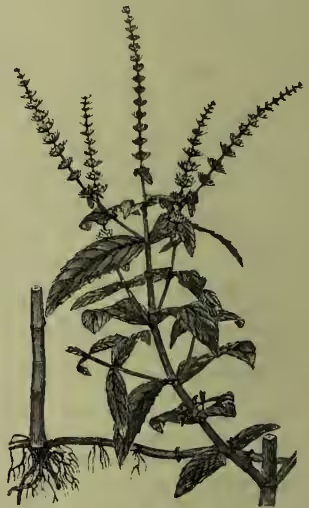
Peppermint, pennyroyal, and spearmint are used in medicine. The pharmacopoeias contain an aqua, spiritus, and oleum of each of them; the official part being the herb, which should be collected when in flower. Peppermint is a powerful diffusible stimulant, and, as such, is antispasmodic and stomachic, and is much employed in the treatment of gastrodynia and flatulent colic. It is also extensively used in mixtures, for covering the taste of drugs. Pennyroyal and spearmint are similar in their action, but inferior for all purposes to peppermint.