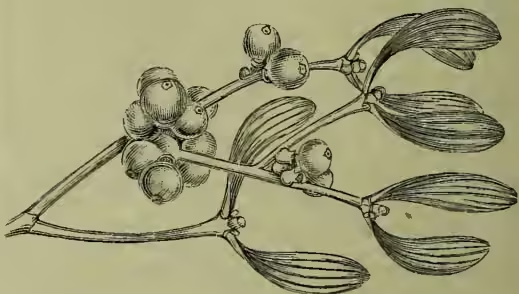
Mistletoe. This mystic plant, with its thick, succulent, yellow-hued foliage, and white, viscos berries, was long a puzzle to botanists, its peculiar mode of growth having given rise to the most curious fancies. Its name is most probably from the Anglo-Saxon mist-el, from mist, 'mist,' 'gloom' (Ger., 'dung'), and tán, 'twig.' The only British species of this genus of parasitical shrubs is the Common Mistletoe (Viscum album), a native also of the greater part of Europe (not of north England, Scotland, or Ireland), growing on many kinds of trees, particularly on the apple, and others botanically allied to it, as the pear, service, and hawthorn; sometimes, also, on sycamores, limes, poplars, locust-trees, and firs, but very rarely on oaks (contrary to the common belief). In the Himalayas the mistletoe grows abundantly on the apricot-tree, on the vine and loranthus in Italy, on spruce-firs in France and Switzerland. The ever-green leaves of the V. album of English woods, with their yellowish hue, make a conspicuous appearance in winter among the naked branches of the trees. The flowers are insignificant, and grow in small heads at the ends and in the divisions of the branches, the male and female blossoms on separate plants. The berries are about the size of currants, white, translucent, and full of a very viscid juice, which serves to attach the seeds to branches, where they take root when they germinate, the radicle always turning towards the branch, whether on its upper or under side. It may be easily made to grow on suitable trees even where not native—as in Scotland, for example.
The mistletoe was intimately connected with many of the superstitions of the ancient Germans and of the British Druids. In the northern mythology, Balder (q.v.) is said to have been slain with a spear of mistletoe; and in Holstein it is the Märentaken, or 'branch of spectres,' which confers upon its possessor the power to see ghosts. Among the Celts the mistletoe which grew on the oak was in peculiar esteem for magical virtues. According to an old tradition the mistletoe supplied the wood for the cross, which until the time of the crucifixion had been a forest tree, but was henceforth condemned to exist only as a mere parasite. Traces of the ancient regard for the mistletoe still remain in some old English Christmas customs, as kissing under the mistletoe. The mysterious surrounding of the mistletoe invested it with a widespread importance in old folk-lore remedies, the Druids having styled it 'all-heal,' as being an antidote for all diseases. Culpepper speaks of it as 'good for the grief of the sinew, itch, sores, and toothache, the biting of mad dogs and venomous beasts;' while Sir Thomas Browne alludes to its virtues in the cure of epilepsy. In Sweden a finger-ring made of the mistletoe is an antidote against sickness, and in France amulets made of its wood were formerly much worn (see H. Friend, Flower-lore).—Loranthus Europæus, a shrub very similar to the mistletoe, but with flowers in racemes, is plentiful in some parts of the south of Europe, and very frequently grows on oaks.—L. odoratus, a Nepalese species, has very fragrant flowers.—The American mistletoe, of which there are some half-dozen species, is similar in general appearance and habit to the European, yet differs in so many points as to justify its being called by a different name, Phoradendron. The commonest species is P. flavescens, found from New Jersey to Mexico.