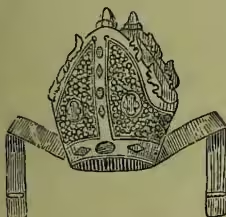
Mitre (Lat. mitra, also infula), the head-dress worn by bishops in solemn church services. The name, as probably the ornament itself, is borrowed from the orientals, although, in its present form, it is not in use in the Greek Church, or in any other of the churches of the various eastern rites. The western mitre is a tall, tongue-shaped cap, terminating in a twofold point, which is sup- posed to symbolise the 'cleft tongues,' in the form of which the Holy Ghost was imparted to the apostles, and is furnished with two flaps, which fall behind over the shoulders. Opinion is much divided as to the date at which the mitre first came into use. Eusebius, Gregory of Nazianzus, Epiphanius, and others speak of an ornamented head-dress, worn in the church; but the cleft mitre does not seem to have been known till the 12th century. The material used in the manufacture of the mitre is very various, often consisting of most costly stuffs, studded with gold and precious stones. The mitre of the pope is of quite a different form, and is called by the name Tiara (q.v.). Although the mitre properly belongs to bishops only, its use has been permitted by special privilege to certain abbots, to provosts of some distinguished cathedral chapters, and to a few other dignitaries.
In the English Church, since the Reformation, the mitre was no longer a part of the episcopal costume till 1885, when it was resumed by the Bishop of Lincoln; but it is placed over the shield of an archbishop or bishop, instead of a crest. The Bishops of Durham surround their mitre with a ducal coronet, in consequence of their having been till 1836 Counts Palatine of Durham.