MOABITE STONE, a stone bearing an inscription of thirty-four lines in Hebrew-Phoenician letters, was discovered by the Rev. F. Klein in 1868 among the ruins of Dhibân, the ancient Dibon. The stone was of black basalt, rounded at the top and bottom, 2 feet broad, 3 feet 10 inches high, and 14½ inches in thickness, but was unfortunately broken up by the Arabs, whose cupidity had been aroused by the indiscreet eagerness to acquire it shown by M. Clermont-Ganneau. The fragments were afterwards collected and laboriously fitted into their proper places by means of imperfect squeezes made before the stone was broken, and the monument now stands in the Louvre at Paris. The inscription was discovered to be a record of Mesha, king of
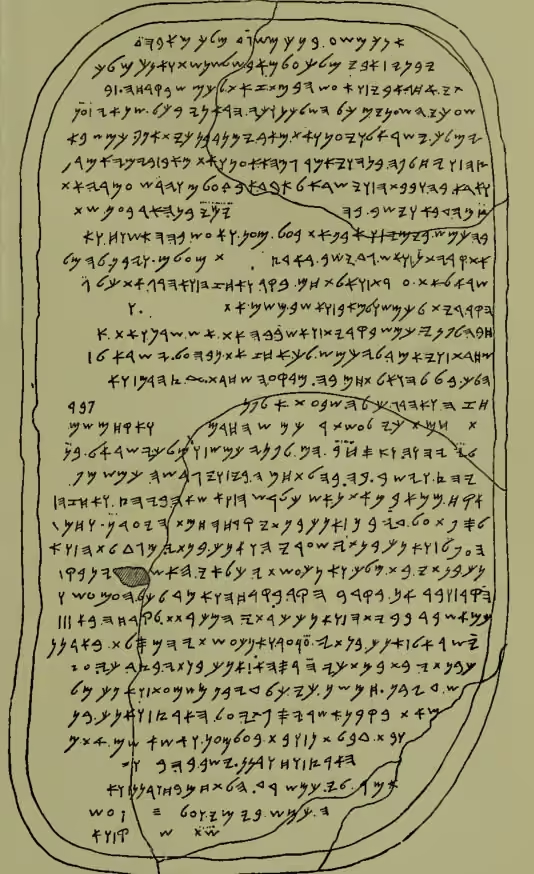
Moab, mentioned in 2 Kings, iii., referring to his successful revolt against the king of Israel. The characters of the inscription are Phoenician (see ALPHABET), and form a link between those of the Baal Lebanon inscription (10th century) and those of the Siloam text.
See Dr Ginsburg's Moabite Stone (2d ed. 1871); Héron de Villefosse's monograph, Notice des Monuments provenants de la Palestine (1876), contains a bibliography of books and papers written on this subject. Readings are given by Clermont-Ganneau in the Revue Critique for 1875, by Profs. R. Smend and A. Socin of Tübingen in their monograph, Die Inschrift des Königs Mesa von Moab für Akademische Vorlesungen (Freiburg, i. B., 1886), and by Dr A. Neubauer in Records of the Past (new series, vol. ii. 1889).