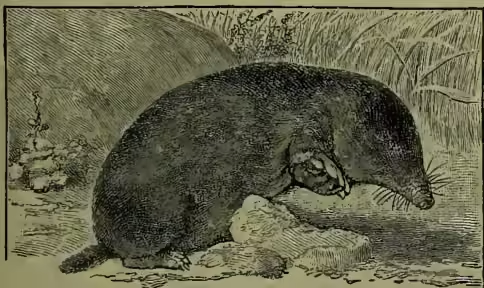
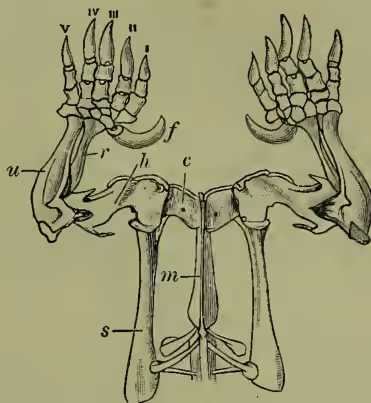
Mole (Talpa), a genus of quadrupeds of the order Insectivora and family Talpidae. In structure and habits all the species, seven in number, essentially resemble the Common Mole (T. europæa). This animal is found in the southern and central parts of Europe, extending northwards as far as to the shores of the Baltic and throughout Denmark, also in central Asia as far as to the confines of China. In Britain it is very plentiful, but it is not found in Ireland, nor in the western islands of Scotland, except in Mull. It possesses a plump, nearly cylindrical body, covered with a velvet-like coat of short soft fur of a black or blackish-brown colour inserted perpendicularly to the skin, very short stout limbs with naked flesh-coloured feet, a short scaly tail furnished with long stiff hairs, and a pointed muzzle. The total length is about 6 inches, of which the tail measures about half an inch. It has no external ears, and its eyes are so minute as to be easily overlooked. By its bodily structure it is so eminently fitted for underground progression that it might almost be said to swim through the soft earth. Its whole skull is like a wedge, and its nose is a borer fastened to the sharp end of the wedge. The nostrils are elastic and flexible tubes of cartilage, strengthened by a little bone, and moved by special muscles. The fore-limb is enclosed in the skin of the body up to the wrist. The fore-feet are extremely broad and strong, the palm is turned outwards and backwards; the last phalanges are much longer than the others, are bifurcated, and have strong claws firmly attached to them. The wrist is composed of short and compact bones, and from its inner side there springs a long sickle-shaped bone which runs forward towards the first digit, strengthening the hand and increasing its breadth. The elbow process is long, thus giving greater leverage to the arm than usual. The bone of the upper arm is short, broad, flattened at both extremities, and contracted in the middle, and has upon it very prominent ridges for the attachment of the muscles moving the shoulder-joint. These ridges give it a most peculiar appearance, different from anything found among mammals. The shoulder-blade has the form of a long stout triangular rod. The breast-bone has its fore-part (manubrium) longer than the body and keeled below and expanded. The collar-bone is short, almost cuboid, and is placed at some considerable distance in front of the ribs, thus allowing the fore-limb to be brought very close to the head in burrowing. The hind-limbs are more slender, and are used only for purposes of progression. The incisor teeth are small and sharp, the upper canine is long and possesses a double fang. There are three nearly equal conical premolars and a fourth much larger: the true molars are broad, with many sharp conical projections. The dentition is represented by the formula . The senses of hearing, taste, and smell are very strongly developed. The eye is extremely small, with a nearly globular lens and a minute optic nerve, and is at least sensitive to light. The mole is an exceedingly voracious animal; his appetite is a sort of frenzy—a 'rage of hunger.' Vegetable substances form no part of his diet. Earthworms, the larvæ of various insects, mice, small birds, lizards, frogs, even weaker individuals of his own species, all fall victims to his ravages. His practice is to throw himself, in a state of violent excitement as if maddened with rage, on his prey, and immediately, if it is a bird or a quadruped he has captured, to tear open its abdomen and satiate himself with blood. His favourite food is earthworms, and in quest of them, and guided chiefly by the sense of smell, he works his way underground, throwing up the earth in mole-hills; more rarely in fine summer nights he seeks for them on the surface of the ground, where he is himself in turn likely to be picked up by some hungry owl. The mole's digestion is very rapid; after a feast he falls into a profound sleep, but from this he soon wakes prepared for another raid. If deprived of food for even a short time he perishes. His thirst, too, is very great, and where there is a colony of moles it is said that a run is always made towards the nearest ditch or pond, and also that where water cannot be conveniently reached deep perpendicular shafts are sunk into the ground, at the bottom of which water is always found.
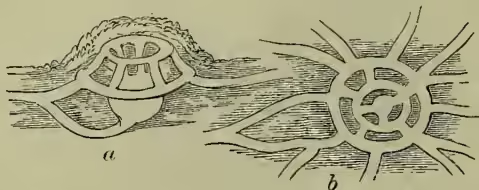
The habitation of the mole is a very remarkable structure. Each mole has his own encampment, but sometimes two or three moles may be sufficiently sociable to share a common passage. It consists of a hillock of earth larger than an ordinary mole-hill, and containing two circular galleries, one above the other, with five connecting passages, and a central chamber which has access to the upper gallery by three passages; whilst about nine passages lead away from the lower gallery in different directions. The end of a passage entering a gallery on one side is usually not opposite to the end of a passage entering on the other. To afford all facility of escape in case of any alarm, a passage leads at first downwards from the central chamber, and then upwards till it joins one of the high roads, kept open for access to the moles' hunting-grounds or for escape in time of danger. Moles pair early in spring. As the males exceed the females in number there is often a search for the females and a fierce struggle for possession of them. The shallow tracks running in all directions which are made by the mole when in search of a partner are called by French naturalists traces d'amour. The nest in which the female mole produces her young is not the encampment that has been described, but is a chamber lined with dried grass, leaves, and fine roots, formed generally under a mole-hill rather larger than usual at the point of meeting of two or three ordinary passages, at some distance from the fortress. Only a single litter is produced in the year, consisting of four or five young, rarely more. The attachment of the parent moles to their young and also to each other seems to be very strong.
Of all British mammals moles are the most constantly and determinedly persecuted. They are regarded by farmers and gardeners as a pest owing to the injury done to lawns and pastures by their burrows, and to young plants in their search for grubs; and mole-catching has long been practised in Britain as an extensive trade. Capture is effected by inserting traps of various kinds in the runs made by the moles, which catch them as they pass. It is a question, however, whether moles do not fully compensate for the injury they do by destroying many insects and other noxious animals.
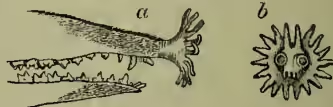
Another species of mole (T. caeca) is found in the most southern parts of Europe, very similar to the common mole, but rather smaller, and having its eyes covered by a membrane which is pierced only by a minute hole, so that it justifies Aristotle's assertion that the mole is blind. Among the other Talpidae are the Cape Golden Mole (Chrysochloris capensis), which exhibits splendid metallic reflec- tions, and is remarkable in not having the clavicle short and the manubrium of the sternum expanded and keeled, but in having the chest-wall hollowed out for the lodg- ment of the fore-limb; the Shrew Mole (Sculops), a genus to which the most common American moles belong, so called from its resemblance in dentition to the shrews; and the Star-nosed Mole (Condylura), also American, and found from Canada to Florida, having the end of the nose surrounded by about twenty fleshy radiating filaments, which are movable, and serve as organs of touch.
The name mole is abbreviated from the old English name Mouldwarp or Mouldinwarp, still provincially used, which is derived from the Anglo-Saxon molde, 'mould,' and weorpan, 'to throw up.' Cf. Ger. Maulwurf. For moles on the person, see NÆVUS; for masonry moles, see BREAKWATER.