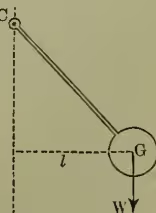
Moment of a dynamical quantity is the importance of that quantity in regard to its dynamical effect relatively to a given point or axis. The most familiar example is the Moment of a Force. For simplicity, take a body movable about a fixed axis—say, a door on its hinges. Everyday experience teaches us that such a door is most easily moved by a push or pull applied as far as possible from the hinge. In moving the door slowly through a certain angle, we must do so much work in, first, causing the necessary acceleration, and then in overcoming the friction of the hinges. If we apply the force at a greater distance from the hinge, it works through a proportionally greater arc, and is therefore proportionately less. Such considerations lead to the definition of the moment of a force about a point as the product of its amount into its perpendicular distance from the point. The tendency of the action of such a force is to cause rotation about an axis perpendicular to the plane passing through the point and containing the force. Thus, in the case of a pendulum, the effectiveness of the force in causing rotation is measured by the moment —where is the weight of the pendulum, and is the distance of the line of action of the force from the centre of rotation , or (what comes to the same thing) the distance of the centre of mass from the vertical line through .
The term moment enters into several other phrases, all of which relate either directly or indirectly to rotation. Thus, there is the moment of momentum, or angular momentum, whose rate of change is the measure of the moment of the force producing the change. To obtain it for any given body rotating with angular speed about an axis, we first imagine the body broken up into a great many small portions of masses , &c. at distances , &c. from the axis, multiply the momentum () of each mass by its distance, and then take the sum of all these products. The angular speed being the same in every expression, the moment of momentum takes the form , which it is usual to write in the symbolic form . The quantity , which is the sum of the products of each mass into the square of its distance from the axis, is called the Moment of Inertia about that axis. It is the factor in the moment of momentum, which depends upon the distribution of matter in the body. It enters into all questions of mechanics in which rotation is involved, from the spinning of a top or the action of an engine governor to the stability of a ship. By an obvious extension, the word moment is also used in such combinations as moment of a velocity and moment of an acceleration. Such phrases correspond to nothing truly dynamic, unless we regard velocity as meaning the momentum of unit mass, and acceleration as the rate of change of that momentum. See DYNAMICS, FORCE, INERTIA, ROTATION, &c.
MOMENTUM is our modern equivalent of Newton's quantity of motion (quantitas motus), which in Definition II. of the Principia is stated to be measured by the product of the velocity and the mass. Its dynamic importance is sufficiently discussed under FORCE.