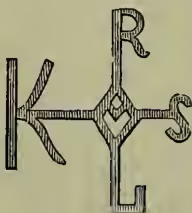
Monogram (Gr.), a character composed of two or more letters of the alphabet, often interlaced with other lines, and used as a cipher or abbreviation of a name. A perfect monogram is one in which all the letters of the word are to be traced. They are found on early Greek coins, medals, and seals, and on the family coins of Rome, but not on the coins of the earlier Roman emperors. Constantine placed on his coins one of the earliest of Christian monograms, composed of the first and second letters of ΧΡΙΣΤΟΣ (Christos), a monogram which also appeared on the Labarum (see CROSS, Vol. III. p. 582; and CONSTANTINE); we often find it combined with the first and last letters of the Greek alphabet (Rev. i. 8). Another well-known monogram is that of the name of Jesus, IHS, from the first three letters of ΙΗΣΟΥΣ. Popes, emperors, and kings of France during the middle ages were in the practice of using a monogram instead of signing their names. Fig. 1 represents that of Charlemagne, a perfect monogram, in which all the letters of Karolus can be traced.
Painters and engravers in Germany and Italy have used monograms to a large extent as a means of distinguishing their works. Fig. 2 is the monogram of Albert Dürer. The first typographers made use of monograms or ciphers, a series of which, well known to the bibliographer, fixes the identity of the ancient editions, German, Italian, and English, from the invention of printing down to the middle or end of the 16th century. Those of William Caxton and Gaspard Philippe, an old Paris printer, will be found at BOOK, Vol. II. p.

303. See Brulliot, Dictionnaire des Monogrammes (1834); Duplessis, Dictionnaire des Marques (Paris, 1887). Potters' marks will be found at POTTERY.