Montreal, the largest city of the Dominion of Canada, is the centre of Canadian commerce, of Canadian banking, and of the extensive system of railways by which the country is now covered. It is built on the south-east side of an island formed by the junction of the Ottawa River with the St Lawrence, and may be said in general terms to be situated on the northern bank of the St Lawrence.
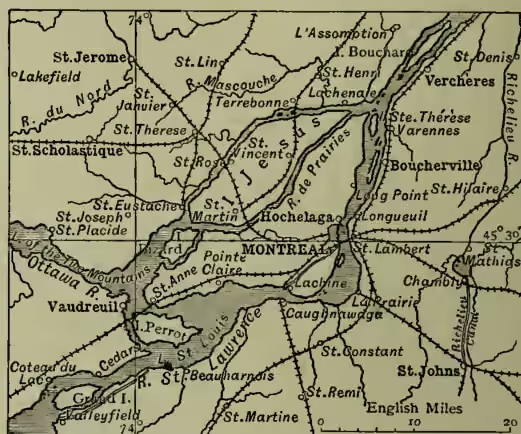
The city is about 4 miles long and 2 wide, the Central Mountain rising in the rear narrowing the city at its base for some distance. It is not the political capital of the province of Quebec, but it exerts an immense political influence, and practically not only directs the political business of Quebec, but exerts also by means of its banks, its manufactures, and its great importing and distributing commercial houses a great influence on the public policy of the Federal Government. It is also the seat of the greatest universities, hospitals, convents, and seminaries in all Canada. Finally it is during the season of navigation—i.e. from May to November—the great maritime port of the Dominion, a dozen transatlantic steamship companies making it one of their headquarters; while a lake and river and coast navigation of great activity increases and diversifies the business of the city. It is nearly 1000 miles from Montreal to the ocean proper, and 250 to the first salt water. For the Victoria Bridge, see BRIDGE, p. 441. Pop. (1871) 107,225; (1881) 140,747; (1891), including suburbs, 216,650. The people of French descent greatly outnumber all other nationalities; and of the rest, the Irish are more numerous than those of English and Scotch descent. The revenue of the city exceeds $2,000,000 annually.
The growth of the commerce of Montreal is very remarkable. In 1870 the imports amounted to 23,698,688 and the exports to 11,222,101. In 1889 the imports were 43,948,594 and the exports 29,032,613. The 1500 miles of the St Lawrence River contribute to this growth of export, and distribute largely the growth of import. The total of receipts of grain, flour, and meal at Montreal in 1890-95 amounted to about 20,000,000 bushels annually, the shipments of the same being some millions less. The annual tonnage of shipping rose from 208,000 tons in 1870 to 550,000 tons in 1890-95 (the American ships declining). For the great Victoria Railway Bridge across the St Lawrence, see BRIDGE, vol ii., p. 441: see also CANAL. The Federal Government having assumed the debt of the port incurred for deepening the channel, and the canal tolls having been reduced to a minimum with a prospect of being entirely abolished in order to encourage a through trade, the future of the port of Montreal as a practically free port seems assured. The canal system which finds its outlet at Montreal is remarkable. By means of the canals Montreal is enabled to touch and handle the trade of Duluth and Fort William on Lake Superior, of Chicago and Milwaukee on Lake Michigan, Collingwood and Goderich on Lake Huron, Buffalo and Cleveland on Lake Erie, Hamilton, Toronto, Kingston, and Oswego on Lake Ontario. These canals afford a continuous course of water-communication extending from the Straits of Belle Isle to Port Arthur at the head of Lake Superior, a distance of 2260 miles. The aggregate length of the St Lawrence canals is 70½ miles. Montreal is the headquarters of the Grand Trunk Railway, the Canadian Pacific Railway, the South-Eastern Railway, the Central Vermont Railway. These great roads open up by means of various connections the whole railway-system of the United States and Canada, and the Canadian Pacific Railway has a through line from Montreal to Vancouver City in British Columbia, a distance of 2906 miles. In the boot and shoe manufacture over 3000 hands are employed, in clothing-factories over 2500, in tobacco-factories about 3000, in the breweries about 500; and in the workshops of the railways an army of men are employed. There are also rubber-factories, sawmills, sack-factories, tool-factories, silk-factories, cotton-mills, and an endless variety of small industries which receive encouragement from the protection afforded by the tariff. Montreal has therefore been strongly in favour of the protective system.
Of the Episcopal churches, Christ Church Cathedral has a tower 224 feet in height, and St George's of 230 feet. The Catholic churches are numerous and some of them splendid: St Peter's Church is a repetition on a smaller scale of the church at Rome; Notre Dame holds 10,000 people; St Patrick's is the church of the Irish Catholics. In the French churches the preaching is generally in the French language. The Presbyterians have eight larger and several smaller churches, the Methodists have eleven, and other denominations also are well represented. In all there are seventy-four churches in the city. Education in Montreal is conducted under the law of the province of Quebec. It is denominational in character, the vast majority of the schools being of course Roman Catholic. The Protestant schools are under the control of a special board. The taxes on Catholics go to the Catholic schools, the taxes on Protestants to Protestant schools. McGill University, which obtained its charter in 1821, has been an active establishment since 1852; over 1200 graduates claim it as Alma Mater. Laval University of Quebec has a branch at Montreal; the seminary of St Sulpice, founded in 1657, is a theological institution, training about 300 pupils at one time; the Presbyterian College, chartered in 1865, has an endowment and property amounting to over a quarter of a million of dollars; the Wesleyan Theological College was founded in 1873; and others in the long list are the Congregational College, the Anglican Diocesan College, St Mary's College, founded in 1848 by the Jesuits, the academic hall of which holds 1200 people, and the pupils in attendance numbering about 350, the Jacques Cartier Normal School, under the control of the provincial government, the Christian Brothers' Schools, the schools and convents of the congregation of Notre Dame, the schools and convents of the Sacred Heart. McGill College has a library of 25,000 volumes, the Advocates' Library has 15,000 volumes, the Presbyterian College Library 10,000 volumes; the Mechanics' Institute, the Fraser Institute, and the Y.M.C.A. have also libraries of some value. There are about fifty papers published in the city, including six French and five English dailies, and ten French and eight English weeklies. The Quebec Gazette (1764) was the first paper published in Canada; the Montreal Gazette (1778) is the next oldest, and is the leading journal still. There are musical, art, and historical associations also which maintain in Montreal a taste for art, literature, and science not common in colonial commercial cities. Among the chief philanthropic institutions are the General Hospital, costing 40,000 a year; the Protestant House of Industry, to which 20,000 people a year have access; the Y.M.C.A. building; the Dispensary, aiding about 10,000 persons a year; the Gray Nuns' Hospital (1755), which is also a founding hospital; the Hôtel Dieu (1644), with 350 beds, receiving over 3000 persons per annum, and costing about 35,000 a year for maintenance.
History.—Montreal was purchased from the president of the Hundred Associates of France, a trading corporation, by Abbé Olier and Dauversière, who were moved by religious enthusiasm to establish institutions there; it was actually founded by Maisonneuve, the leader and military head of the enterprise of Olier and Dauversière, who landed at Montreal (Ville-Marie de Montreal) on the 18th May 1642. The early history of the city was one of continuous struggles against the Iroquois Indians, by whom the whole island was more than once devastated up to the very palisades of the town's defences; and in 1660 the Indians almost exterminated the population not actually within the feeble defences. In 1722 the city was fortified with a bastioned wall and ditch. In September 1760, the year following the capture of Quebec by Wolfe, Montreal was surrendered by the French governor, De Vaudreuil, to the British, under Lord Amherst and General Murray. In 1776-77 the city was occupied by the invaders from the revolted colonies, who did their best to coerce or cajole the Canadians into joining in the rebellion. In 1777 the British forces advanced from Quebec, and Montreal was evacuated by the invaders. Since that time the history of the city has been peaceful. The war of 1812-14 did not disturb its progress. The rebellion of 1837 for a moment ruffled its political serenity; but all its modern history has been the history of constitutional development, of business progress, of educational advancement, and of growth in population.