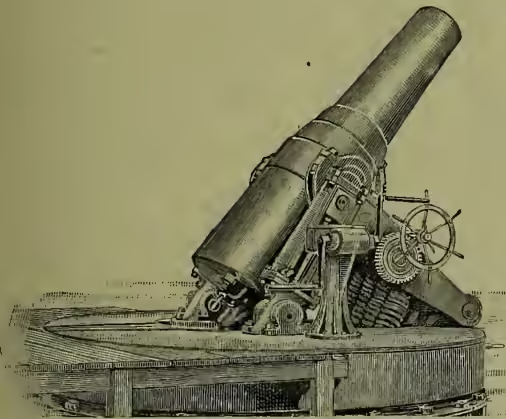
Mortar, a short and very thick piece of artillery of large calibre, firing a heavy shell at a fixed angle of or thereabouts, so that the projectile may strike the object aimed at in a direction more or less vertical. The range is regulated by the amount of powder used, which, being placed in a chamber completely closed by the projectile, produces its maximum effect. Mortars are particularly useful at sieges, as their 'high-angle' fire enables them to search out the interior of the works, and against ships whose decks offer a vulnerable target to such fire. The common type of mortar is a muzzle-loading smooth bore of , 8, 10, or 13 inch calibre, firing a spherical shell; but rifled mortars and elongated shells were used by the Germans at the siege of Strasburg in 1870; and the United States have a very powerful weapon in their 12-inch breech-loading rifled mortar or howitzer, shown in the figure. With a charge of 50 lb. of smokeless powder and elevation, it will project a 1630-lb. shell a distance of miles. The Russian artillery have a so-called field-mortar weighing only 9 cwt., and firing a 46-lb. shell. This weapon is 3 feet long and of 6-inch calibre, but being fitted with elevating gear is better classed as a howitzer. It is breech-loading, effective up to 4000 yards, and as mobile as an ordinary field-gun. Very large mortars have been tried at times, as at the siege of Antwerp citadel in 1832, when the French brought one of 24-inch calibre to the attack. This monster, owing to its unwieldiness and other causes, was a failure. Larger still is Mallet's 36-inch mortar, constructed in 1855, of iron parts welded together, and now in Woolwich Arsenal. Only two or three rounds have been fired from this weapon, as it showed signs of cracking after being discharged.