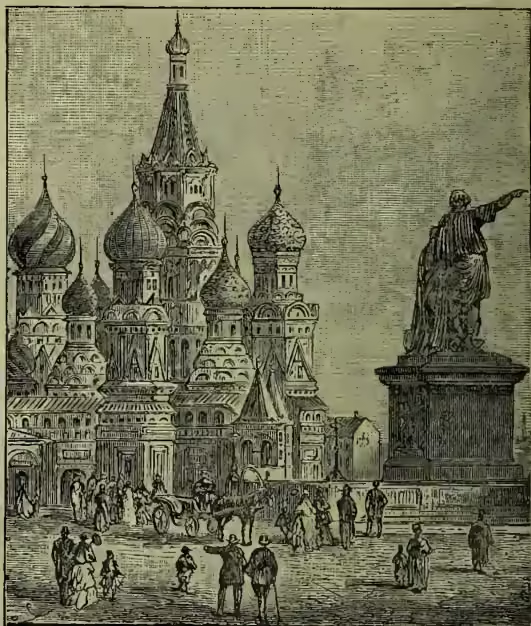
Moscow, formerly the capital of Russia, and still venerated as such by the Russian peasantry, stands on the little river Moskwa, a sub-tributary of the Volga, 403 miles by rail S.E. of St Petersburg, 768 ENE. of Warsaw, and 967 NNE. of Odessa. The city, a rude rhomboid in shape, measures 7 miles by 9 along its diameters, and covers some 40 sq. m. of area. Its centre is the enclosure called the Kreml or Kremlin ('Citadel'), which is surrounded by walls, crowned by eighteen towers and pierced by five gates. This enclosure is the most sacred spot in all the vast Russian empire. The stranger equally with the native pilgrim, on entering its Saviour gate (1491), must doff his cap to the holy icon of the Saviour that surmounts it. The most notable of the religious buildings inside the Kremlin are the cathedral of the Assumption, built originally in 1326 and rebuilt in 1475-79; its interior is encrusted with mosaics and jewelled ornaments, adorned with venerated pictures, and sanctified by numerous relics of saints; within its walls the early czars and all the Russian metropolitans and patriarchs have been consecrated, and the metropolitans buried. The cathedral of the Archangel was originally built in 1533, but restored in 1505; here were buried the Russian czars down to Ivan Alexievitch, brother of Peter the Great. The cathedral of the Annunciation (1489; rebuilt 1554) was formerly the private chapel of the czars; it shelters some remarkable paintings by Rublev (1405). There are numerous churches of minor rank, and several monasteries; in the Voznesenski monastery (1393) the czarinas and female relatives of the czars are buried. In 1600 Boris Godunoff built in the Kremlin the Ivan Veliki tower, 270 feet high, the summit of which commands a magnificent view of Moscow, with her gilded cupolas and fantastic towers, her half Asiatic, half European architecture. Close by, at its foot, stands the gigantic bell, Czar Kolokol ('king of bells;' see BELL). The more important secular buildings within this sanctuary of Moscow are the imperial palace (1849); the palace built in the reign of Ivan III.; the new palace Orushenaya, which serves as a museum of the most valuable Russian antiquities; the palace of the patriarchs, with archaeological treasures and 1500 rare Russian and Greek MSS.; the arsenal (1701-36), before which is the trophy of 1812, a pile of 800 or 900 French cannon; and the Hall of the Synod, with a valuable library and ecclesiological collections. Outside the Kreml the chief objects of interest are the colossal 'Temple of the Saviour' (1838-81), a building commemorative of 1812; the cathedral of St Basil (1554), a 'nightmare in stone,' with fantastic towers; the gigantic bazaar (Gostinoi Dvor); the historical museum; the library (10,000 vols. of old printed books and 600 MSS.) of the synod and its typographical museum; the university (1755), with scientific collections and a library of 170,000 vols.—it is frequented by 3350 students; the public museum (1861), containing a library of 300,000 vols. and 5000 MSS., a first-rate ethnological museum, a gallery of pictures, and scientific collections; the Golitzyn Museum (1865), with 20,000 vols. and a collection of paintings; an observatory; a large foundling hospital (1764); and numerous monasteries and special educational institutions. Moscow is celebrated for its excellent scientific societies. The suburbs of the city are thickly sprinkled with palaces, parks, and monasteries, some of the first and last being of great historic significance.
Next to St Petersburg, Moscow is the busiest industrial city in the empire, manufacturing cotton and woollen goods, silks, leather, tobacco, candles, metallic articles, machinery, paper, chemicals, bricks, carriages, pottery, and watches, all on an extensive scale. But the city occupies an even higher position as a commercial mart. Situated nearly in the centre of European Russia, midway between the Baltic, the Black Sea, and the Caspian, it is one of the principal meeting-places of the streams of Asiatic and European commerce. In the 14th, and more especially the 15th century, it was of even greater importance than it is to-day as a commercial mart. An enormous trade is done in grain, collected from the provinces and exported through the Baltic ports; in timber, from the northern governments; in furs, hides, tallow, and cattle; in the mineral products of the Ural region; in tea, sugar, and other groceries; in cotton, silk, and woollen goods, and in all the various manufactured wares of Russia. The Moscow customs office levies annually £6,000,000 to £7,000,000 on merchandise entering the city bounds. Pop. (1864) 365,000; (1891) 822,397, nearly all Great Russians of the Orthodox Greek Church. As a general rule the temperature ranges from a winter mean of 14° F. to a summer mean of 66°, the annual mean being 40°.
Previous to its settlement by Great Russians in the 12th century, the site had been occupied by Finnish races. The young state was greatly imperilled in its first years by the Mongols, who sacked the town in 1237 and 1293. But by the beginning of the 14th century its princes had secured their position, and began to make conquests and annexations on all sides. In 1325 the metropolitan of central Russia moved his seat to Moscow; a few years later the principality of
Vladimir was united to that of Moscow; the Kremlin, built in 1300, was in 1367 encircled with stone walls. Moscow continued to grow in area and in political influence, and Ivan III. (1462-1505) assumed the title Czar of all Russia. Its prosperity received serious checks in the next century: it was nearly wholly burned to the ground in 1547, was taken and burned by the Khan of the Crimea in 1571, was hard pressed by the Mongols in 1591, and was the scene of riots arising out of the behaviour of the large Polish retinue who accompanied the bride of the Czar Demetrius early in the 17th century. During the whole of that century the people frequently rose against the czars and their unworthy favourites. In 1713 Peter the Great founded St Petersburg and made it his capital; but the old merchant families, the old conservative nobles, and the common peasantry still continue to look upon 'Moscow the Holy' as the real capital of the empire. The city again suffered greatly from fires in 1739, 1748, and 1753, and the cup of misfortune was filled to the brim when the city was set on fire and burned in 1812, according to the traditional belief the patriotic act of its own inhabitants to save it from Napoleon and the French (see NAPOLEON). Since then the city has been in great part rebuilt. —The government of Moscow has an area of 12,855 sq. m., and a pop. (1887) of 2,210,791.