Mosses (Musci). The mosses are a class of small flowerless plants, important in the economy of nature, and of great interest in their life-history. They are found in all climates, but are most abundant in temperate regions and in damp places. They are included with the Liverworts in the division Muscinere, which is sharply separated from the higher division of Vascular Cryptogams (Ferns, &c.) by the absence of vessels; while the lower members of the group consist of a mere flat thallus, and are thus related to the Thallophytes. This, with other characters, indicates that the Muscinere form an independent branch of the tree of evolution, and are not an intermediate type.
The uses of mosses in medicine and the arts are few and unimportant, but in mountain-regions the thick felts of moss and deep beds of peat soak up the rain, and so prevent floods from sudden storms, and in dry weather supply the streams through weeks of drought. With favouring surroundings the life of a moss-plant seems to be endless; the mosses (Sphagnum) we see growing to-day in a bog are the tips of plants which began life perhaps thousands of years ago, and which have formed a great bed of peat, which may be 20 feet thick. This social habit of moss is a peculiarity. In some species cushions of marvellous regularity are formed; it enables individual plants to stand erect, and is of great importance in the process of fertilisation. The capsules of many mosses must be familiar to every one as small sacs at the ends of their hair-like stalks, which rise in great numbers from a moss-cushion. These contain the spores, from each of which when sown there grows in a few days a tiny thread-like plant, the protonema. Buds of young moss-plants soon appear on this, and then, as a rule, the thread-plant dies. A moss-plant consists of a stem with leaves and roots. The roots will grow out from any part of the plant that is kept dark and damp; they are very like the pagated, indeed in many species the production of spores is rare. The sexual mode of reproduction is as follows. At the apex of a plant about mid-summer may often be seen what are popularly known as moss flowers. These consist of a rosette of numerous leaves, smaller than ordinary, a sort of bud in fact. In the centre are male and female organs (antheridia and archegonia), but in some species the male are on one plant, the female on another; within the 'flowers' are also barren leaves known as paraphyses. The antheridia are club-shaped bodies; when ripe, if they are wetted, they burst; the contained cells are squeezed out as a gelatinous mass; within each cell is a small motile 'antherozoid;' this, owing to the nearness of the plants to one another, is able to swim away if the moss is thoroughly wet. The archegonia are flask-shaped; within them lies, in the bottom of the flask, the large egg-cell; in the neck a row of 'canal cells;' these, when the egg-cell is ready, swell up and form a jelly. If an antherozoid is near, it enters the jelly, and working down to the egg-cell fertilises it. The ovum now grows within the flask, which for a time grows with it, forming the 'calyptra;' but after a time the flask is split, and the growing embryo forces its way down into the parent plant, and is nourished by it. When fully grown it is the capsule containing spores, of which we have already spoken, and thus the life-cycle of the moss is completed. This cycle consists of two generations, the moss-plant which produces an egg; from the egg grows a plant which produces spores, but itself remains attached to the parent plant. This is called an alternation of generations. The fern has a similar story, but in this case the spore-bearing generation is the conspicuous plant. Fossil remains have been found in rocks of Palæozoic age.
Classification.—There are some 3000 species; these are divided into four orders. (1) Bryaceæ, which include the vast majority of genera. The sporangium always has a cap, 'calyptra,' which, when ripe, is blown away by the wind; beneath this is a lid, 'operculum,' which splits off from the capsule, exposing the spores. The capsule has a long stalk, 'seta.' The commonest forms are Funaria, Polytrichum, &c. (2) Phascaceæ, a small order; the spores are set free by the rotting of the sporangium; the protonema persists until the maturity of the sporangium. (3) Andraceæ, a single genus; no operculum; the sporangium opens by 4-8 longitudinal slits. (4) Sphagnaceæ, bog mosses; some of the cells of the leaves grow larger than the rest, lose their contents while their walls become spirally thickened; these cells open one into the other; the smaller cells are filled with chlorophyll, and form a network round the large empty ones. The tissue of the stem is in the centre a sort of pith; outside this a layer of long cells with thick walls; outside this an epidermal layer of large empty cells. The male and female organs are either on separate branches or separate plants.
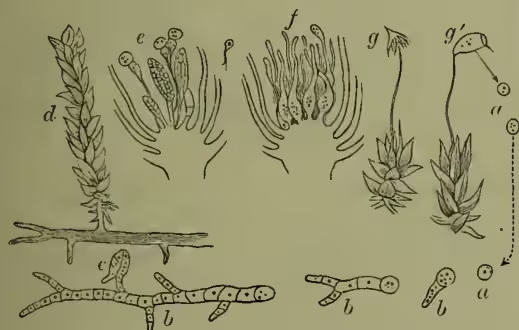
See articles LIVERWORTS, FERNS, GENERATIONS (ALTERNATION OF). Also Ruskin, Proserpina; Goebel, Outlines of Classification and special Morphology (Oxford); Bennett and Murray, Handbook of Cryptogamic Botany; and works on British mosses by Stark, Holmes and Gray, Bagnall, and Holbirk.—The so-called Irish moss (see CARRAGEEN) is a seaweed. Corsican moss and Ceylon moss are names of algæ (of the genus Plocaria) used for producing an edible mucilage. Iceland Moss (q.v.) is a lichen. protonema, indeed buds of new plants may arise on them. Even from a detached leaf roots and new plants will grow; this is a sign of the simple nature of the tissues. By their branching habit, and by the death of the older parts, which leave the branches as separate plants, and in many species by the growth of special buds which are easily separated from the parent, mosses are rapidly pro-