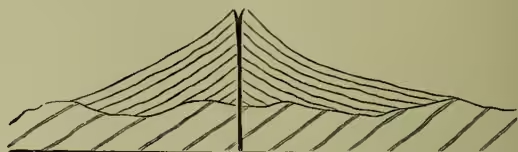
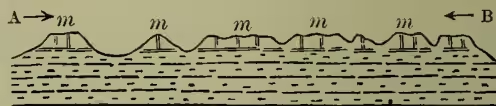



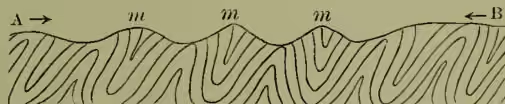
Mountains. Every one knows what a mountain is, and yet it is hard to give an adequate definition of the term. We may say vaguely that any region the surface of which rises with a more or less steep gradient to a height of 1000 feet or more is a mountain. Mountains differ vastly in form—some assuming pyramidal or conical shapes, others forming ridges, others occurring as irregular amorphous masses. Some again stand in more or less isolated positions, whilst in other cases very many crowd together, forming a billowy mass of elevated ground; and yet others, amongst which are the most prominent mountains of the globe, extend continuously in definite directions as long ranges and chains for hundreds or thousands of miles. Notwithstanding this diversity of form and of grouping, all mountains may be classified as—(a) mountains of accumulation, (b) mountains of elevation, (c) mountains of circumdenudation. (a) Mountains of Accumulation.—Volcanoes may be taken as the type of this class of mountains (fig. 1). These are of course formed by the accumulation of igneous materials around the focus or foci of eruption. Most volcanoes are more or less conical in shape; but in the case of those which have been long extinct the form has often been greatly modified by the denuding action of the subaërial agents. Some very ancient ones have been so demolished that frequently all that remains of them are mere stumps, formed of the hard crystalline rocks that plug up the pipes or flues through which the igneous materials found a passage to the surface. In former times lava seems often to have welled up along the lines of extensive fissures and flooded surrounding regions. This happening again and again, vast plateaus have been built up. These are called plateaus of accumulation. Many of these, however, have since been highly denuded, so that they have now quite a mountainous appearance (fig. 2). As examples may be mentioned the denuded plateaus of Iceland, the Faroes, Antrim and Mull, Abyssinia, and the Deccan. Of course plateaus of accumulation are not always formed of igneous rocks. Any area of approximately horizontal aqueous strata, were it to be elevated to a height of a thousand feet or so, would form a plateau of the kind, such as the plateau of the Colorado. That plateau is geologically of recent origin, and yet sufficient time has elapsed to allow of profound erosion of its surface. Thus, mountains and plateaus of accumulation often owe many of their present features to the action of denuding agents. (b) Mountains of Elevation owe their origin to the folding, crumpling, and fracturing of strata that accompany certain great movements of the earth's crust. They are lines of weakness along which the rocks have yielded to excessive lateral compression by folding and doubling up, during the sinking down of the cool outer shell of the globe upon the more rapidly contracting hot nucleus. The simplest structure presented by such mountains is shown in the Uinta Mountains of Wyoming and Utah. This is a flattened arch of strata, having a breadth of 50 miles and a length of 150 miles, which bulges up to a height of 5000 or 6000 feet above the plains on either side. It shows a broad plateau-like surface which has been deeply eroded. Powell believes that a thickness of miles of strata has been denuded from its surface. In the Jura Mountains we have a series of parallel ridges, each ridge coinciding with a symmetrical anticlinal or saddle-backed arrangement of strata, while the intervening hollows occupy symmetrical synclinal troughs (fig. 3). The tops of the anticlines are all more or less denuded. In the western part of the same range of mountains the flexures of the strata are mostly unsymmetrical (fig. 4). In the Alps and mountain-ranges of similar character the flexures of the strata are frequently reversed—the beds being doubled back so that older strata are inverted and overturned upon younger beds. The accompanying section exhibits the principal features in what is known as the Alpine type of mountain structure (fig. 5). A glance at the diagram will show that the greater features of the surface coincide approximately with the larger flexures of the strata, but that these features have been greatly modified by denudation. In such mountain-regions the highly flexed and contorted strata are frequently dislocated; but for the sake of clearness such dislocations are not represented in the diagram. Occasionally we find that the prominent features in a mountain-region have been determined by profound dislocations of the rocks, as is well shown in the parallel ranges of the Great Basin, of western Arizona, and of northern Mexico. That region has been divided into a series of long narrow blocks by a system of parallel dislocations—the prominent mountain-ridges corresponding to the blocks on the high or upcast side of the fractures. Although the direction and general form of those mountains are thus the result of earth-movements, the evidence of subsequent erosion and denudation is everywhere conspicuous. (c) Mountains of Circumdenudation.—In countries composed of undulating and highly-folded strata which have been for long ages exposed to the action of eroding agents the ultimate form assumed by the ground is directly dependent on the character of the rocks and the mode of their arrangement (fig. 6). Plateaus in course of time come to be explanation. Mountains of elevation are in the course of time denuded and degraded, and should the land of which they form a part remain long enough above the sea, the whole surface must eventually be reduced to the condition of a low gently undulating plain. Should elevation now ensue, this plain becomes a plateau—the surface of which by-and-by is trenched and furrowed by running water, &c., as is the case with the ancient plateaus of Scotland and Scandinavia.

Age of Mountains.—As might have been expected, mountains are of all geological dates, and the age of a large number has been determined. But this has reference chiefly to those that owe their origin to accumulation (volcanic cones) or to compression and folding of strata during great earth-movements (mountains of elevation). Many of the latter are the result, not of one, but of several successive periods of uplift. It can often be shown that between those periods of movement the mountains have been subjected to long-continued erosion, and partially or even wholly submerged, while newer accumulations of sediment were gradually piled up over their denuded surfaces. The Pyrenees, the Alps, the Jura, the Himalayas, the Andes, and many other conspicuous ranges have been formed by successive upthrusts, separated by longer or shorter periods of degradation and sedimentation. Some mountains of elevation, which originated in very early geological times, appear to have been denuded down to their very roots—reduced to the condition of low-lying plains. Such plains have subsequently been pushed up bodily and converted into plateaus, which in the course of time have been profoundly modified by denudation, so as now to present the appearance of a rolling mountainous country—the mountains being mountains of circumdenudation (fig. 7). The greatest and loftiest mountains of elevation have all received their latest uplift in comparatively recent geological times. Amongst such young ranges we find that the larger orographic features coincide more or less closely with the greater convolutions, folds, and fractures of the strata. In ranges belonging to much older dates denudation has profoundly deeply trench in different directions and eventually lose their plateau character. The remaining portions of high ground then form groups of mountains and hills. In regions of horizontal or approximately horizontal strata the mountains assume the form of pyramids or flat-topped mesas and buttes, excellent examples of which are seen in the western territories of North America, and in the much-denuded basaltic plateaus of Iceland and the Faroe Islands (fig. 2). In regions of folded and contorted strata, composed of diverse kinds of rock, the orographic features are more variable. A highly-denuded plateau of folded strata seen from a height presents the appearance of a tumbled and billowy sea—the Scottish Highlands and the high grounds of Scandinavia being examples of mountains of circumdenudation which have been carved out of elevated plateaus of denudation (fig. 7). The origin of a plateau formed of such folded and contorted strata requires a word of modified the original configuration of the surface—the present orographic features being the result of denudation, determined by the character of the rocks and the geological structure of the ground. Hence in such regions anticlinal mountains, which are weak structures, are almost unknown, while synclinal troughs, which are strong structures, in place of coinciding with valleys (as in the Jura Mountains, fig. 3), have often come to form mountainous ridges (figs. 6, 7).
Mountain-systems.—Some attempts have been made to group the various mountain-ranges of the world into systems, more particularly by E. de Beaumont, who maintained the synchronism of ranges situated on lines parallel to one another. The parallelism does not consist in having the same relations to the points of the compass—for these as regards north and south would be far from parallel—but is estimated in its relation to some imaginary great circle, which being drawn round the globe would divide it into equal hemispheres. Such circles were called Great Circles of Reference. But De Beaumont went beyond this, and proposed a more refined classification, depending on a principle of geometrical symmetry, which he believed he had discovered among his great circles of reference. These geometrical speculations have never commended themselves much to geologists. It has been demonstrated indeed that certain mountain-chains in widely separated regions belong approximately to the same geological age, and may really be strictly synchronous. But much more has yet to be known of the geological structure of the various ranges of the earth before any general grouping of these into systems can be considered reliable. See ALPS, GREAT BRITAIN (Physical Geography), HIMALAYA.
The following table shows the heights of some of the principal peaks in the several continents:
| ASIA. | Feet. | NORTH AMERICA. | Feet. |
|---|---|---|---|
| Everest, Himalayas..... | 29,002 | Nevado de Tolúca..... | 19,454 |
| Dapsang, Karakorums..... | 28,700 | Orizaba..... | 18,205 |
| Tagarma, Pamir..... | 25,800 | Mount St Elias..... | 18,010 |
| Khan-tengri, Tian-shan..... | 24,000 | Mount Brown..... | 16,000 |
| AFRICA. | SOUTH AMERICA. | ||
| Kilima-Njaro..... | 19,680 | Aconcagua..... | 22,427 |
| Kenia..... | 19,000 | Mercedario..... | 22,302 |
| Ruwenzori..... | 18,000 | Gualtieri..... | 22,000 |
| Ligonyi..... | 14,000 | Huascan..... | 22,000 |
| AUSTRALIA AND POLYNESIA. | EUROPE. | ||
| Charles-Louis, N. Guinea 20,000 | Mont Blanc..... | 15,732 | |
| Mauna Kea, Hawaii..... | 13,805 | Ben Nevis..... | 4,406 |
| Mt. Cook, New Zealand..... | 12,349 | Snowdon..... | 3,571 |
| Kinabalu, Borneo..... | 11,562 | Carran-Tual..... | 3,414 |
| Mt. Townsend, N.S. Wales 7,350 | Scaw Fell Pike..... | 3,210 |