Mouse (Mus musculus), a familiar rodent, representative of a large genus to which rats also belong. It is not necessary to describe the soft 'mouse-coloured' fur occasionally varying to white; the scaly tail so useful in climbing; the bright, conspicuous eyes; and the well-hidden cosy nest. Not less familiar is the way in which this tiny mammal has followed man everywhere over the earth; breeding all the year round, and bringing forth four or five young at a birth, its extraordinary fecundity sometimes causes a plague in a district (as in the wheat-fields of South Australia in 1890). It may be well, however, in the face of continually recurrent discussion, to note the power that at least some of the common mice have of making musical sounds, 'not squeaking, but singing, musically and rhythmically, in a high key, with a thin and wiry, but not displeasing quality—something like a weak-voiced canary bird.' Mice are occasionally cannibals, and have been known to eat painters' putty with red lead in it. Larger than the above is the beautiful Wood-mouse (M. sylvaticus), an abundant pest in the fields and gardens of Europe, notable for the stores of grain and other food which it accumulates among the grass or just under the surface of the ground. Smaller than either, and smallest of British mammals, is the Harvest-mouse (M. minutus), which makes a neat globular nest of woven leaves among the grasses and reeds. The white-footed mouse (Hesperomys leucopus), which is exceedingly common in N. America, has small cheek-pouches, structures best developed in the related family of Cricetinae or hamsters. Corresponding to the European harvest-mice are the American species of Ochotodon, of which O. humilis measures only about 2 inches in length, not including the tail. Finally, the Water-mice (Hydromys) of Australia may be noted as remarkably divergent. The name is sometimes extended, as we have seen, to include the smaller species of other genera than Mus, rat being an equally wide title for the larger forms. But, while the wide application of the name is naturally justified, care must be taken to keep the shrews (Sorex) in their entirely distinct, though somewhat analogous, position among Insectivora. See RAT, SHREW, VOLE.
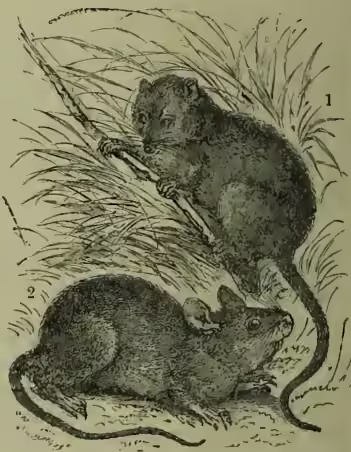
2, Long-tailed Field-mouse (Mus sylvaticus).