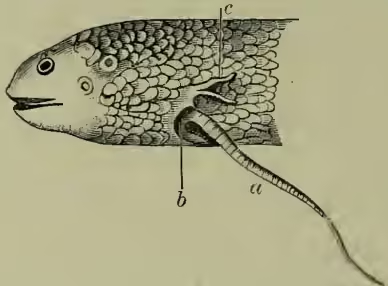
Showing fore-limb (a), entrance to gill-cavity (b), external gills (c).
Mud-fishes (Dipnoi), a small but very important order of fresh-water fishes, a connecting-link towards Amphibians. There are only two genera, widely separated in geographical distribution—Ceratodus from Queensland and Protopterus from tropical Africa. Of an alleged third genus, 'Lepidosiren' from Brazil, we know extremely little, not enough to warrant its separation from Protopterus. The wide range of distribution, and the discovery in Mesozoic rocks of fossil teeth resembling those of Ceratodus, confirm the impression of ancient origin which is suggested by not a few facts of Dipnoan anatomy, such as the persistent notochord without distinct vertebrae, the intestinal spiral valve, the cloaca, the abdominal pores, &c. (see FISHES). On the other hand the mud-fishes are in other respects almost amphibians, for the swim-bladder functions as a single (Ceratodus) or double (Protopterus) 'lung,' along with which gills also persist. The Dipnoi are thus important connecting-links. The limbs are peculiar in the possession of a central axis, which in Ceratodus bears rays on each side. The body is covered with flat scales, is from four to six feet in length, and bears a symmetrical tail. Ceratodus seems to feed on decaying leaves and the like, Protopterus on fish, frogs, insects, &c., while 'Lepidosiren,' though described by the natives as feeding on roots, is said to have teeth suited to carnivorous diet. The nostrils open posteriorly into the mouth, a condition occurring in no other fish, unless Myxine be reckoned as such. Air is taken into the lungs at the surface of the water, and this mode of respiration becomes more emphatic when the fishes venture to wriggle ashore, as Ceratodus is said to do, or get into thick muddy water, or when the dry season begins to desiccate the pools. It is then in fact that Protopterus most deserves its popular name, descending into the mud, rounding off a nest for itself, and becoming more or less dormant. 'The mud around one of these nests becomes very hard, and the balls thus formed have been dug out, and, without breaking, have been brought to Europe or North America. A short immersion in water serves to release the fish, which will live for some time in confinement.' Both Ceratodus and Protopterus are esteemed as food. The development of all the forms is still quite unknown. The term 'mud-fish' is also applied to a Ganoid (Amia calva) not uncommon in some of the fresh waters of the United States. It attains a length of two feet, is carnivorous in diet, and gulps air at the surface of water, the air-bladder having truly pulmonary functions.
See CERATODUS, FISHES, LEPIDOSIREN; also Günther's Study of Fishes (Edin. 1880); Howard Ayers, Jenaische Zeitschr. f. Naturwiss. xviii. 1885, with literature.