Mulberry (Morus), a genus of trees of the natural order Moraceæ, natives of temperate and warm climates, with deciduous leaves, unisexual flowers in short, thick spikes, a 4-parted perianth, containing either four stamens or one pistil with two styles, the perianth of the female flowers becoming succulent and closing over the small pericarp, the whole spike coalescing into an aggregate fruit.—The Common Mulberry, or Black Mulberry (M. nigra), is a native of the middle parts of Asia, but was introduced into the south of Europe more than a thousand years ago, and is now almost naturalised there. It is a low tree, much branched, with thick rough bark, and broad heart-shaped leaves, which are unequally serrated, and very rough. It is cultivated in the middle parts of Europe, and succeeds well in the south of
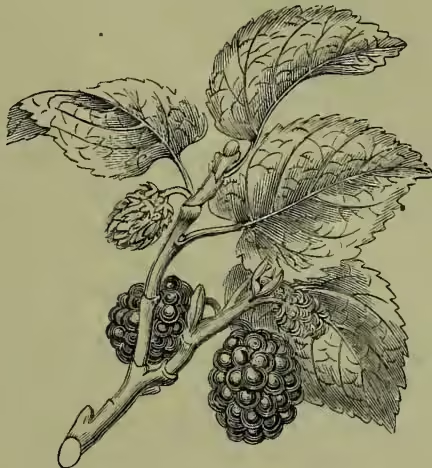
England, but in the northern parts of Britain it requires a wall. The perianth and stigmas are roughly ciliated, and the fruit is of a purplish-black colour, with dark red juice, fine aromatic flavour, and subacid sweet taste. The fruit is much esteemed for dessert; an excellent preserve and a pleasant light wine are made of it. The tree often produces its fruit in prodigious quantity. The wood is employed in cabinet-work, but is not of much value. The leaves are sometimes used for feeding silkworms. The Black Mulberry lives long; trees still existing in England are known to be more than 300 years old. It is propagated by seed, by suckers, by layers, or by cuttings. It succeeds best in a rich light soil.—The White Mulberry (M. alba) is a native of China, and has been there planted from time immemorial for the sake of its leaves, which are the best food for silkworms; on this account also it has been cultivated in the south of Europe since about 1540. In North America it does not succeed farther north than 43° lat., being somewhat more impatient of frost than the Black Mulberry. The perianth and stigmas are smooth; the fruit is almost white, and is much less palatable than that of the Black Mulberry, although in this respect there is great difference among the many varieties. A rob made of it is useful in sore throat. The best variety for feeding silkworms, on account of its rapid growth and abundant leaves, is that called the Philippine Mulberry. In India the White Mulberry is treated as a bush, and cut down twice a year; the shoots, stripped of their leaves, being thrown away, although the bark has long been used in China and Japan for making paper. It grows readily from cuttings. The root has a considerable reputation as a vermifuge.—The Red Mulberry (M. rubra), a native of North America, abounding particularly on the lower parts of the Missouri, endures severe frosts much better than either of the preceding, and is therefore preferred for cultivation in some parts of Europe. Its fruit is deep red, and almost as pleasant as the Black Mulberry. It forms a tree 60 to 70 feet high, with a circumference of about six feet; the wood is fine grained, strong, and adapted even for shipbuilding, but cannot be procured in any quantity for that purpose.—The Indian Mulberry (M. Indica) has black fruit of a delicate flavour, and the leaves are extensively used for feeding silkworms in China, Cochinchina, and Bengal.—M. atro-purpurea has been introduced into India from China for feeding silkworms. M. Mauritiana, a native of Madagascar and Mauritius; M. celtidifolia and M. corylifolia, Peruvian species; M. Tatarica, a native of central Asia; M. lavigata, the species most common in the north of India; and M. Cashmeriana, a native of Cashmere, produce pleasant fruit. M. dulcis, a native of the north of India, is said to be superior in flavour to all others.
The Paper Mulberry (Broussonetia papyrifera) differs from the true mulberries in having the female flowers collected in a globular mass. The tree is of moderate size, or, in cultivation, a bush of 6 to 12 feet high, with leaves either simple or lobed, a native of India, Japan, and the islands of the Pacific Ocean, but now not uncommon in pleasure-grounds in Europe and North America. The islanders of the Pacific cultivate the Paper Mulberry with great care. They make a kind of clothing from the bark, using for this purpose the bark of small branches about an inch in diameter, which they macerate in water, and then, scraping off the epidermis, they press and beat the moist slips together. The paper also which is used in Japan and many parts of the East is in great part made from the bark of the young shoots of this plant, which for this purpose is boiled to a pulp, and treated somewhat in the same way as the pulp of rags in Europe. When the shoots are cut, new ones spring up very rapidly. Silkworms eat the leaves of the Paper Mulberry. The fruit is oblong, of a dark-scarlet colour, sweetish, but insipid.