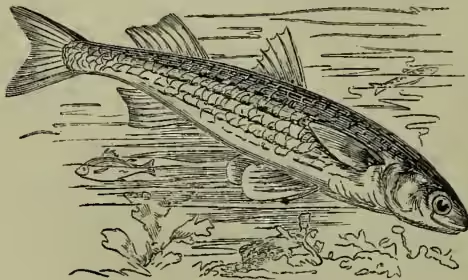
Mullet (Mugil), a genus of acanthopterous bony fishes, type of the family Mugilidae. The members are common coast fishes, often frequenting brackish water. They eat mud, which they crush and sift within a filtering pharynx, rejecting the useless stuff, swallowing the rest for the sake of the organic debris it contains. The mouth has at most feeble teeth; the gill-rakers form an effective sieve; the stomach is rather like a bird's gizzard; the intestines are exceedingly long. There are about seventy species, some of which attain a weight of 10 or 12 pounds. As they are edible and sometimes highly esteemed, the mullets ought to be more cultivated. Among British species M. octo-radiatus, M. capito, M. auratus may be noted. A species from the fresh waters of Central America (M. proboscideus) has a pointed fleshy snout. The Mediterranean mullet formed a favourite Roman dish, and their roes preserved are made into a delicacy.
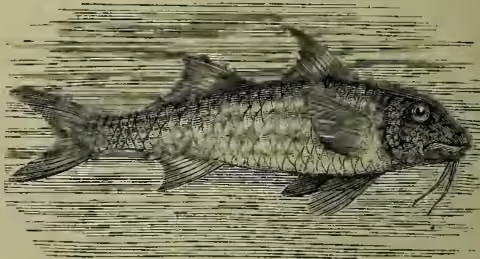
The so-called 'red mullets' (Mullus) are quite different from the above, and not far removed from perches. The body is slightly compressed, and covered with large, thin scales. There are two long, erectile barbels and feeble teeth. About forty species, mostly from tropical seas, are divided among a number of sub-genera. There is only one European species (M. barbatus), of which the so-called 'surmullet' is probably the female form. It occurs on the southern coasts of Britain, and is much esteemed as a delicacy. The male seems to be smaller than the female, which in British waters rarely exceeds two pounds in weight. The colour of the surmullet is pale pink, with three or four yellow longitudinal stripes; but where any of the scales have been rubbed off beautiful tints of purple and bright red appear. This takes place also during the struggles of the fish when dying, and the Romans were therefore accustomed to bring surmullets alive into their banqueting-rooms that the guests might see them die, and enjoy the brilliant display of colour before eating the fish. 'The fishermen of our times,' Günther says, 'attain the same object by scaling the fish immediately after its capture, thus causing a permanent contraction of the chromatophores (colour-cells) containing the red pigment.' See Günther's Study of Fishes (Edin. 1880).