Muscle, the fleshy parts of an animal. Muscular tissue is specially distinguished by its power of contracting in one direction, and is the instrument by which all the sensible movements of the animal body are performed. When examined under a high magnifying power the fibres of which it is composed are found to exist under two forms, which can be distinguished from one another by the presence or absence of very close and minute transverse bars or stripes. The fibres of the voluntary muscles—those whose movements can be influenced by nerve impulses originated by the will—as well as the fibres of the heart, are striped; while those of the involuntary muscles, such as the muscular fibres of the intestinal canal, of Blood-vessels (q. v.), and in skin, are unstriped.
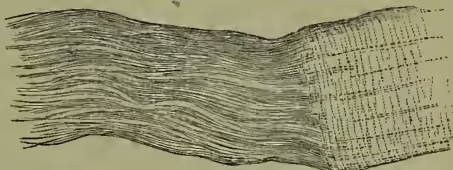
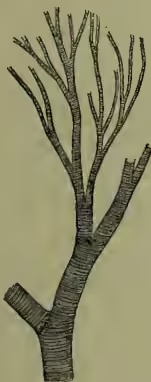
On examining an ordinary voluntary muscle with the naked eye, we observe that it presents a fibrous appearance, and that the fibres are arranged with great regularity in the direction in which the muscle is to act or contract. On closer examination it is found that these fibres are arranged in fasciculi, or bundles of various sizes, enclosed in sheaths of areolar tissue, by which they are at the same time connected with and isolated from those adjoining them; and when the smallest fasciculus visible to the naked eye is examined with the microscope it is seen to consist of a number of cylindrical fibres lying in a parallel direction, and closely bound together. These fibres may end in blunt extremities or be forked as in the lips, or branched as in the tongue. Each fibre consists of an elastic homogeneous sheath—the sarcolemma (Gr. sarx, 'flesh,' and lemma, 'a skin or husk'), which contains a contractile semi-fluid material. This substance shows transverse striæ at regular intervals, as well as longitudinal striæ. Dilute mineral acids cause the fibre to cleave crosswise into discs. When
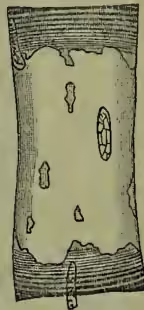
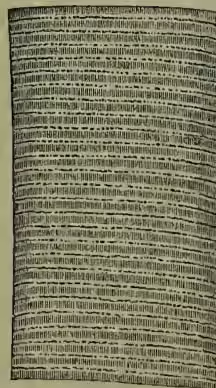
highly magnified the transverse striæ resolve them- selves into (1) a thin dim disc whose edges appear to adhere to the sarcolemma, (2) a clear space, (3) a broad dim disc, (4) a clear space like 2, (5) another disc like 1, &c.
Nerve fibres pierce the sarcolemma, and end upon the contractile substance (see NERVOUS SYSTEM). No blood-vessels penetrate the sarcolemma; they merely lie in the intervals between the fibres. Through the medium of tendon or aponeurosis the muscular fibres are attached to the parts which they are intended to move. Aggregated in parallel series, of greater or lesser size, and associated with nerves, vessels, tendinous structures, &c., they form the various muscles, which are for the most part solid and elongated, but are sometimes expanded (as in the diaphragm) into a membranous shape. In the human subject voluntary muscles are red, and although pale fibres are scattered through many of them, still nothing is ever seen to correspond with what may be found in the muscles of the rabbit. The colour is due to a substance closely akin to the blood-pigment. Each muscle has a middle portion or belly and two extremities which are attached. When the belly contracts it acts in a straight line, and drags equally on both extremities; but, as one is more fixed than the other, the force is spent in bringing the movable attachment nearer to the fixed one, and thus the fixed end is named the origin, the movable end the insertion. Muscles are usually grouped around joints, and attached to bone.
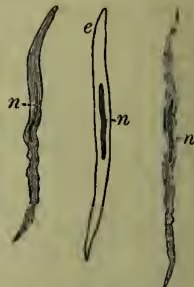
The involuntary or unstriped muscular tissue most commonly occurs in the shape of flattened bands of considerable length, but of a width not exceeding th or th of an inch. Their substance presents fine longitudinal markings, and each cell possesses an elongated nucleus, towards each end of which a few fine granules are found. Kölliker has shown that every one of these bands or fibres is either a single elongated cell (a fibre-cell) or is a fasciculus of such cells (see CELL). These fibres have not usually fixed points of attachment like the striated fibres, but form continuous investments around cavities within the body, such as the intestinal canal, the blood-vessels; or are dispersed through the substance of tissues, such as the skin, to which they impart a contractile property.
Cardiac muscle, although involuntary, differs in a remarkable manner from the fibres just described. It consists of quadrangular cells, which are often branched at their ends. Each cell has a clear oval nucleus near its centre, and the cells present transverse striæ not so distinct and less regular than those of voluntary muscle. Hitherto these cardiac fibres have not been shown to possess a sarcolemma.
The chemical composition of ordinary or voluntary muscle is described at FLESH. The fibrille, or the sarco elements of which they are composed, consist of a substance termed Syntonin (q.v.), which closely resembles the fibrine or coagulating constituent of the blood; and the same syntonin is also the main constituent of the unstriped muscles, or at all events of their fibre-cells. Like the blood-fibrine, it exists in a fluid form in the living tissue, and only coagulates or solidifies after death.

Muscles vary extremely in their form. In the limbs they are usually of considerable length, surrounding the bones and forming an important protection to the joints; while in the trunk they are flattened and broad, and contribute very essentially to form the walls of the cavities which they enclose. Muscles derive their names variously (1) from their situation—as the temporal, pectorals, gluteals; or (2) from their direction—as the rectus, obliquus, &c., of which there may be several pairs—as, for example, rectus femoris, rectus capitis; or (3) from their uses—as the masseter, the various flexors, extensors; or (4) from their shape—as the deltoid, trapezius, rhomboid; or (5) from the number of their divisions—as the biceps and triceps; or (6) from their points of attachment—as the sterno-cleido-mastoid, the sterno-thyroid.
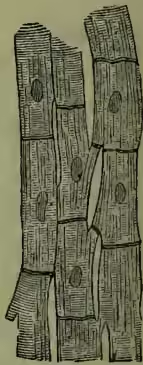
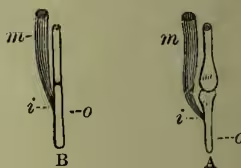
The skeleton, which may be termed the locomotive framework, may be regarded as a series of levers, of which the fulcrum is, for the most part, in a joint—viz. at one extremity of a bone—the resistance (or weight) at the further end, and the force (or muscle) in the intermediate portion. In most cases, in order to preserve the necessary form of the body, muscles are applied at a great mechanical disadvantage as regards the exercise of their power; that is to say, a much larger force is employed than would suffice, if differently applied, to overcome the resistance. The two main sources of this disadvantage Fig. 7.—Muscular Fibres from the Heart. lie in the obliquity of the insertion, and consequently of the action of most muscles, and in the muscles being usually inserted very near the fulcrum. The first of these disadvantages is in many cases diminished by the enlargements of the bones at the joints. See fig. 8, A. The tendons (i) of the muscles (m) situated above the joint are usually inserted immediately below the bony enlargement, and thus reach the bone that is to be moved (o) in a direction somewhat approaching the perpendicular. If this enlargement did not exist (as in fig. 8, B), the contraction of the muscle, instead of causing the lower bone to turn upon the upper one with comparatively little loss of power, would do little more than cause the two ends of the bones to press upon each other. The second mechanical disadvantage is compensated for by gain in the extent and velocity of movement, and by the avoidance of the great inconvenience of having the muscles extended in straight lines between the ends of jointed continuous levers. Thus, the bones of the forearm (fig. 9, b, c) are bent upon the bone of the arm (a) by the biceps muscle (d), which arises close to the head of the latter, and is inserted at e, at a short distance from the elbow-joint, which acts as the fulcrum of the lever (c). By this arrangement a contraction of a single inch in the muscle moves the hand (f), in the same time, through the extent of about 12 inches, but then the hand moves through every inch with only about the twelfth part of the power exerted by the muscle. By the junction of two or more levers in one direction, as in the different segments of the extremities, the extent and velocity of their united actions are communicated to the extreme one.
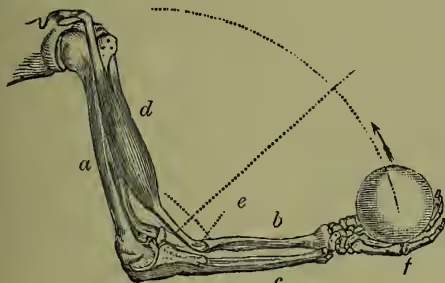
Thus, a blow of the fist may be made to include the force of all the muscles engaged in extending the shoulder, elbow, and wrist.
The great and characteristic property of muscular tissue—that of shortening itself in a particular direction when stimulated—is called contractility. The stimulus may be direct irritation by mechanical means, or by galvanism, or by some chemical substance, but in the living body the muscular fibres are, in most cases, made to contract by the immediate influence of the nerves distributed among them, which are consequently termed motor nerves (see NERVOUS SYSTEM), and are under the influence of the will. By an exertion of volition, we can contract more or fewer muscles at once, and to any degree, within certain limits; and, as a matter of fact, there is hardly any ordinary movement performed in which several muscles are not called into play. But every voluntary muscle is also subject to other influences more powerful in their operation than the will. The movement of the features under the impulses of passion and emotion are more or less involuntary, as is shown by the very partial power the will has of restraining them, and the extreme difficulty of imitating them. Many movements ensue involuntarily when certain impressions, which need not necessarily be attended with consciousness, are made on the surface of the body, or on any part of its interior, either by external or internal causes. Such movements are termed reflex, and are noticed in the article NERVOUS SYSTEM. For various important groups of muscles, see ARM, EYE, FOOT, HAND, KNEE, LEG, &c.; and for the source of muscular force, see DIET, DIGESTION.