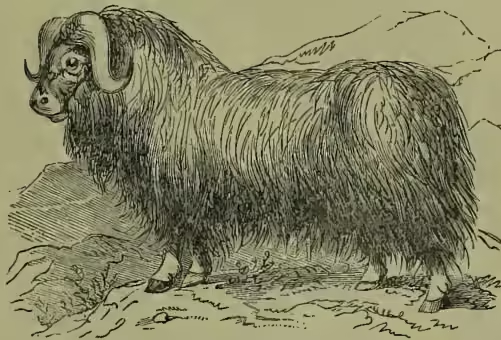
Musk-ox (Ovibos moschatus) is a member of the family Bovidae. It inhabits at present the most northern parts of the American continent north of lat. 60°. Its remains, which have been found in Quaternary deposits of England, Europe, and Siberia, indicate that it had formerly a much wider range. The hair is long, serving of course to protect the animal from the rigour of the climate which prevails in its habitat, and of a brownish colour. The creature measures above 5½ feet from the tip of the nose to the root of the tail, and so approaches in size the smallest Highland cattle. It is gregarious, there being only one or two males to a herd of eighty or a hundred. They brouse on grass, reindeer moss, willow shoots, the Labrador tea-plant, and crowberry bushes. The flesh of the calves and cows, when in condition, is very palatable. Unlike many purely Arctic animals—e.g. the Arctic fox—the hair does not become white at the approach of winter. But it has been suggested that this protective change in coloration is not necessary, since it is an animal which lives in herds; hence it is better for an individual, which has got accidentally separated from its fellows, to regain a position of safety by being able to readily detect the whereabouts of the herd than to trust to escape from carnivorous foes by a resemblance in colour to the surrounding snow.