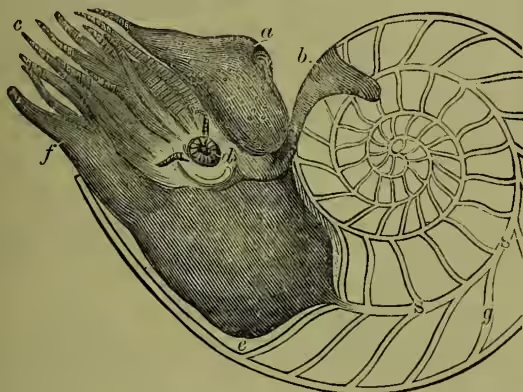
Nautilus, a remarkable mollusc in the class of Cephalopods, the only surviving member of a race once abundant. It differs conspicuously from the other extant Cephalopods or 'cuttle-fish' in possessing a shell, within the outermost chamber of which it lives, while the lobes of the 'foot' round about the mouth bear numerous tentacles retractile into sheaths, the 'siphon' consists of two free folds, the eyes are open sacs without cornea or lens, there are four gills and four kidneys, and there is no ink-bag. The spiral shell, coiled in one plane like that of the water-snail Planorbis, differs from this in being chambered; moreover, the foot or ventral side of the enclosed animal is towards the outside in Nautilus, towards the inside in Planorbis. When young the Nautilus lives in a small shell bent like a horn; with growth this is increased spirally, but as the animal periodically draws itself onwards and closes a door behind it, a chambered spiral results, in which the original shell is in the very centre. The successive chambers are all connected, however, by an organic, partially calcareous tube; and all except the outermost, in which the animal lives, are filled with gas—apparently a mixture of oxygen and nitrogen somewhat different from air. The outside of the shell is covered with a thin organic layer, beneath which there is a porcelain-like stratum with bands of colour, while internally the lime has the usual mother-of-pearl structure, the lustre of which, often artificially exposed by the use of acids, has earned for the animal its common name of Pearly Nautilus.
Though the Nautilus seems to have been known to Aristotle, and though the shells have always been familiar, our knowledge of the animal itself is almost wholly due to the investigations of Owen, and to some interesting observations (1705) by the Dutch naturalist Rumphius. The rarity of specimens, so evident from the fact that only one was collected on the Challenger expedition, is mainly due to its habitat in somewhat deep water. But it must also be noted that the natives of Fiji, the New Hebrides, the Moluccan Islands, &c. catch the animal in lobster-pots and eat it with relish. The Nautilus probably creeps or gently swims along the sea-bottom, feeding on crustaceans and the like; but it is also seen floating on the surface, probably washed up by storms and injured by the waves. The species best known is Nautilus pompilius, but there are probably four or five others, while the fossil relatives are reckoned in hundreds.
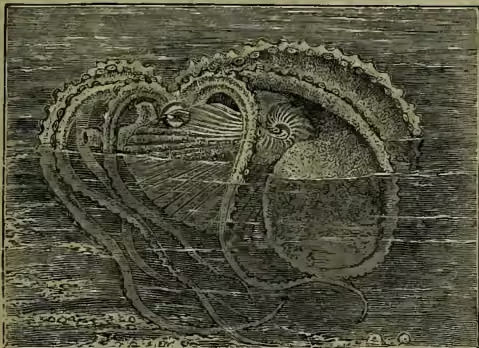
The Paper Nautilus (Argonauta) is a very different animal, like an octopus except that the female bears a beautiful, translucent, ribbed shell in which the eggs are sheltered. But this shell is not in any way comparable to that of the Nautilus or of other molluscs; it is a cradle, not a house; it is secreted and embraced by two broadened dorsal 'arms,' not by the mantle; it is unchambered and peculiar to the females. The Argonaut was credited by Aristotle with the power of lifting its broad arms, and of thus sailing before the wind, but there is no truth in this fancy often reiterated by poets and naturalists. For the Argonaut squirts water from its funnel and swims backwards like any other cuttle-fish, or else creeps along the bottom. At the breeding season it is a pelagic surface swimmer in tropical seas, at other times it seeks the depths. The male measures little more than an inch in length, only about a tenth of the size of his mate, and he is also notable for the modification of one of the arms into a detachable sac of spermatozoa, formerly mistaken for a parasitic worm. Some half-dozen living species are recorded. See CEPHALOPODA, CUTTLE-FISH.