Navy. The ancient method of naval warfare consisted in great part in the driving of beaked vessels against each other; and therefore skill and celerity in manoeuvring, so as to strike the enemy at the greatest disadvantage, were of the utmost importance. The victory thus usually remained with the best sailor. These vessels were propelled by oars, which were arranged in one, two, or three banks, according to size of ship; the oars were manned by men sitting or standing on platforms arranged above each other according to the number of banks; those with three banks of oars were called triremes. The earliest powers having efficient fleets appear to have been the Phoenicians, Carthaginians, Persians, and Greeks; the Greeks had fleets as early as the beginning of the 7th century B.C.—the first sea-fight on record being that between the Corinthians and their colonists of Coreyra, 664 B.C. The earliest great battle in which tactics appear to have distinctly been opposed to superior force, and with success, was that of Salamis (480 B.C.), where Themistocles, taking advantage of the narrowness, forced the Persian fleet of Xerxes to combat in such a manner that their line of battle but little exceeded in length the line of the much inferior Athenian fleet. The largest triremes in the Persian fleet were manned by 200 rowers and 30 fighting men; there were 1200 triremes and 3000 smaller vessels, while the Greek fleet consisted of 366 triremes only, with a certain proportion of smaller vessels, yet they succeeded in inflicting a crushing defeat on the Persians. The Peloponnesian war, where 'Greek met Greek,' tended much to develop the art of naval warfare. But the destruction of the Athenian maritime power in the Syracusan expedition of 414 B.C. left Carthage mistress of the Mediterranean. The Roman power, however, gradually asserted itself, and after two centuries became omnipotent by the destruction of Carthage. For several following centuries the only sea-fights were occasioned by the civil wars of the Romans—the greatest that of Actium (q.v.) in 31 B.C. Towards the close of the empire the system of fighting with pointed prows had been discontinued in favour of that which had always co-existed—viz. the running alongside and boarding by armed men, with whom each vessel was crowded. Onagers, ballistæ, &c. were ultimately carried in the ships and used as artillery; but they were little relied on, and it was usual, after a discharge of arrows and javelins, to come to close quarters. A sea-fight was therefore a hand-to-hand struggle on a floating base, in which the vanquished were almost certainly drowned or slain.
The northern invaders of the empire, and subsequently the Moors, seem to have introduced swift-sailing Galleys (q.v.), warring both in small squadrons and singly, and ravaging all civilised coasts for plunder and slaves. This—the break-up of the empire—was the era of piracy, when every nation which had more to win than lose by freebooting sent out its cruisers. Foremost for daring and seamanship were the Norsemen, who penetrated in every direction from the Bosphorus to Newfoundland. Combination being the only security against these marauders, the mediæval navies gradually sprang up; the most conspicuous being, in the Mediterranean, those of Venice, Genoa, Pisa, Aragon, the Knights of Malta, and the Turks; and on the Atlantic seaboard, England and France.
Mediæval Navies.—In the Mediterranean, towards the middle of the 16th century, so powerful and so threatening had the Turkish fleet become that, after the Knights Hospitallers had been driven out of Rhodes by the Sultan Solyman I. in the year 1523, a combination of the Christian powers was formed for self-defence; but it was not until the year 1571 that the celebrated battle of Lepanto was fought, which broke temporarily the naval power of the Turks. The Christian fleet was composed of Venetian, Genoese, Spanish, and papal ships, under the command of Don John of Austria, with six Maltese galleys, and mustered over 200 vessels, of which six were Venetian galeasses, which were larger and carried a heavier weight of metal than had yet been known in Mediterranean warfare. The ordinary galleys were about 160 feet long, 32 feet wide, and were propelled by some sixty oars; they generally carried a 24-pounder forward and two 8-pounders on the poop. In the galeasses the rowers were covered by a narrow deck on which small guns were mounted. The Turkish fleet consisted of 240 galleys, but they were completely defeated, losing over 224 of their ships, of which 94 were sunk or run aground, and the remainder were captured; 30,000 Turks were slain, and 15,000 Christians serving as galley-slaves in the Ottoman fleet were rescued from captivity. The confederates lost 15 galleys and 8000 men. The Venetian and Maltese fleets subsequently became the great naval powers, although sharing the sovereignty of the Mediterranean with the Turks; but during the close of the 16th and 17th centuries the naval power gradually fell into the hands of the English, French, Dutch, and Spaniards.
Modern Navies.—Dating the modern navies of the world from the 16th century, we find the British navy rising from insignificance by the destruction of the Spanish Armada in 1588, a blow from which Spain only partially recovered, and the weight of which the Dutch, whose naval force had acquired tremendous strength in their struggle for independence, increased by their triumph in 1607, in the Bay of Gibraltar. At this time there was no decisive superiority of the fleet of England over that of France; but each was inferior to the Dutch navy. The Commonwealth and reign of Charles II. were signalised by the struggle for mastery between the English and Dutch, when victory, after many alternations, finally sided with the former. Through the 18th century the English and French were the principal fleets; but Louis XVI. gave a decided superiority to the navy of France, and at the period of the American war the naval power of England was seriously threatened. Spain, Holland, and Russia (now for the first time a naval power) had meanwhile acquired considerable fleets; and the 'armed neutrality' to which the northern powers gave their adherence rendered the British position most critical. However, the slowly roused energy of her government, the invincible courage of her seamen, and the genius of her admirals brought Britain through all her trials. Camperdown broke the Dutch power; many battles weakened the French navy; and at Trafalgar in 1805 it, with the Spanish power, was swept temporarily from the ocean.
The resources of France, however, were so great that in a few years after the signing of peace in 1815 her fleet had again been brought up to its old strength, and it still continues to occupy the second place among the navies of the world. To Napoleon III. belongs the credit of first protecting ships with iron, and La Gloire, launched at Toulon in 1859, was the first armoured battleship to be put afloat. Much more uniformity in armament and design is found in the French armoured fleet of the present day than exists in the English. The armour-belt round the water-line of many of their ships is of greater thickness than in corresponding English ships. All the armour is well distributed, the guns are carried high out of the water, and the ships themselves steam well. Many distinguished English naval officers are of opinion that, ship for ship, many of the latest French ships are more than a match for ships of a similar tonnage in the British navy. During the Franco-German war of 1870-71 the French fleet had no opportunities of proving its effectiveness.
Of navies which have sprung recently into exist- ence two deserve special notice, the German and the Italian. The first named may be said to date its birth from the acquisition of Kiel by Prussia after the war with Denmark in 1864; and, although too weak to make any head in the war with France in 1870 against the French fleet, yet since that date so rapidly has the young fleet grown that the German navy will most certainly play an important part in any future European complications. The ships are good, and the officers and men are probably among the most highly trained of any navy in the world.
The Italian navy dates from the absorption of the kingdom of Naples by Sardinia in 1860. Since the disastrous battle of Lissa (1866), each successive Italian government has devoted large sums and much energy towards building up a powerful navy, and Italy may fairly claim now to rank as a first-class naval power, occupying a position next to France (see ITALY). Among the Italian ironclads may be numbered ten of the largest and most powerful battle-ships afloat—viz. the Dandolo and Duilio and the Italia and her seven sisters. All these ships carry four 110-ton guns in their turrets or barbettes, besides a powerful auxiliary armament, while the engines of the five latest of these ships are far more powerful than those of even the most newly-designed English battle-ships, and are calculated to drive them at a speed of 18 knots an hour.
The Austrians, the victors at Lissa, have since 1840 possessed a small, but probably for its size one of the most efficient of the European navies, officers and men being most carefully and thoroughly trained.
The Turkish navy, once the terror of the whole Mediterranean, has now sunk to a low ebb. In 1827 it sustained at the battle of Navarino a crushing defeat, from which it never recovered. At the outbreak of the war with Russia in 1853 a division of the Turkish fleet was completely destroyed by a superior Russian force at Sinope; but as a result of the restrictions imposed on Russia after the Crimean war, and of the energy infused once more into Turkish naval administration by Admiral Hobart Pasha, when war broke out again between Russia and Turkey in 1877 the Russian fleet was effectually paralysed by the superior Turkish forces, which retained command of the Black Sea during the war. Since then, however, no new ships have been built, and in the present state of the finances of the country it is unlikely that the Turkish navy will play any important rôle again in the future.
The Russian navy was founded by Peter the Great, but, although it soon became a formidable one, it has never as yet distinguished itself or become an important factor in the numerous wars in which Russia has been engaged. After the battle of Sinope in 1853 the bulk of the Black Sea fleet was sunk by order of Prince Menschikoff, governor of Sebastopol, to block the entrance to the harbour, and the remaining ships were burned when the Russians retreated in September 1855. By the abrogation of the Black Sea portion of the treaty of Vienna in 1871 Russia regained a free hand once more in the Black Sea, and she has for some years been making strenuous efforts to resume her place as a naval power. Several formidable ironclads have been built, while others are in course of construction, as well as several cruisers of the most modern type, and she in her turn is once more mistress of the Black Sea.
Simultaneously with the war which followed the declaration of independence the Americans began to build ships, and during that war and the war of 1812 and 1814 their fleet maintained a glorious although unequal struggle with Great
Britain. The war of Secession, which broke out in 1860, however, found the United States navy at a low ebb, and although a large number of vessels were built during the ensuing four years, they were mostly gunboats for blockading purposes and monitors for coast and river work. Armour-plated ships played, however, an important rôle during the naval operations, and the construction of the original Monitor at that time by Captain Ericsson, and the good work she performed, in reality settled the type of the armoured battle-ships of the future. Since the war came to an end in 1866 their navy, however, has been much neglected, but since 1887 great efforts have been made to construct a new fleet of the most modern type, both as regards armoured ships and cruisers. In 1899 the force consisted of 236 vessels built, building, and projected, of which 149 were fit for active service. The personnel consisted of 1340 officers, 4547 warrant and petty officers, and 12,352 men and boys.
The accompanying table will give a fair estimate of the comparative strength of the different navies of the world.
The ships are arranged in columns according to their fighting value. All ships in the 1st and 2d classes are modern ships, and many of them quite new. A large proportion of the ships in the 3d class are obsolete, and can hardly be considered effective. All the English battle-ships are of iron, built with double bottoms and watertight compartments; but seventeen of the French are built of wood and armour-plated, and these must soon be withdrawn as non-effective. Coast-defence ships are classed among the battle-ships, according to their size. Belted and armoured cruisers are counted among the 1st class cruisers; of these in 1890 Great Britain possessed twelve against five French (on the stocks) and eight Russian. The new Australian squadron is included among British ships. The heavy guns range from the 9-inch 12-ton gun, throwing a projectile of 250 lb., to the 111-ton gun, with a projectile of 1800 lb. The light guns include the quick-firing 3-pounder guns, but not machine guns. All ships actually on the stocks are included in the above list, but not ships simply proposed to be built.
THE BRITISH NAVY.—Alfred the Great was the founder of the English navy, having perceived the necessity of a fleet to protect the coasts from the swarms of pirates in the northern seas. A slight advantage gained by some ships of his over the Danes in 876 induced him to build long ships and galleys, which, as his countrymen were not competent to manage them, he manned with such piratical foreigners as he could engage. After he had driven out the Danes he applied his talents to improve his ships, and built vessels higher, longer, and swifter than before, some rowing more than thirty pairs of oars. Under his successors the number of vessels increased, and both Edward the Elder and Athelstan fought many naval battles with the Danes. Edgar aspired to be lord of all the northern seas, and had from three to five thousand galleys, which he divided into three fleets, on the western, southern, and eastern coasts respectively. Ethelred II. enacted that every owner of 310 hides of land should build and furnish one vessel for the service of his country. William the Conqueror established the Cinque Ports, and gave them certain privileges, on condition of their furnishing fifty-two ships for fifteen days, carrying twenty-four men each, in case of emergency. Richard I. took one hundred large ships and fifty galleys to Palestine. King John claimed for England the sovereignty of the seas, and required all foreigners to strike to the English flag, an honour which was exacted by the English
CHIEF NAVIES OF THE WORLD, 1890.
| Country. | Battle-ships, including those building. | Cruisers, including those building. | Torpedo-boats. | Guns. | Men. | Annual Cost. | Country. | |||||||||||||||
|---|---|---|---|---|---|---|---|---|---|---|---|---|---|---|---|---|---|---|---|---|---|---|
| 1st Class. | 2d Class. | 3d Class. | Belted Cruisers included in 1st Class. | 2d Class. | 3d Class. | |||||||||||||||||
| Great Britain.. | 30 | 23 | 11 | 23 | 62 | 47 | 32 | 18 | 2 | 36 | 63 | 13 | 70 | 25 | 455 | 109 | 95 | 430 | 3201 | 94,561 | £15,786,600 | Great Britain. |
| France ..... | 18 | 9 | 26 | 9 | 11 | 44 | 15 | 12 | 1 | 12 | 48 | 37 | 39 | 16 | 280 | 129 | 48 | 252 | 1483 | 70,560 | 11,000,000 | France. |
| Italy ..... | 11 | 7 | 4 | .. | 14 | 13 | 14 | 11 | .. | 10 | 23 | 5 | 15 | 8 | 136 | 110 | 21 | 75 | 531 | 23,000 | 5,100,000 | Italy. |
| Russia ..... | 9 | 5 | 22 | .. | 2 | 29 | 4 | 25 | .. | 7 | 20 | 7 | 66 | 16 | 221 | 50 | 87 | 124 | 586 | 31,000 | 4,354,539 | Russia. |
| Germany ..... | 14 | 6 | 14 | 5 | 10 | 15 | .. | 5 | 1 | 7 | .. | 2 | 17 | .. | 92 | 112 | 13 | 135 | 473 | 16,455 | 4,400,000 | Germany. |
| Austria-Hung. | 5 | 7 | 3 | 3 | 2 | 14 | 9 | .. | .. | 6 | .. | 4 | 19 | .. | 72 | 62 | 34 | 49 | 260 | 9,040 | 1,656,000 | Austria-Hung. |
| Turkey ..... | .. | .. | 11 | .. | .. | 7 | 4 | .. | .. | 11 | .. | 11 | 46 | .. | 101 | 21 | 2 | 54 | 328 | 23,000 | .. | Turkey. |
| Spain ..... | 1 | 6 | 6 | .. | 6 | 12 | 1 | .. | .. | 12 | 51 | 4 | 10 | .. | 120 | 14 | 2 | 48 | 257 | 16,700 | 1,930,000 | Spain. |
| Netherlands.. | .. | 2 | 22 | 1 | 8 | 1 | .. | .. | .. | 15 | .. | 17 | 19 | .. | 108 | 12 | 30 | 39 | 217 | 10,000 | 1,090,000 | Netherlands. |
| Swed.-Norway. | .. | 2 | 18 | .. | .. | 9 | 1 | 12 | .. | 24 | 29 | 3 | 17 | .. | 93 | 59 | 10 | 39 | 115 | 7,850 | 550,000 | Swed.-Norway. |
| Denmark..... | .. | 3 | 6 | .. | 1 | 2 | .. | .. | .. | .. | .. | 1 | 13 | .. | 40 | 14 | 22 | 22 | 130 | 1,400 | 298,000 | Denmark. |
| Greece..... | .. | 3 | 2 | .. | .. | 4 | .. | .. | .. | .. | .. | .. | .. | .. | 31 | 1 | 43 | 8 | 74 | 1,100 | 256,000 | Greece. |
| Portugal..... | .. | .. | 1 | .. | .. | 3 | .. | .. | .. | .. | .. | 3 | 11 | .. | 40 | 24 | .. | 2 | 96 | 3,530 | 360,000 | Portugal. |
| United States.. | 8 | 1 | 17 | 7 | 5 | 25 | 2 | 11 | .. | 3 | .. | .. | 15 | .. | 89 | 6 | .. | 26 | 258 | 11,400 | .. | United States. |
| Brazil ..... | .. | 2 | 8 | .. | 4 | 4 | .. | 9 | .. | .. | .. | .. | 6 | .. | 42 | 8 | .. | 23 | 106 | .. | .. | Brazil. |
| Argent. Confed. | .. | 1 | 3 | .. | 1 | .. | .. | 3 | .. | .. | .. | 2 | 10 | .. | 29 | 12 | .. | 12 | 23 | .. | .. | Argent. Confed. |
| Chili ..... | 1 | .. | 8 | .. | .. | 8 | .. | 2 | .. | .. | .. | 2 | 7 | .. | 26 | 11 | .. | 13 | 77 | .. | .. | Chili. |
| Japan ..... | .. | 1 | 6 | .. | .. | 11 | .. | 12 | .. | 2 | .. | 6 | 9 | .. | 53 | 24 | .. | 17 | 193 | .. | .. | Japan. |
| China..... | .. | 2 | 4 | .. | 4 | 12 | .. | 17 | .. | .. | .. | 13 | 5 | .. | 58 | 22 | .. | 25 | 108 | .. | .. | China. |
admiral from the fleet conveying Philip II. of Spain off Southampton-water, when the latter was on his way to espouse Queen Mary : this honour was formally yielded by the Dutch in 1673 and the French in 1704, but the custom since the peace of 1815 has fallen into disuse. In the year 1293 a great naval action was fought in mid-channel with the French, when the English captured 250 sail ; and Edward III. with the Black Prince at the battle of Sluys in 1340 defeated a greatly superior French fleet.
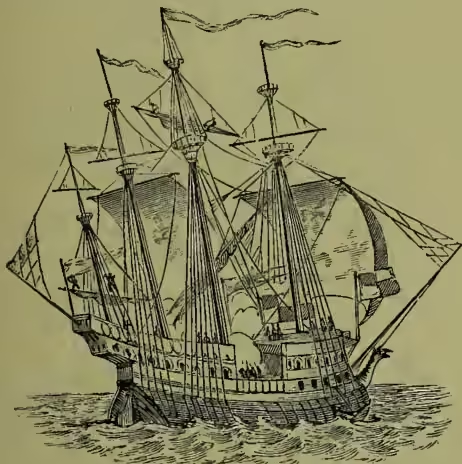
Henry V. had something of a navy ; but Henry VII. seems to have been the first king who thought of providing a naval force which might be at all times ready for the service of the state. He built the Great Harry, properly speaking the first ship of the royal navy. She cost £15,000, and was accidentally burned in 1553. To Henry VIII., however, belongs the honour of having laid the foundation of the British navy as a distinct service. He constituted the Admiralty and Navy Office, established the Trinity House, and the dockyards of Deptford, Woolwich, and Portsmouth, fixed regular salaries for the admirals, captains, and sailors, and made the sea-service a distinct profession. In 1512, when a fleet was fitted out against France under Sir Edward Howard, Lord High Admiral, the following allowances were made : For his own diet, maintenance, wages, and rewards per diem, 10s. ; each captain for his own diet, maintenance, wages, and rewards per diem, 1s. 6d. ; every soldier, mariner, and gunner for his wages per lunar month, 5s., and for his victuals, 5s. In 1515 King Henry caused the Henri Grace-à-Dieu, of about 1000 tons and carrying 122 guns, to be constructed, in emulation of a somewhat similar ship called the Caracon, but only carrying 100 guns, which had lately been built by Francis I. of France. She appears to have been built rather for magnificence than for use ; only thirteen of her guns were 9-pounders or upwards, and she is said to have steered badly and rolled heavily. After making one voyage she was disarmed at Bristol and suffered to decay. The French ship was still more unfortunate, being accidentally destroyed by fire at Havre. The ships of this period were high, unwieldy, and narrow, their guns close to the water, and they had lofty poops and forecastles. At the death of Henry VIII. the tonnage of the navy was 12,000 tons ; there were some fifty ships manned by 8000 men. Elizabeth increased the fleet greatly. The fleet which met the Spanish Armada numbered 176 ships armed by 14,996 men ; but these were not all 'shippes royal,' for she encouraged the merchants to build large ships which were as much fighting ships as traders, and rated at 50 to 100 tons more than they measured. She raised the wages of seamen to 10s. per month. Signals were first used in this reign as means of communication between ships. In the reign of James I. lived the first able and scientific naval architect, Phineas Pett ; he introduced a better system of building, and relieved the ships of much of their top-hamper, abolishing the lofty poops and forecastles. In 1610 he laid down the Prince-Royal, a two-decker carrying sixty-four guns ; and in 1637 from Woolwich he launched the celebrated Sovereign of the Seas, the first three-decker and the largest ship hitherto constructed on modern principles. She was 232 feet in length, of 1637 tons, and carried at first 130 pieces of cannon ; being found unwieldy, she was cut down, and proved an excellent ship, but was burned in 1696. In this reign the navy was first divided into rates and classes. Cromwell left 154 sail, measuring 57,643 tons, of which one-third were two-deckers. He was the first to lay before parliament annual estimates for the support of the navy, and obtained £400,000 for that purpose. During the Protectorate Peter Pett, son of Phineas, built the Constant Warwick, the earliest British frigate, from a French design and pattern. The Duke of York, afterwards James II., assisted by the celebrated Samuel Pepys, as Secretary, did much for the navy. He appointed a new commission when he came to the throne, with which he joined Sir Anthony Deane, the best naval architect of the time, who essentially improved the ships of the line by copying from French models ; at this time, and during the 18th century, naval architecture was zealously studied in France, and the English constructors were so sensible of their inferiority that even up to the beginning of the 19th century all our best ships were either captured from the French or copied from them. At the Revolution of 1689 the fleet was in excellent condition, with sea stores complete for eight months for each ship. The force consisted of 184 vessels, carrying 6930 guns, and 42,000 men, whereof nine were first-rates.
William III. added greatly to the navy, which numbered at his death 272 ships of 159,020 tons, the annual charge being £1,056,915. The dockyard at Hamoaze, out of which has since grown the considerable town of Devonport (q.v.), was also established during his reign (see also the article DOCKYARDS, ROYAL).
At the death of Queen Anne in 1714 the number of ships was less, but the tonnage relatively greater, there being 198 ships, carrying 10,600 guns, the tonnage being 156,640. In 1747 a naval uniform was first established. The navy increased rapidly during the reigns of the first two Georges, and at the accession of George III. consisted of 127 ships of the line and 198 of fifty guns and under, measuring 321,104 tons, and manned by 70,000 seamen and marines. The navy was kept in a high state of preparation, and, when in February 1793 the French Republic declared war against England, in a few weeks fifty-four sail of the line and 146 smaller vessels had put to sea completely equipped. The whole fleet in 1793 consisted of 122 ships of the line, 97 frigates, and 102 sloops and smaller vessels, manned by 85,000 seamen and marines. The navy of France had never been so powerful ; it amounted to above 200 vessels, of which 82 were of the line, and 71 were in addition ordered to be built. The English had about 115 sail of the line fit for service ; but the majority of the French ships were larger and finer and carried heavier guns on their lower or principal battery. The following abstract will show the losses on both sides up to the peace of Amiens (1802).
| Captured. | Destroyed. | |
|---|---|---|
| British ships of the line..... | 5 | 0 |
| Smaller vessels..... | 37 | 9 |
| Total..... | 42 | 9 |
| French ships of the line..... | 32 | 11 |
| Dutch " "..... | 18 | 0 |
| Spanish " "..... | 6 | 5 |
| Danish " "..... | 2 | 0 |
| Total..... | 58 | 16 |
| French smaller vessels..... | 266 | 44 |
| Dutch " "..... | 62 | 6 |
| Spanish " "..... | 57 | 10 |
| Grand Total..... | 443 | 76 |
This estimate does not include 807 privateers, chiefly French, taken and destroyed. Of the above, 50 sail of the line and 94 under that size were added to the British navy.
During the peace of Amiens preparations for war were actively continued on both sides, and when war broke out again in March 1803 the British fleet consisted of 153 ships of the line and 411 under that size, manned by 120,000 seamen and marines. 'In the year 1809,' to quote the words of Alison, 'the British fleet was at the zenith of its power, and Great Britain first appeared in the field on a scale adequate to her mighty strength. With a fleet of near 1100 vessels, including 240 of the line, manned by 140,000 men, she blockaded every hostile harbour in Europe, and still had 37 ships of the line to strike a blow at the Scheldt. With 100,000 regular troops she maintained her immense colonial empire; with 191,000 more she ruled India; with 400,000 militia she guarded the British Isles; while her fleet could convey yet another 100,000, with which she menaced, at once, Antwerp, Madrid, and Naples; while Lord Minto, the Governor-general of India, announced in his despatches with well-founded pride that "from Cape Comorin to Cape Horn a French flag could nowhere be found flying."'
The following abstract shows the losses on each side from 1803 to the end of the war, during which 33 sail of the line and 68 under were added to the British navy.
| Captured. | Destroyed. | |
|---|---|---|
| British ships of the line..... | 0 | 0 |
| " under..... | 83 | 7 |
| Total..... | 83 | 7 |
| Enemies' ships of the line..... | 55 | 14 |
| " under..... | 79 | 23 |
| Total..... | 134 | 37 |
Since the peace in 1815 the number of vessels has been greatly diminished, although their power has vastly increased.
The progressive augmentation of size in vessels may be judged from the increase in first-rates. In 1677 the largest vessel was from 1500 to 1600 tons; by 1720, 1800 tons had been reached; by 1745, 2000 tons; 1808, 2616 tons; 1853, 4000 tons; 1860, 6959 tons—the Victoria, the last three-decker built in England; while the Warrior, the first ironclad built in Britain, and launched in 1861, is 9210 tons, and in 1890 ironclads were building of 14,000 tons. We may observe by the way that up to the year 1860 the ships were practically the ships of the last two centuries, improved and developed largely certainly by the introduction of steam, of increased tonnage and of better lines, but still the same ships, and in the matter of armament with but little improvement to record over the beginning of the century. In 1786 the Victory was launched; she was at that time the largest three-decker in the English service; she is 186 feet long, has a tonnage of 2100 tons, and carried 100 guns, the bulk of which were long 32-pounders, weighing 56 cwt. In 1859 the flagship in the Mediterranean was the screw three-decker, the Marlborough; she was 282 feet long, 6100 tons, and carried 121 guns; her lower-deck guns were 65 cwt. 8-inch shell guns throwing a shell with bursting charge inclusive of 56 lb., while her remaining guns were the long 56 cwt. 32-pounders, with which the Victory had been armed nearly a century before. But since 1860 a vast revolution has been effected in our naval forces, and it seems almost incredible that in so short a space so great a transformation should have taken place. Masts and sails have disappeared, the wooden walls of old England are things of the past, and, instead of the graceful frigate and stately line-of-battle ship, our battle-ships of the present day are floating castles protected with massive armour, crammed with engines, without which they could neither move, fight their guns, nor be even habitable for their crews, the breathing air below being driven down by fans worked by steam; while the 32-pounders and 10-inch shell guns have given place to 67-ton and 110-ton rifled guns, throwing projectiles of 2000 lb. weight.
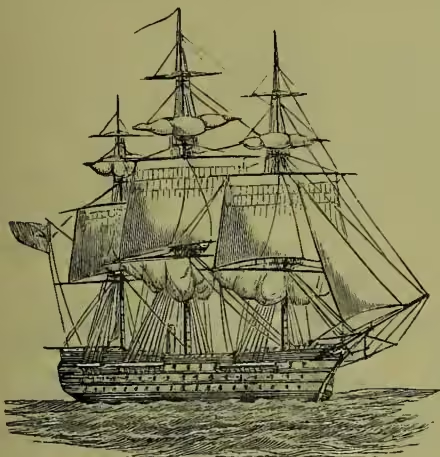
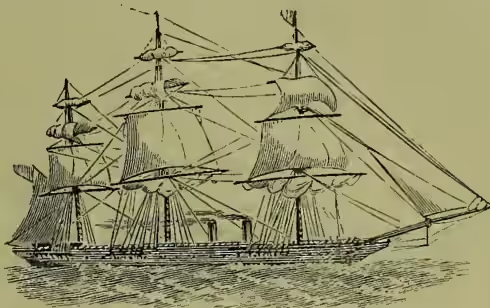
The use of steam as a propelling power is the agent by which this change has been effected. From 1841 a gradual substitution of steam for sailing vessels began, which was not completed, however, until 1860—in fact, the last sailing frigate in commission, the Calypso, only returned from the Pacific at the latter end of 1861. The first war steamers were all paddle-wheel vessels, and this mode of propulsion brought a change in the armament, or rather in the method of mounting guns. The paddle-wheels being quite exposed, and the machinery also being mostly above the water-line, there was great danger that a lucky shot would soon put a ship out of action, if compelled to fight broadside to broadside, as ships had been accustomed to do formerly. To obviate this danger as far as possible, the few guns these paddle-ships carried were mounted as pivot-guns, by which a far larger arc of training was possible than to a gun mounted on the broadside, thus enabling a ship to fight her guns without exposing her whole broadside to an enemy's fire. A few paddle-frigates, however, of large size, were built, and in their day did good service; of these the well-known Terrible, nicknamed during the Russian war of 1854-56 the 'Black-Sea Cat,' was the largest; she was a ship of some 3600 tons, carried sixteen 68-pounders, and had engines of 800 horse-power. At the bombardment of Sebastopol the sailing line-of-battle ships were all towed into their places by the paddle-frigates, which were lashed on their off-sides. But it was the application of the screw as a means of propelling ships which has really revolutionised ships of war. Its vast superiority over the paddle was at once seen, and by the commencement of the Russian war in 1854 many ships of the line, frigates, and smaller vessels had been either converted or built as screw ships. After the conclusion of the war many of the sailing three-deckers were converted into steam two-deckers, being lengthened amidships, and engines being then fitted to them; while during the three and four succeeding years naval architecture seemed to have reached its acme, the line-of-battle ships and frigates which were launched at the time being quite unsurpassed for beauty of their hulls, their size, and their sailing and steaming qualities. Strangely enough, for the first time in history, the new ships at this time were far superior to the French, especially the line-of-battle ships, which all carried their lower deck guns twice as high out of the water as the French ships, and were altogether finer and handsomer models. But the knell of wooden ships had already sounded, and many of the finest line-of-battle ships built at this time were never even commissioned.
To Napoleon III., emperor of the French, belongs the idea of plating ships with iron. The effect of shells on the ships at the first bombardment of Sebastopol showed clearly that unless some means of protection could be devised ships were placed at a terrible disadvantage when attacking heavy shore batteries. The result was the laying down in France and England in the year 1855 of what were called floating batteries, which were, however, completed too late to take any active part in the war. Some ten were built in England; they were 172 feet long, 43 feet beam, about 2500 tons displacement, a draught of water of 7 feet 9 inches, and had engines of 200 horse-power; they were plated with 4 inches of iron on 20 inches of wood backing; they could only steam about 5 knots, and, as they were flat-bottomed with no keels, were very unmanageable; but they were heavily armed, carrying sixteen 68-pounders in their batteries. Three years later, however, the first ironclad frigate was laid down at Toulon, the celebrated La Gloire. She was designed by M. Dupuy-de-Lôme, head of the constructive department of the French admiralty, was built of wood and plated entirely with inch iron plates to 6 feet below the water-line; she was 250 feet long, 55 feet beam, was built with a ram-bow, and could steam about 13.5 knots. She was launched in the early part of 1860, and in December of that year proceeded on a series of trials in company with the Algeciras, one of the fastest French line-of-battle ships. She proved herself a good sea-boat, and under all conditions steamed better than the wooden ships. In England they were not idle, and in January 1861 the Warrior was launched from the works of the Thames Shipbuilding Company. Designed by Mr Scott Russell, this ship, which, unlike La Gloire, is still fit for service, was built entirely of iron. She is, however, only armour-plated for two-thirds of her length, her bow and stern being unprotected; she is 9210 tons, 420 feet over all, with a beam of 59 feet, and her plating inches thick; while her engines—5770 indicated horse-power—gave her a speed of nearly 15 knots. She was thus nearly double the size and tonnage of La Gloire; but, although still a fine vessel and a beautiful model, she has long been obsolete as a fighting ship. She was quickly followed by others—ships in which the armour was carried completely round the hull; and in order more rapidly to form a large ironclad fleet several of the new line-of-battle ships were cut down, and converted into armoured frigates with ram-bows, and with plating from to 6 inches in thickness. These ships were, however, only makeshifts, as they had no watertight bulkheads, and the armour soon caused the wooden sides underneath to rot and decay. Still they answered their purpose, and filled a gap until newer and stronger ships, built entirely of iron, could be designed and constructed.
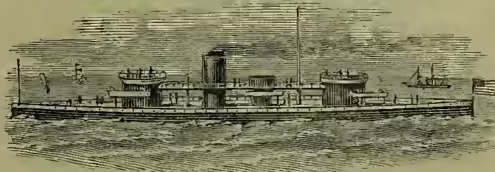
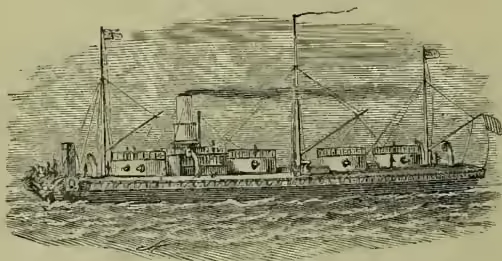
From 1861, when the Warrior was launched, up to the present day has been an unceasing era of change in design to meet the ever-increasing requirements of a modern ship of war, brought about by the production of guns ever growing in size and power, and the corresponding necessity of increased thickness of armour. In Hampton Roads during the American civil war was fought on the 9th of March 1862 the first naval action between armoured ships, which practically sealed the fate of armoured frigates of the earlier type almost before they had in many cases left the stocks. When Norfolk with its dockyard was evacuated by the Federal troops at the outbreak of the war between the Northern and Southern states, the Merrimack, a large 50-gun steam-frigate, was set on fire to prevent her falling into the hands of the Confederates. She was, however, only partly burned, and the Confederates found her in all essential respects uninjured. Remembering the many experiments that had been made in Europe to show the value of iron armour for ships, and painfully conscious of their weakness at sea, they appear to have thought there was one grand opportunity open to them, and to have made use of it with characteristic vigour and skill. They built up over her deck and down upon her sides to below the water-line a shot-proof covering formed of sloping plates of railroad iron, and meeting at the top like the roof of a house, through which came her funnel and the only opening for ventilation. She was armed with two 100-pounder Armstrong guns and eight 11-inch guns, and on the 8th of March 1862 she steamed out to attack the blockading Federal squadron, consisting of two sailing frigates, the Cumberland and the Congress, and three steam-frigates, which latter, however, were unable to come up in time to take part in the action. The Cumberland was sunk and the Congress had to surrender, the Merrimac herself sustaining no injury, although she sunk the first-named ship by ramming. The next morning she came out to attack the remaining ships, but was met by an antagonist which, although much smaller, proved more than a match for her. This was the celebrated Monitor, built and designed by Captain Ericsson (q.v.); and from her have sprung the monster turret-ships of the present day. She was only 210 feet long, with an extreme beam of 45 feet; her deck and low sides were plated, and she carried two 150-pounder Dahlgren guns in a single turret amidships, which was protected with eight 1-inch iron plates screwed together, and was turned by steam; she had no bulwarks, and her deck was barely two feet out of the water, while besides the turret nothing showed on deck except her funnel and an armoured pilot-house at the stern. The result of the fight is well known, and the Merrimac had to retreat before her small opponent. Great was the excitement caused when the news of this action reached Europe, and nowhere more than in England, where a demand immediately arose for the conversion of the fleet into turret-ships. Captain Cowper Coles (q.v.) had ever since the Crimean war been urging the Admiralty to build turret-ships in some form or another, but no attention had been paid to him; he now again came forward with plans for converting some of the wooden ships into Monitors, and the Admiralty determined to give his plan a trial. Accordingly a screw three-decker, the Royal Sovereign, was cut down, armour plated, and fitted with four turrets, each carrying two 9-ton guns. She had a freeboard of six feet, thus making her a great deal more seaworthy than the American Monitor; but, as the ship had not originally been destined for such heavy work, she laboured under some disadvantages. Nevertheless she was considered for a time the most formidable ship in the navy. When once fairly tried the advantages of the turret over the broadside system was evident; the turrets are placed in the centre of the ship, so the weight of the guns and the armour of the ship is more systematically and evenly distributed, and it has become possible to mount the heaviest guns in turrets and barbettes—guns of a size and weight which by no possibility could ever be carried on the broadside. Another advantage which turrets offer is the much greater protection afforded to the guns in them and to their crews, not only from the increased thickness of the armour which can be carried on them, but also from the probability that many projectiles will glance off the rounded surface of the turret instead of penetrating, while, owing to the low freeboard, the mark offered to an enemy is much smaller than in a high freeboard broadside ship.
Turret-ships did not, however, immediately supersede broadside ships, and the controversy as to the respective merits of the two systems raged for some time. Guns and armour were in the meantime growing. In 1866 the Bellerophon was completed, a fine broadside ship with a 6-inch belt at the water-line and 5-inch over her battery, in which she carried twelve 12-ton guns.
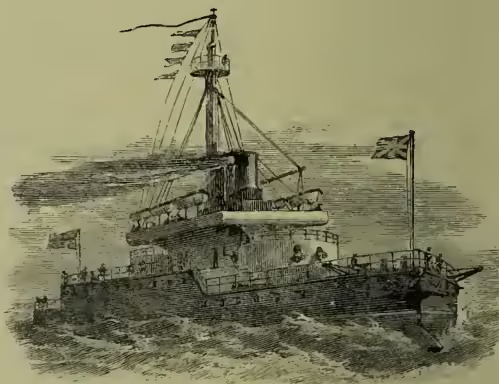
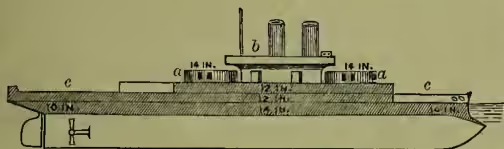
To Rear-Admiral Scott the country is indebted for the iron carriages and slides, with their patent compressors for checking the recoil, which made the mounting of heavy guns on the broadside possible. But now a new danger to be guarded against had arisen in the shape of that dangerous weapon the torpedo. The word was first applied to everything, no matter what its nature, which was exploded under water against ships; but of late years the word torpedo refers solely to mobile under-water weapons of offence, and more particularly to the fish or Whitehead torpedo, whilst the fixed or stationary torpedoes are now called submarine mines (see TORPEDOES and MINES). To afford as much protection as possible from these enemies, and also to make a ship as unsinkable as possible, not only has a system of building ships with an inner as well as an outer bottom been adopted, but by means of transverse and other bulkheads the whole hull below the water-line is subdivided into a number of watertight compartments, so that if a ship is injured the damage and water admitted is confined to as small a section as possible. Two complete sets of engines, driving each a separate screw, also took the place of the old single screw. This not only gives ships greater turning powers, but if one engine is disabled they are not left quite helpless. In 1869 three large low freeboard mastless turret-ships were laid down, the Devastation, Thunderer, and Dreadnought; the first-named ship was commissioned at the end of 1872, and they have all done good service, and still remain amongst our most formidable ships. They are protected by a belt of 14-inch armour at the water-line; above this, running about two-thirds of the length of the ship, is an armoured breastwork with 12-inch armour which protects the base of the turrets, loading-gear, &c. An armoured deck resting on the top of the belt covers in the whole ship outside the casement, the turrets being placed at each end of this breastwork. The freeboard fore and aft of these ships is extremely low, the deck being barely four feet out of the water, thus necessitating at sea the closing of all apertures by watertight hatches, as the deck is continually under water. A superstructure or hurricane deck is erected in the space between and slightly above the turrets, where accommodation is found for the boats, chart-house, and armoured conning-tower; the funnels, ventilators, and means of communication with the interior of the ship when the hatches on the upper deck are closed, all lead up through this structure, which is sufficiently spacious to form a small promenade in bad weather. These ships and others of the same type are ventilated below by means of air which is driven down by fans worked by steam. They have only what is called a military mast, the principle use of which is to serve as a support for the derrick used to hoist out the large boats. The original armament of these ships consisted of four 35-ton muzzle-loading guns, but since 1890 they have been supplied with 29-ton breech-loading guns of the most modern type, and a full complement of 3- and 6-pounder quick-firing guns, which are mounted on the superstructure. The introduction of this new type of sea-going turret-ship was a bold experiment and the occasion of much controversy; but even in the first venture a large measure of success was achieved. Deficiency of freeboard forward is the fault of the Devastation and her sisters, as also of many of the later ships, for with such a form of bow it is difficult, if not impracticable, to maintain a high rate of steaming against a heavy sea. Of course, the object of the bows being kept so low is to offer a smaller target to the enemy and to enable the guns mounted in the fore-turret to command an all-round fire.
Captain Coles was not satisfied with the Royal Sovereign or the turret-ships subsequently designed. He believed he could build a turret-ship which, with a low freeboard, should yet be heavily masted and able to keep the sea under sail alone; so the Captain, a large ship of over 6000 tons, was built from his designs with a freeboard of only 6 feet; she was heavily masted so as to give her great sail-power; her design was not approved at the Admiralty, her freeboard for a masted-ship being considered dangerously low. So the Monarch, a turret-ship of about the same tonnage, but with a freeboard of 14 feet, was built at the same time, embodying the Admiralty idea of what a masted turret-ship ought to be. Both ships carried four 25-ton guns in their turrets. The fate of the unfortunate Captain is well known. About an hour after midnight on the morning of the 6th of September 1870, while cruising with the Channel Squadron off Cape Finisterre, she was capsized when under sail in a heavy squall, and went down immediately; 500 officers and men, among whom were her captain, Captain Burgoyne, V.C., and Captain Coles himself, were lost. The Monarch, on the other hand, has been continually in commission, and in 1890 was re-engined and provided with new breech-loading guns. After the completion of the Bellerophon in 1866 an entire change was made in the arrangement of the guns in the batteries and in the disposition of the armour-plating in the new broadside ships which followed her. The Bellerophon, like her predecessors, was armoured all over, the plating extending some 5 feet below the water-line. while her guns extended along the maindeck as in the old wooden ships. An attempt was now to be made, without materially increasing the size of the ships, to carry yet heavier guns and protect them with thicker plating; at the same time various devices were resorted to to try and combine some of the advantages of the turret-ship with the broadside system of mounting guns, by giving an end-on fire to bow and quarter guns and generally increasing the arc of training.
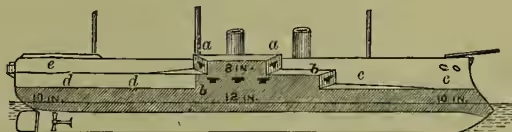
The result was what are now known as central-battery ships, of which the Hercules, Sultan, Téméraire, and Alexandra are very fine specimens. These ships have a complete belt of armour round the water-line tapering from 12 inches to 5 inches in thickness. The armour is carried up over the central portion of the ship and the batteries; athwartship armour bulkheads shut in the batteries fore and aft, forming a complete armoured citadel; before and abaft these bulkheads, above the armour-belt, the sides are unprotected in any way, and here are the quarters for the officers and men. The guns are carried in the batteries, there being an upper and a lower one, the lower being the main or principal battery; the foremost and after ports are recessed so as to give a nearly end-on fire, while in some cases the upper battery is made to overhang, the ship's side being made to fall in, and thus a direct bow and stern fire is obtained. Both the Alexandra and Téméraire carry 25-ton and 18-ton guns in their batteries; these ships were launched in 1875, and were the last broadside ships to be built, as they are the finest. After the loss of the Captain, and in view of the rapidly increasing competition between guns and armour for the mastery, as illustrated by the fact that in ten years progress had been made from 4½ to 14 inch armour, and from 68-pounders to 35-ton guns, the Admiralty appointed a committee of naval officers and architects to consider and report on the best design for the battle-ship of the future. The result of their deliberations was the adoption of what is known as the citadel type of ship, and on this principle, with certain modifications, several battle-ships were built.
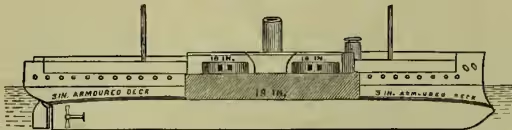
In this type of ship the continuous armour-belt round the water-line is done away with, and in its place the armour of great thickness is concentrated round a citadel in the central portion of the ship; the length of the citadel varies from about one-third the length of the ship to nearly a half; the armour extends to a depth of some 5 feet below the water and about 6 feet above; at each extremity rise the turrets in which the guns are mounted. In the Inflexible, the first ship of this type built, the armour at the water-line is 24 inches thick, with 17 inches on the turrets; the plates, however, are of iron, while in the later ships they are compound—iron faced with steel. The Inflexible carries two 81-ton muzzle-loading guns in each of her turrets, capable of throwing a projectile of 1750 lb. weight a distance of 6½ miles, with an initial velocity of 1800 feet. From the base of the citadel fore and aft extends the whole remaining length of the ship a watertight turtle-backed armoured deck, from to 3 inches thick; and below this deck, which is below the water-line and within the citadel, are contained all the vitals of the ship—engines, boilers, magazines, &c.—the only communication from above being down through the citadel. The quarters for the officers and men are mostly provided for in those parts of the ship before and abaft the citadel, and are built up above the armoured deck; the idea being that these unarmoured ends might be destroyed by the enemy's fire, but that the body of the ship would remain intact; the citadel, in fact, resting on an unsinkable inner ship below the surface of the water, there being as many as two hundred different watertight compartments in some of the latest battle-ships, including the compartments of the double bottom.
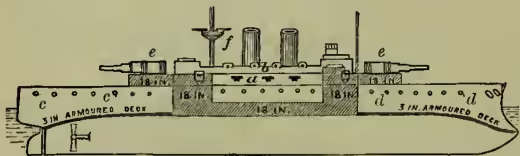
Since the year 1880 another revolution has been carried out, this time in the armament of ships, steel breech-loading guns being now substituted for the old muzzle-loaders. This change was rendered necessary in order to obtain the increased velocity requisite to penetrate the thicker armour now in use. It was found that the necessary length to obtain this increased velocity could not be given to guns which were loaded at the muzzle, so the authorities found themselves compelled to re-arm our whole fleet anew. The work was long in completing, but since 1882 all the new battle-ships and cruisers have received the new guns. The introduction of fast-steaming torpedo boats has also rendered it necessary for the heavy armament of battle-ships to be supplemented by a large number of light guns; and to the necessity of meeting the attacks of these swift little vessels, we are indebted for all the rapid-firing guns now in use, of which every ship carries a large complement. It thus again became necessary to carry guns on the broadside, and the design of the citadel ships had to be materially modified. Six battle-ships were laid down, known as the Admiral class, being named after distinguished naval commanders. Much controversy has arisen over these ships, and it is certain that they are deficient in armour-protection; on the other hand, their armament is a formidable one; they carry four 67-ton guns mounted in pairs, en barbette, in fixed heavily-armoured redoubts instead of in turrets. These barbettes are carried at a considerable height above the armoured portion of the hull, and all the hydraulic loading arrangements are protected by them. The ammunition is also brought up from below through armoured tubes. A belt of 18 inches of compound armour protects about 156 feet of the water-line of the ship amidships, and there is in addition a 3-inch steel-armoured deck. Between the barbettes is a long central battery, in which are carried the ten 6-inch guns forming the auxiliary battery, while on the spar-deck above are mounted a due proportion of 3- and 6-pounder quick-firing guns. The advantages claimed for the barbette system, which is in general use by the French, over the turret, is that the guns are carried much higher out of the water; on the other hand, they are much more liable to injury from an enemy's fire, as, except when loading, the whole gun is completely exposed; while the absence of broadside armour for the central secondary battery is a serious defect, leaving the crews, as it does, exposed to destruction by shells charged with melinite or other high explosives, and the hail of fire from the quick-firing guns. These ships are also too low forward, and, although fast ships, they cannot steam at any speed against a heavy head sea.
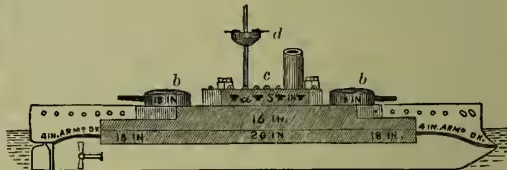
As the outcome of the popular revulsion against the Admiral type of battle-ship, in consequence of the small amount of armour-protection, and in view of the development of high explosives for use in shells, and the rapid growth in the size of the quick-firing guns, the Nile and Trafalgar were laid down in the year 1885. For their offensive powers and for the completeness of their armour-protection, as compared with any former ships, they were unquestionably the two most formidable battle-ships launched till then. Although not completely belted all round, they are very nearly so, and may be described as improved Devastations, with the addition of a central battery between the turrets for the auxiliary armament, in place of the superstructure of the earlier ships. The main armament consists of four 67-ton guns, while the auxiliary armament consists of eight 4.7-inch 40-pounder quick-firing guns, which are protected by 5-inch steel armour; and in addition they carry sixteen 3-pounder and 6-pounder quick-firing guns, mostly mounted on the spar-deck. In 1889 what is known as the Naval Defence Act was passed, which authorised the construction of ten new battle-ships, forty 1st and 2d class cruisers, and twenty torpedo gunboats. The battle-ships (of which the first were launched in 1892), of 14,000 tons displacement, have a length of 380 feet, and a beam of 75 feet; their engines of 13,000 horse-power have a speed of 18 knots, a knot faster than that of the Nile and Trafalgar. The disposition of the armour is much the same as in the two former ships, and the armour is of the same thickness except at the water-line, where it is two inches less; this water-line belt is 8½ feet broad, extending three-fourths the length of the ship, with a maximum thickness of 18 inches; the belt is terminated by transverse armoured bulkheads; above it is a 3-inch steel deck, while a strong under-water deck completes the protection before and abaft the belt. The broadside above the belt is protected to a height of 9½ feet above water over a considerable portion of the length by 5-inch armour, screen bulkheads similarly armoured enclosing the central battery. The armour on the barbettes is 17 inches thick, while the protection of the guns and crews of the auxiliary armament has been carefully arranged in view of the development of high explosives and quick-firing guns. In eight of these ships the main armament of 13½-inch 67-ton guns is carried in barbettes 23 feet above the water; in the remaining two they are mounted in turrets. The auxiliary armament consists of ten 6-inch 5-ton 100-pounder quick-firing guns, sixteen 16-pounder, and eight 3-pounder quick-firers, together with seven torpedo-tubes, of which two are submerged.
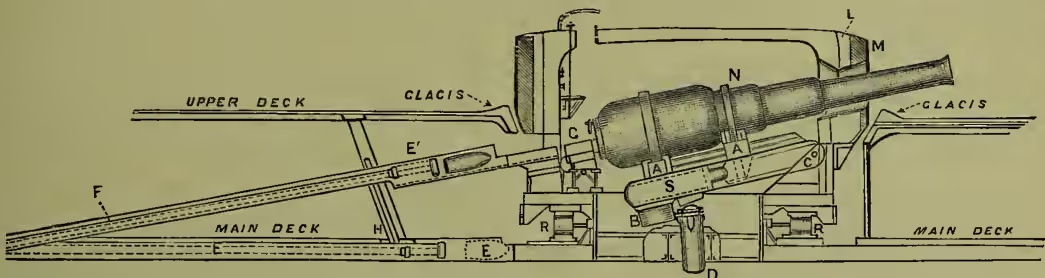
Since 1880 a large number of fast cruisers have been built. Of these ten are protected by a belt of 10-inch steel armour two-thirds of the length of the ship at the water-line, as well as by an armoured deck; all the remainder are known as 'protected cruisers'—i.e. they have an armoured turtle-backed deck which extends throughout the length of the ship; the thickness varies in the different ships from 6 inches on the slope to 2 inches on the horizontal part. The top of the deck rises to a maximum of about 18 inches above the water-line, but on the side it curves down to join the plating of the skin 6½ feet below the water. In the new cruisers, round the hatchways, funnel casings, &c. protection is given by 5-inch steel armour, while the guns also are protected by casemates plated with 4-inch steel armour, and the ammunition is passed up from the magazines to the guns through armoured tubes. The speed of these ships varies from about 16 knots in the cruisers of 1880 to 19 knots in the more recent ones, and two first-class cruisers, the Blake and Blenheim, were intended to steam 22 knots. As in the battle-ships, so in the modern cruisers masts and sails have been done away with; and while the battle-ships have what is called a military mast fitted with two armoured tops in which are carried one or more quick-firing guns, the cruisers have only a couple of light poles for signalling purposes. The armament of the cruisers consists generally of two 9-inch 22-ton guns as bow- and stern-chasers, and a proportion of 6-inch or 5-inch guns, according to the size of the ship, with a due complement of quick-firing guns and four or six tubes for discharging White-head torpedoes. In these ships which have no vertical armour a certain amount of protection is afforded by the stowage of coal in bunkers above the water-line. Battle-ships and cruisers alike are now lit by electricity, by means of which also the guns are fired and torpedoes discharged; they are also provided with powerful electric search-lights, which will illumine the sea for some 2 miles, while night-signalling is now carried on also by electric light. As a further defence against torpedoes, all large ships are provided with torpedo-nets, which are made of steel wire, with meshes of about 3 inches in diameter, and are rigged out all round the ship by means of booms, which project about 30 feet from the ship's side a little above the water-line; these nets are about 18 feet deep, and when not required for use are stowed inboard.
Ships are further provided with countermines for the purpose of destroying mine-fields defending hostile harbours. See TORPEDOES, MINES.
In England iron plates faced with steel (called compound plates) have been definitively adopted for heavy armour; while steel plates, from 6 inches to 2 inches in thickness, are used for the armoured decks and the shields for the protection of the light guns; and mild steel is now used instead of iron for the hulls of all ships.
The heaviest guns in use in the royal navy are the 111-ton breech-loaders, which throw a projectile of 1800 lb., with an initial velocity of 2300 feet, from 10 to 11 miles. The charge for this gun is 900 lb. of brown prismatic powder. These guns were put in three ships, the Victoria (lost in 1893) and Sanspareil, in these being mounted in pairs in a single turret forward, and the Benbow, which has one mounted in each of her barbettes forward and aft. The 67-ton gun proved most successful, and was in 1889 adopted as the heavy gun. The cost of the 110-ton gun is £19,600; of the 67-ton gun, £13,600; of the 22-ton gun, £4816; while a 5-inch 36-cwt. gun costs £568. In considering the question of guns it is essential to keep in view that the endurance diminishes as the calibre increases; the life of the 110-ton gun is considered to be 95 rounds; that of the 67-ton gun, 127 rounds; and that of the 45-ton gun, 150 rounds. The 67-ton gun throws a projectile of 1250 lb., with a charge of 630 lb. of brown prismatic powder, a distance of 10 miles, and will pierce 30 inches of armour; but experience shows that armour of this weight cannot be carried on ships of anything like a reasonable size. There is a strong opinion among naval officers that a 12-inch gun of modern design and about 50 tons in weight should possess sufficient power; and in 1898 the Majestic's 12-inch 46-ton gun showed energy little less than that of the 67-ton gun, and greater power of penetration than the 110-ton gun. In the smaller types of quick-firing guns the projectile and charge are made up in one cartridge, and by an ingenious arrangement of the breech it can be opened and closed by one man almost instantaneously. The first quick-firing guns were the 3-pounders and 6-pounders invented by Nordenfelt and Hotchkiss: these guns fired twenty-eight rounds a minute. A 40-pounder quick-firer, made at Elswick, proved most successful. A 100-pounder gun was the next enterprise (see CANNON, MACHINE GUN).
The nine battleships of the Spencer programme—Majestic, Magnificent, Victorious, Prince George, Mars, Jupiter, Illustrious, Hannibal, and Cæsar, launched 1896–97—were of 14,900 tons, and the largest ships afloat except the Italia and Lepanto. The Canopus class (Canopus, Ocean, Goliath, Albion, Glory, Vengeance) are of about 12,950 tons. The Renown is of 12,350. The Spartiate, launched 1898, is of 11,000 tons. The first-class cruisers Powerful and Terrible are ships of 14,000 tons. The Formidable, launched in the end of 1898, like the Irresistible and the Implacable—then being built—are called ‘improved Majestics,’ as the Majestic was itself called ‘an improved Royal Sovereign.’ The tonnage is 14,900, the engines are 15,000 horse-power, and there are twin screws; the side armour is 9 inches thick by 15 feet deep. The ship is armed with four 12-inch breechloading wire guns, twelve 6-inch quick-firers, each in its own casemate of Harveyed steel; sixteen 12-pounder quick-firers; two 12-pounder 8-cwt. guns; eight Maxims; four submerged torpedo-tubes; and a heavy steel ram. The cost of the greater ships may be set down at or over £1,000,000.
In 1898 there were 30 battleships of the first class afloat, 7 of the second, and 21 of the third; 14 coast defence ships; 9 armoured cruisers; 16 first-class cruisers; 64 second and third class cruisers; 19 lookout ships; 34 torpedo gunboats; 147 first-class torpedo boats, 4 of the second class and 20 of the third. Besides, there were building 9 first-class battle-ships, 12 first-class cruisers, 2 sloops, 4 gunboats, and 41 torpedo destroyers. The new programme of 1898 comprised 3 battle-ships, 4 armoured cruisers, and 4 sloops, besides 4 armoured cruisers ordered in July 1897.
The naval estimates for 1901—£27,522,600—provided for a force of 114,880 men and boys of all ranks, besides the Naval Reserve (q.v.).
As compared with the French navy, next in size, Britain had, in 1898, in battle-ships 53 to their 32; in armoured cruisers 18 to their 9; protected cruisers 109 to 36; in unprotected cruisers 16 to 16; in coast defence ships 15 to 14; in torpedo craft 214 to the French 225. The general contention is that Britain must keep her navy strong enough to defeat any two other navies.
The great naval review at Spithead in the Jubilee year, 1897, attracted notice to the unparalleled strength of the British navy. And after the German Emperor’s letter to President Kruger in 1896, and during the Fashoda incident in 1898, the weight of the navy obviously influenced the scales of diplomacy. The year of the Czar’s peace manifesto (1898) saw the utter destruction of the Spanish navy by that of the United States, a still more convincing proof of the importance of a powerful navy than the destruction of the Chinese fleet by the Japanese in 1894; and Britain, France, Germany, and Russia were all increasing their naval strength.
In 1861, just before the introduction of ironclads, the flagship in the Mediterranean was the screw three-decker Marlborough, of 121 guns, and with a crew of 1200 officers and men. The officers and crew of a line-of-battle ship averaged as a rule from 800 to 950; of a frigate, from 400 to 600; and smaller ships in proportion. A modern battle-ship of the Colossus type has a complement of 450 officers and men; a barbette ship of the Rodney class, one of 560; and a broadside ship of the Alexandra type, one of 750. The Formidable (1898), if used as flag-ship, has a complement of 789 officers and men. In a battle-ship, with a complement of 600 officers and men, the numbers and ratings would be approximately as follows: the vice-admiral and his staff, consisting of his flag-lieutenant, secretary, and 4 secretary’s clerks; a captain, commander, staff-commander (for navigating duties), 6 lieutenants, 2 sub-lieutenants, 13 midshipmen, 7 warrant officers, 3 marine officers, a chaplain, and naval instructor, 3 surgeons, a paymaster, a chief-engineer, and 5 assistant-engineers. The ship’s company would be composed of about 40 chief, 1st and 2d class petty officers and leading seamen, 260 seamen and boys, 90 marines, 15 engine-room artificers, and 120 stokers, the remainder bandsmen and other non-combatants. Not only are the complements of modern ships much smaller than in the old ships, but the proportion of trained seamen is also much smaller in comparison with the rest of the crew. This is due to the increase of the engine-room staffs, and to the large number of stokers now carried in the new ships, amounting sometimes to as many as one-third of the whole complement. As this large number of untrained men seriously affects the fighting efficiency of ships, steps are now taken to minimise the danger by training the stokers regularly at heavy gun and other drill, so that those not actually required in the stokeholes may be available for use as combatants in action. Foreign men-of-war are far more heavily manned than English ships of a similar size. By the Naval Defence Act of 1889, and in the estimates of 1898, provision was made to carry into effect a large increase of the personnel of the navy.
See Derrick, The British Navy (1806); W. James, Naval History of Great Britain (3d ed. 6 vols. 1847); King, Navies of the World (1880); Lord Brassey, The British Navy (5 vols. 1882–83), and his Naval Annual; G. T. Mahan, Influence of the Sea Power (1892); several works by Spencer Wilkinson (1894–95); Colomb, Naval Defence (1893); H. H. Wilson, Ironclads in Action (1895); Robinson, The British Fleet (new ed. 1896); Steevens, Naval Policy (1896); W. L. Clowes and others, The Royal Navy (3 vols. 1897–99); and the Annual Naval Pocket-Book by Clowes. For the Royal Naval College, see GREENWICH; see also TRAINING-SHIPS, TACTICS, CADET, MARINES, NAVAL RESERVE, TORPEDO, GUN, &c.; the articles on ADMIRAL, CAPTAIN, &c.; those on the great naval commanders, BLAKE, NELSON, &c.; and the sections of the articles on the various countries—FRANCE, GERMANY, ITALY, &c.—dealing with national defence.
NAVY AGENT, a banker and attorney for naval officers, who bears some such relation to Admiralty expenditure as the Army Agent (q.v.) to War Office expenditure. By the Act of 1865, each of Her Majesty’s ships of war, while in commission, has an agent appointed by the commander, and registered. His duties are to act for the ship in cases of salvage, merchant shipping law, distribution of prize-money, capture of slave-ships, &c. He receives 2½ per cent. as payment in full of his services. See the Navy List.
Nawanagar, a seaport of India, and capital of a native state (area, 1380 sq. m.; pop. 320,000), stands on the south shore of the Gulf of Cutch, 310 miles NW. of Bombay. Pop. (1891) 48,530.
Naworth Castle. See LANERCOST.
Naxos, the largest, most beautiful, and most fertile of the Cyclades, is situated in the Ægean, midway between the coasts of Greece and Asia
Minor. It is 20 miles in length, and has a pop. of 14,880. The shores are steep, and the island is traversed by a ridge of mountains, which rise in the highest summit, Dia, to 3289 feet. The wine of Naxos was famous in ancient as it is in modern times, and on this account the island was celebrated in the legends of Dionysus, and especially in those relating to Ariadne (q.v.). It was ravaged by the Persians, 490 B.C., and after the conquest of Constantinople by the Latins became the seat of a dukedom founded by the Venetians. It was Turkish from 1566 till Greece became a kingdom. Naxos, the capital (pop. 2000), is the seat of a Greek bishop and a Latin archbishop. See Tozer's Islands of the Ægean (1890).