Nets. A net is a kind of trap formed of string worked into open meshes and used for capturing fishes, birds, and other animals. The cord or string is knotted at the intersections so as to keep the meshes of their original size. As there is evidence that nets were used in prehistoric times, and since they are almost everywhere made by savage tribes, it is probable that they were among the earliest implements constructed by primitive man for procuring animal food.
Remains of nets belonging to the stone age have been found at Robenhausen and Vinelz in Switzer- land. Not only do the paintings on ancient Egyptian monuments show that in the days when these were executed nets were in common use, but portions of actual nets of great age have been obtained in Egypt. They are also represented on the monuments of ancient Greece. The Eskimo and Tchukchis make nets of twisted sinew or of strips of seal-skin, and the Chinese construct fine nets from the cocoons of the wild silkworm, which are soaked in oil so as to render them barely visible. Silk nets also are used in Greece. In some parts of the world nets are made of the fibres of plants but little known; but in civilised countries the chief materials used in their construction are hemp and cotton, and to a less extent flax. More nets are now made of cotton than of hemp, because, although the former are less durable, they are of lighter weight, more easily managed, and a smaller number of corks and bungs suffices to float them.
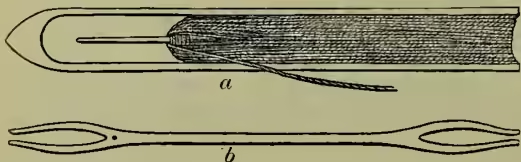
The making of nets by hand is an extremely simple operation. Only two instruments are required—viz. a netting-needle like a in the figure, for meshes above one-half inch in width, or one like b for meshes under this size, and a mesh-pin, which is simply a straight piece of wood of oval section and a few inches long, upon which the loops are formed. If the meshes are to be one inch from knot to knot, then the circumference of the mesh-pin requires to be two inches. There are two ways of forming the knots on hand-made nets (see KNOTS, figs. 11 and 13), but both are equally simple, and the whole process can be learned in a few minutes by seeing an operator at work. In some countries nets are still largely made by hand.
Netting-machines are now extensively used for the manufacture of nets. The looms are of complicated construction, and it would require a considerable number of illustrations and detailed descriptions to give even a general idea of how they perform their work. One of the most successful of these is known as the Paterson net-loom. It was invented by Mr James Paterson, and subsequently (1835) brought into a more practical shape by Mr Walter Ritchie, both of Musselburgh. (The knot made by this loom is the same as fig. 13 of KNOTS.) It works by a peculiar arrangement of hooks, needles, and sinkers. Since the middle of the century Messrs J. & W. Stuart, who then took up Mr Paterson's business, have made some further improvements upon his loom. An improved form of a net-loom, on a different principle, invented by a Frenchman named Pecqueur, in 1840, was subsequently patented in England. The designers of the later and more perfect form of this loom, which does its work well, are MM. Baudouin and Jouannin. Their English patent is taken out in the name of W. Clark, agent, and the specification, which contains a number of explanatory lithographs, is dated 19th September 1861 (No. 2340).
A variety of nets are used by fishermen, but the principal kinds are the seine, the drift-net, the moored-net, and the trawl (see FISHERIES). The net used for taking the tunny in the Mediterranean is often nearly a mile long, and some Russian hand-made nets are 3000 feet in length. Means are adopted to increase the durability of cotton and hemp nets, especially of the former. One plan is to tar them; but, although this to some extent prevents the injurious action of sea-water upon them, it has the disadvantage of hiding faulty parts. They are, however, much more frequently 'barked' in an infusion of cutch (see CATECHU), which like tar lessens the action of salt water upon them and at the same time admits of the state of the meshes being better seen. A solution of alum is also useful in preserving the fibre of the string of which nets are made.
One or two kinds of nets are made for catching birds, such as fly-nets for waders frequenting the seashore, and clap-nets for small birds (see WILD-FOWL). Fine nets are used to capture insects, and by the inhabitants of some countries as a protection from mosquitoes. Other kinds are employed to protect fruit and blossoms, for articles required on board ship, for mess-cooking, and for domestic purposes.