New York City, the largest and most important city on the American continent, and the third wealthiest on the globe, is situated on the east side of Hudson (here called North) River, at its confluence with the East River (q.v.), which opens into Long Island Sound. It lies in the state of New York, in a straight line 8½ miles, and by the waterway about 12 miles from the ocean, in 40° 42' 43" N. lat., and 74° 0' 3" W. long. It comprises the island
Hudson River. Spuyten Duyvil Creek. Long Island Sound. Hell Gate. Long Island City. Navy Yard. Long Island.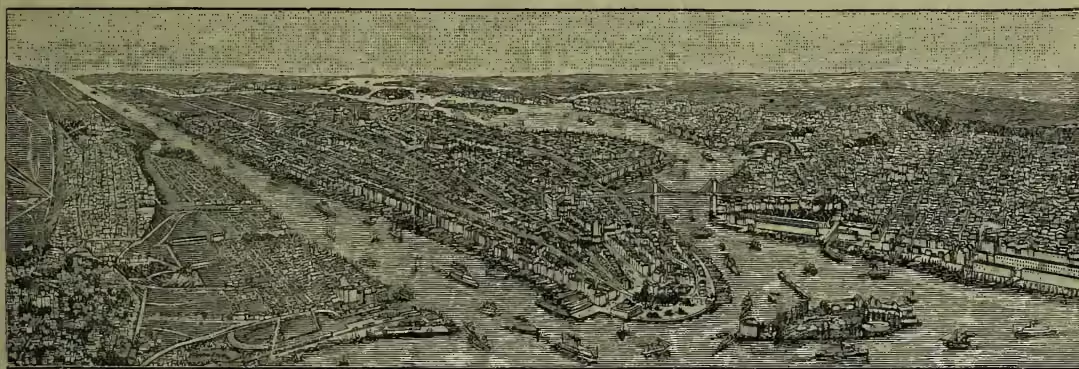
of Manhattan, formed by the two rivers, which is separated from the mainland by a narrow strait, the east portion of which is known as Harlem River, and the west as Spuyten Duyvil Creek. It also includes several small islands in the inner bay and East River. In 1873 the city's limits were extended so as to embrace 12,100 acres on the mainland, lying toward the east and north, in Westchester county, as far as the city of Yonkers. The total area of New York City now embraces 41½ sq. m. Manhattan Island is 13½ miles long, with an average breadth of 1¾ mile. A rocky ridge runs through the upper part of its western side, rising to 238 feet, known as Washington Heights. With the exception of a small portion of wild and stony space, which is being utilised for ornamental purposes, the entire island is laid out in avenues and streets, lined with houses; its area includes several greens and parks. The lower part of the city has to a considerable extent been extended by filling in on the two river-sides.
The bar at Sandy Hook, 18 miles south of the city, which divides the Atlantic Ocean from the outer bay, is crossed by two ship-channels, from 21 to 32 feet deep at ebb-tide. The lower bay covers 88 sq. m. for anchorage. In it are buildings for quarantine and hospital purposes, and an anchored floating hospital-ship, in charge of a health-officer. The Narrows, through which all large ships pass on their way to the inner harbour, is a strait between Long Island and Staten Island, about a mile in width, 8 miles distant from the city, in a south-easterly direction. This approach is defended by Forts Wadsworth, Tompkins, and Hamilton. There is also another channel leading from the sea, through the so-called Kills, around Staten Island, between it and the New Jersey shore; only vessels of light draught can approach by this route. Vessels that come from the north and east, by way of Long Island Sound, pass the fortifications at Throgg's Neck on the mainland and Willett's Point on Long Island, about 10 miles from the city; their nearer approach is hindered by the rocky shoals and intricacies at Hell Gate (see BLASTING). New York's harbour or inner bay covers about 14 sq. m.; it is one of the amplest, safest, and most picturesque on the globe, open all the year round; many waterways place it in easy communication with the interior. Bridges span the East River and Harlem River, and about thirty steam-ferries are in constant intercourse with the neighbouring shores. The island of Manhattan has nearly 25 miles of water-frontage, of which 13 miles are on the Hudson River side; a large, unimproved part of the shore remains for future extension. The city is the centre of finance and commerce of the United States. It receives 66 per cent. of all the imports, and sends abroad 44 per cent. of the exports. Over 4000 steamers and 4000 sailing-vessels enter and clear in the coastwise trade, and 2150 steamers and 5000 sailing-vessels in the foreign trade. The annual exports of merchandise in 1890 amounted to about 400,000,000, the imports to over 500,000,000. There are more than seventy wooden piers on each river; and for want of convenient wharf accommodation several lines of foreign steamers have transferred their piers to the shores of Brooklyn and New Jersey, while a large amount of staple produce from the southern states and from distant lands is housed on the wharves and in the large storehouses of Brooklyn. Liberty Island, for a long time known as Bedloe's Island, is situated in the harbour, about mile from the lower end of the city. In 1886 the famous Bartholdi (q.v.) statue was erected on this spot, and occupies its central surface. The New York and Brooklyn Suspension Bridge (see BROOKLYN) spans the East River from opposite the old City Hall Park.
Old New York is laid out very irregularly. Here the money interests and wholesale traffic are centred. Wall, New, and Broad streets are the great centres in which banking and speculative enterprises are conducted to an enormous extent. The first-named thoroughfare is hardly half a mile in length, but in extent of business is perhaps unequalled by any other locality on the globe. The newer part of the city, from 14th Street to the end of the island, northward, is divided into twelve great avenues and several smaller ones, from 75 to 150 feet in width, running north and south. These are crossed at right angles by streets, mostly 60 feet in width, running from river to river. Fifth Avenue, the great modern central thoroughfare, divides the city into eastside and westside. Twenty street blocks measure a mile; every tenth street is double the usual width, designed for business purposes. Among old inhabitants remote parts of the city still bear the names of former village sites. The original great thoroughfare, Broadway, runs a distinct, devious course through the regular street arrangement, making several short angles and turns through the middle of the island. On reaching 59th Street it resolves itself into a grand boulevard. The streets, in general, are substantially paved, and at night well lighted by gas and electric lights. Many, however, are suffered to remain in an unswept and neglected condition. In the lower part of the city obstructions are often permitted permanently to occupy the sidewalks, and pedestrians are compelled, among carts and horses, to explore their way through the middle of the street.
Night and day sumptuous passenger steamers pass up and down Hudson River, Long Island Sound, and beyond the Narrows, down to the lower bay. Lines of railroads radiate from the Grand Central Dépôt; others run from the opposite shores of New Jersey and Brooklyn. The large city dépôt is 695 feet long and 240 wide; about 125 trains arrive and depart daily. Several of the city's avenues are traversed their full length by elevated steam passenger-railroads, built on wrought-iron structures, which from early dawn to midnight carry crowds of local passengers. Besides these there are many lines of horse and cable tramways, and a few worked by electric agency. Already these modes of conveyance are so overtaxed that additional travelling facilities are urgently demanded. More river-bridges, a viaduct avenue, subterranean roadways, and tunnelling under the rivers are in active contemplation; for most of these enterprises charters have already been granted. The number of houses is estimated at above 120,000, mostly built of red brick, the better class of brown sandstone, a few of wood. Besides these there are stores built of iron, brown and yellow sandstone, and a few of marble; little granite is being used in modern structures. The construction of wooden buildings in the lower part of the city has been interdicted. The modern tendency is to build roomy, tall, fireproof and semi-fireproof structures for apartment-houses and for business purposes, the internal ascents of which are made, from story to story, by mechanical elevators. Most of these structures range from 75 to 100 feet in height, and are costly and elegant. Among prominent public edifices are noteworthy: the City Hall, County Court-house, Custom-house, Treasury Building, Tombs (prison), Barge Office, Masonic Temple, Academy of Design, Cooper Union, Post-office, Produce Exchange, Madison Square Garden Hall, University of the City of New York, Lenox Library, Temple Emanuel, Trinity Church, and the Roman Catholic cathedral, besides numerous large, imposing hotels and palatial dwellings and business dépôts. In many cases vaulted basements and sub-cellar are laid out under the buildings and sidewalks on an extensive scale. Among the apartment-houses conspicuous for size and luxurious appointments are Navarro's Spanish Flats, the Dakota, Gerlach, Knickerbocker, Florence, and Central Park structures. In out-of-the-way side streets the dependent and poorer classes are huddled together in equally tall, brick-built, dirty, yardless tenement houses. Immense retail bazaars and arcades are found on Broadway, Grand Street, 14th, 23d, and 125th Streets, and 3d, 6th, and 8th Avenues.
The city government is under a mayor and board of aldermen; these offices are mostly filled by adopted citizens from Ireland and Germany, who form a large part of the city's voting elements. The police force numbers 3420 men; there are thirty-five station-houses, where prisoners are temporarily conveyed, and shelter is provided for the homeless at night. New York has a paid fire-department, conducted at an annual expense of $2,000,000, and divided into 76 companies; 1039 well-trained men and 337 horses are employed. Its appointments include, among others, 89 steam fire-engines, 15 trucks, and 84 telegraph stations. The lighting of the city is mostly done with gas, although electric lighting is gradually being brought into use. Of public gas-lamps there are some 25,000. Four gas companies are in operation, and have together about 900 miles of mains laid underground. The Croton Aqueduct conveys to the city an ample supply of soft water from the Croton River and its lakes, a distance of about 40 miles, to the four reservoirs of the city (see AQUEDUCT).
In Central Park the retaining reservoir holds 1,030,000,000 gallons, the receiving reservoir 150,000,000 gallons, the distributing reservoir on 5th Avenue 20,000,000 gallons; at High Bridge there is also a high-service reservoir, with a capacity of 11,000,000 gallons. The iron main-pipes are little short of 500 miles in length. Electric telegraphs and telephones are largely in use. The New York General Post-office building, erected of granite, at a cost of $6,500,000, was first occupied in 1875. It is situated in what was formerly known as the City Hall Park, in the lower part of the city. More than 2500 persons are here employed. There are 18 stations and 20 sub-stations in various parts of the city, and 1600 lamp-post boxes. A federal commissioner now receives and attends to the wants of immigrants. In some years the immigration by way of New York has risen to nearly half a million.
The Battery Green encloses twenty-one acres, planted with trees, shrubbery, and grass, and occupies the most southern point of Manhattan Island; it marks the original site of Nieu Amsterdam. After the American revolution it was used for military and civic displays, and from that time until near the middle of the 19th century was the fashionable promenade. On its west side is Castle Garden (q.v.). The grading of Central Park was begun in 1857. It is laid out in the highest style of art, containing walks, drives, and bridle-paths, and is decorated with artificial lakelets, fountains, bridges, monuments, statues, recreative and garden structures. It also holds the Egyptian obelisk, brought from Alexandria in 1880. Within the park confines, besides the reservoirs, are the Museum of Art and buildings for a zoological collection, while 'annex' grounds contain the Museum of Natural History. Central Park comprises 843 acres, extends from 59th to 110th Street, and is bounded by 5th and 8th Avenues; its dimensions are thus miles by mile. Riverside Park is a narrow, irregular strip of land, running alongside the Hudson from 72d to 130th Street, much used for riding and driving purposes. On the newly-acquired mainland two extensive parks have been laid out—Jerome and Van Cortlandt—the first named being used as a racecourse.
New York has 97 local fire-insurance companies, 10 local marine-insurance companies, 39 local life-insurance companies, 83 commercial banks (of which several have a capital of $5,000,000), 23 savings-banks, and 15 trust-companies. About 288 newspapers (daily, weekly, and monthly) are published—some of them are in foreign languages; the prominent journals occupy immense buildings. Dispensaries, hospitals, and charitable institutions are numerous. Homes for the aged and crippled, the insane, idiots, blind, deaf and dumb, magdalens, and foundlings are provided. Of church buildings there are about 400—91 Episcopal, 88 Methodist, 84 Presbyterian, 59 Roman Catholic, 54 Baptist, and 29 Jewish. There are congregations of Christian Israelites, Swedenborgians, Salvation Armyists, Spiritualists, Negroes, and Chinese. Of the public schools 47 are primary and 85 grammar-schools, each jointly under a male and female principal. Many children of Roman Catholic parents are being withheld from these institutions, in favour of parish schools of their own denomination. The day attendance at public schools averages 307,000; at evening schools about 20,000. There are three general colleges—Columbia, the University of the City of New York, the College of the City of New York, and the Normal College, belonging to the public-school system. Besides these there are many special colleges and academies, Union Theological Seminary (Presbyterian), the Protestant Episcopal General Theological Seminary, &c. Among libraries may be named the Astor, with 300,000 volumes; Mercantile, 250,000; Columbia College, 120,000; Apprentices', 100,000; Historical Society, 100,000; and Society, 70,000. The Museum of Art, Museum of Natural History, and Lenox Gallery are famous to the public. Annual exhibitions of paintings and statuary are held at the Academy of Design and other places, and of mechanical inventions at the hall of the American Institute. The theatres are numerous and well appointed. Noted clubs are the Manhattan, Union, New York, St Nicholas, Knickerbocker, Union League, University, Lotus, Harmonic, and Century. The principal orchestral society is the Philharmonic.
John Verrazani, a Florentine navigator, was the first European who entered New York bay, in 1525. His exploration was interrupted by a storm that compelled him to put to sea without making a settlement. In 1609 Henry Hudson entered Hudson River, and, trading with the aborigines, ascended the stream for about a hundred miles. In 1614 the Dutch built a fort on Manhattan Island, and in 1623 a permanent settlement was made, named Nieu Amsterdam. In 1664 the English drove out the Dutch, in 1673 the Dutch the English. In 1674 Manhattan Island came permanently by treaty into the possession of Great Britain, the name New York being given in honour of James, Duke of York. New York privateering was a great business during the climax of the slave importation, about 1730–35. At the time of the American Revolution the city's population was less than that of Philadelphia and Boston. It was evacuated by the forces of Great Britain in 1783, and from 1785 to 1789 was the seat of government of the United States. In 1774 the city census, taken by government, showed a population of 22,861; (1800) 60,489; (1825) 166,136; (1850) 550,394; (1860) 813,669; (1870) 942,292; (1880) 1,206,599; (1890) 1,515,301, a recounting by the city police giving 1,710,715. In 1898 Brooklyn, Richmond County, Flushing, Port Hempstead, Jamaica, Long Island City, Newton, Jamaica Bay, East and West, Chester, and Pelham were incorporated with the municipality; and 'Greater New York,' with an area of 359 square miles, had a population of over 3,000,000 and a debt of near $200,000,000.
See Histories by Lossing (1885) and Roosevelt (1891); the article TAMMANY; the Memorial History, edited by Grant Wilson (4 vols. 1891–94); and Historic New York by Misses Goodwin, Royce, and Putnam (1898).