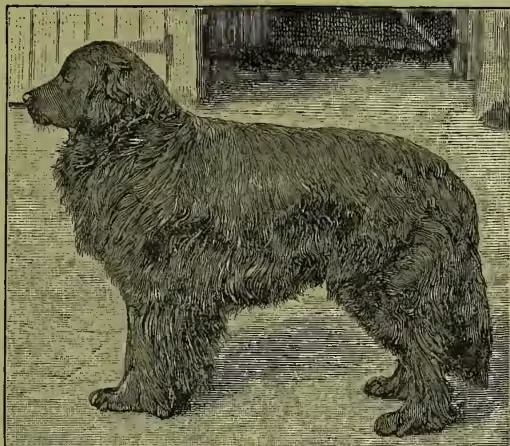
Newfoundland, a breed of dogs originally introduced into England from the island of Newfoundland, where they were used for draught purposes. As the mastiff at that time was scarce, and the St Bernard had not yet appeared in England, the Newfoundland became exceedingly common, but has been eclipsed in popularity of late years by the other two breeds mentioned. In general appearance the Newfoundland is a large and imposing dog, mild in expression, but showing great strength. The head should be large, with ears falling close; neck long, if possible; loins strong and well ribbed up, a point seldom seen in this breed; tail long and powerful, as it is used greatly when swimming; coat, long and wiry; colour, black without any white markings. Much discussion was caused by Sir E. Landseer's well-known picture of a black and white dog entitled 'A Distinguished Member of the Humane Society' (1838). An attempt was made to prove that the black and white dog was the true Newfoundland; but it is now generally regarded as a cross from the black. The black and white variety, now known as the Land- seer Newfoundland, has been kept pure for many generations; it is now almost as pure, and certainly as handsome, as the original variety. The Newfoundland is a splendid water-dog, and takes to the sea at an early age. He is also a natural retriever, and, though himself too heavy for field work, has been extensively used to find the ordinary retriever. From his formidable appearance, combined with docility and intelligence, he makes a capital watch-dog, for which purpose he is extensively used.