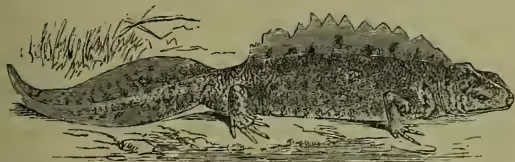
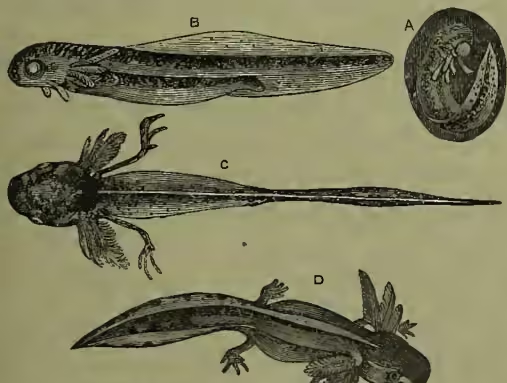
Newt, or EFT (Triton), a genus of caducibranchiate Amphibians (q.v.), corresponding in many respects to the Salamanders, but more slender and active, and making up with them the family Salamandridæ. The newts have a soft, sensitive skin, covered with warty tubercles or granules; a laterally-compressed tail; four fingers and five toes; teeth on the jaws and palate; an upper and a lower eyelid, and a third eyelid or nictitating membrane; small nostrils near the snout, opening internally into the mouth; and generally well-developed organs of the lateral line. They are found in marshes and ponds and damp places. In habit they are carnivorous, devouring insects of various kinds, worms, snails, frog-spawn, and even smaller animals of their own kind. Sixteen species are enumerated, widely distributed in Europe, and found also in Algeria, North China and Japan, the eastern states of North America, California, and Oregon. The Great Water Newt, or Warty Newt (T. cristatus), is the largest British species. It is about 6 inches long; the body is thick and round, the upper parts are generally very dark, the sides are dotted with white, and the breast and belly are of a bright orange colour, with black spots. The male is more vividly coloured than the female, the sides of the tail are of a beautiful pearly colour, and at the breeding season he develops a large back crest (fig. 1). The movements in slow swimming are accomplished by means of the tail and the limbs; but in fast swimming both pairs of limbs are laid alongside the body, and the movements are effected by rapid undulations of the body and tail. On land they crawl by means of their weak limbs. In summer they cast their skin perhaps many times, sometimes by complete sloughing, but sometimes it comes off in shreds. In winter they generally remain at the bottom of ponds and ditches. Like many other animals of the same genus, they show great power of reproducing lost parts, the tail, limbs, and portions of the head being very perfectly restored, even several times in succession. They are also able to withstand great cold. In laying her eggs the female deposits them on the leaves of aquatic plants, each egg being deposited separately below a leaf, which is then folded, apex to petiole, by means of the newt's hind-limbs, so as to retain the egg in position. The embryo grows rapidly and becomes bent in shape. In seven days the gills and legs appear as small knobs. By the ninth day the tail is oar-shaped, and the heart may be seen beating. On the tenth day the fore-limbs and claspers appear beside the gills. In two or three days more the eyes appear as distinct structures, and the gills become leaf-like. About the fourteenth day the embryo escapes from the egg and holds on to leaves of water-plants by means of its claspers. At this stage of its existence it resembles a fish in outward form and internal structure, and its whole anatomy may very easily be studied on account of its transparency. About twelve days after leaving the egg the forefeet are longer, rudiments of toes are visible; the gills, at first simple, become fringe-like, and red blood circulates through them, and the claspers disappear. About the twenty-second day it begins to breathe by means of its developing lungs; the gills are still large, and the hind-legs begin to sprout. This change takes place concurrently with the change of diet from vegetable to animal food. About the forty-second day after hatching, the gills begin to grow smaller and are soon obliterated. The newt then seeks to leave the water, respire atmospheric air only, and goes on to sexual maturity. In some circumstances individuals of this species occasionally retain some of the external appearances of immaturity in spite of having become capable of reproduction (a phenomenon more common, however, in a European species, T. alpestris, which may become sexually perfect even in its tadpole stage); and in rare instances they may bring forth their young alive as do the true salamanders. The Great Water Newt is seldom found on land. The Common Smooth Newt (T. punctatus), a smaller species about 3½ inches long, is much more common in Britain than the great newt, from which it also differs in having a smooth skin, the back crest continuous with the tail crest, and in being often found on land. Its eggs are laid in the axils of leaves quite as often as under the leaves. The Palmated Smooth Newt (T. palmipes) is the only other common British species. It has been found in various parts of Britain from the Isle of Wight to the north of Scotland. The toes of the hind-foot are webbed, the tail ends in a long filament, and the back crest is straight; these characteristics are prominent only in the breeding season.
Newts form very interesting inmates of aquaria, where they may be easily reared and kept; and their graceful movements and development interest the observer. The words newt and eft are really identical, a newt = an eft, A.S. eftu, just as an adder resulted from a nadder by mistake.