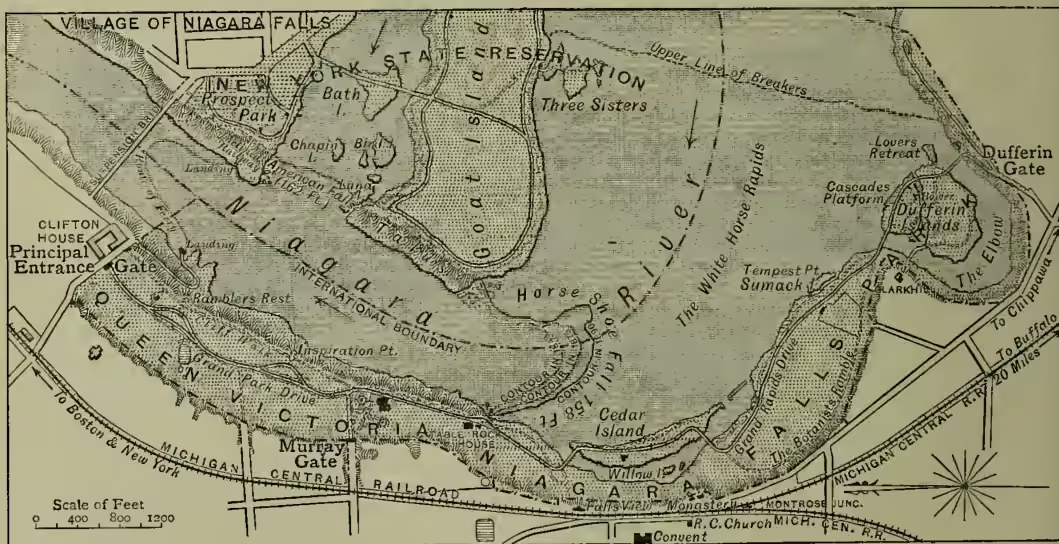
Niagara ('Thunder of Waters'), a river of North America, which forms part of the boundary between New York state and the province of Ontario. It flows from Lake Erie to Lake Ontario, a course of 36 miles, during which it makes a total descent of 326 feet—about 50 feet in the rapids immediately above the great falls, and nearly 110 feet in the seven miles of rapids below. It encloses several islands, the largest Grand Island, which is nearly 10 miles long. Four miles below this island are the most famous falls in the world. The centre of the river here is occupied by Goat Island, dividing the cataract into two—the Horseshoe (Canadian) Fall, with a descent of 158 feet, and the
American fall, 162 to 169 feet; the outline of the former is about 2640 feet, of the latter 1000 feet. The volume of water which sweeps over this immense chasm (nearly nine-tenths passing over the Canadian fall) is about 15,000,000 cubic feet a minute. The depth of water on the crest of the falls is less than 4 feet, except in a few places, notably at the apex of the Horseshoe Fall, where it is about 20 feet. The limestone edge of both falls is rapidly wearing away in the centre: the contour lines in the map represent this in the case of the Canadian fall, whose centre now presents the form of a V; in the American fall the same tendency is visible, although the process has begun much more recently. For seven miles below the falls (to the point, that is, where it has been supposed that the falls originally stood) the river is shut in between perpendicular walls of rock, from 200 to 350 feet high. For some distance below the falls there is still water, the body of water which pours over the precipice sinking, and only coming to the surface again two miles below, where the whirlpool rapids begin; a little lower is the whirlpool, where a sharp turn sends the waters hurling against the Canadian side, and then sweeping round in a great eddy before they find a vent at a right angle with their former course. Just below the cataract the river is crossed by a suspension bridge for carriages and foot-passengers, and a mile and a half farther down there are two railway bridges—one a cantilever bridge—about 100 yards apart. On both shores the lands bordering on the river, for some distance above and below the falls, are under the immediate control of the respective governments. The 'New York State Park at Niagara Falls' (1885) embraces 115 acres, and the 'Queen Victoria Niagara Falls Park' (1888) about 154 acres. From both sides visitors, eased in waterproofs, are conducted under the falls. On October 4, 1890, the first sod was cut of a tunnel for utilising the water-power of the falls, regarded as one of the greatest engineering enterprises ever undertaken. By means of immense turbines, the water-power generates electricity, which is distributed to commercial enterprises in the immediate neighbourhood or transmitted to considerable distances. By the middle of 1895 the first transmission of electric power for commercial purposes had been made, 4000 horse-power having been transmitted to an aluminium manufactury a mile distant. The city of Buffalo, twenty-six miles away, is well within the sphere of the company's operations; in November 1896 the electric energy of the three great turbines at Niagara was made available here, and henceforward the tramways as well as the chief factories of the city are to be driven by this power. It is expected that ere long the whole distance between Buffalo and the Falls will be 'built solid with smokeless factories.' It has even been proposed to use the electric forces generated for the canal-boats on the canal hence to the Hudson River at Albany, 350 miles distant.