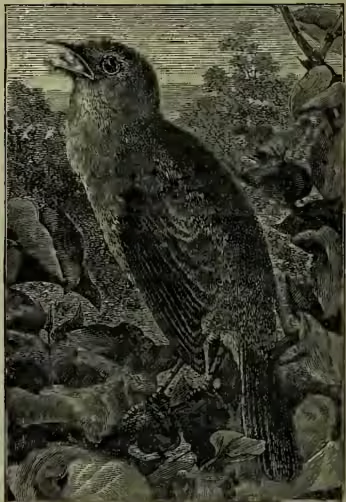
(Daulias luscinia).
Nightingale (Daulias) a genus of Passerine birds of the family Turdidae. The bill is straight, slender, not quite as long as the head; the wings do not much pass beyond the base of the tail; the first quill is very short, the third is the longest; the tail is slightly rounded; toes long, claws rather short. The Common Nightingale (D. luscinia) is well known as the finest of songsters. It is rather larger than the hedge-sparrow, with about the same proportionate length of wings and tail. It is of a rich russet-brown colour above, shading into reddish chestnut on the tail-coverts and tail; the lower part grayish white; bill, legs, and feet brown. The sexes are alike in plumage. It is a native of many parts of Europe and Asia, and of the north of Africa, extending as far as to Abyssinia, and to the Gold Coast in West Africa, and is a bird of passage, extending its summer migrations on the continent of Europe as far north as the south of Sweden, though in Britain it has scarcely ever been seen farther north than Yorkshire. It is plentiful in some parts of the south and east of England, but is less common in the western counties, and does not visit Scotland, Ireland, or Wales, except Glamorganshire and Brecon. It frequents thickets and hedges and damp meadows near streams. The market-gardens near London are among its favourite haunts. It feeds very much on worms, beetles, insects, ants' eggs, caterpillars and other insect larvæ. It arrives in England about the middle of April, the males about ten days before the females. It is at this season, and before pairing has taken place, that birdcatchers generally procure nightingales for cage-birds, as they then become easily reconciled to confinement, whilst if taken after pairing they fret and pine till they die. If nightingales, however, are to be kept in confinement they ought to be taken from the nest when young and reared by the hand. The nightingale makes its nest generally on the ground, but sometimes on a low fork of a bush. The nest is loosely constructed of dead leaves, rushes, and stalks of grass, with a lining of fibrous roots. The eggs are from four to six in number, of a uniform deep olive-brown. The song of the male ceases to be heard as soon as incubation is over. In captivity, however, it is often continued through a more considerable period. The nightingale usually begins its song in the evening, and sings with brief intervals throughout the night. The variety, loudness, and richness of its notes are equally extraordinary; and its long quivering strains are full of plaintiveness as well as of passionate ecstasy. The nightingale has been a favourite from most ancient times, and is often mentioned in the poetry of India and Persia, of Greece and Rome, as well as by Shakespeare and Herrick, Keats and Coleridge, and many others. The loves of the Bulbul (q.v.) and the rose are a fanciful theme in which eastern poets delight. The nightingale, as a rule, is not a shy bird, for although it is but seldom seen it seems to prefer to live near the abode of man; nor is it quarrelsome with others of its own species except at pairing time. A closely allied species (D. golzii) is found from the Caucasus to Turkestan and Persia, and in north-eastern and central Europe the Northern Nightingale or 'Sprosser' (D. philomela) is found, quite a distinct species, of rather larger size, less russet in hue, and slightly spotted on the breast.