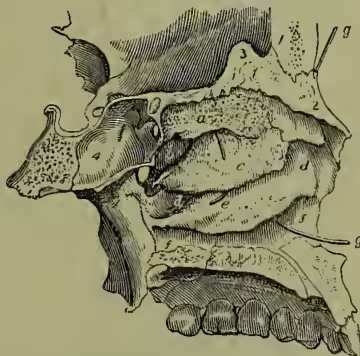
Nose, the organ of smell, and also part of the apparatus of respiration and voice. Considered anatomically, it may be divided into an external part—the projecting portion, to which the term nose is popularly restricted—and an internal part, consisting of two chief cavities, or nasal fossæ, separated from each other by a vertical septum, and subdivided by spongy or turbinated bones projecting from the outer wall into three passages or meatuses, with which various cells or sinuses in the ethmoid, sphenoid, frontal, and superior maxillary bones communicate by narrow apertures. 1, frontal bone; 2, nasal bone; 3, part of ethmoid bone; 4, sphenoidal sinus. a, superior turbinated bone; b, superior meatus; c, middle turbinated bone; dd, middle meatus; e, inferior turbinated bone; ff, inferior meatus; gg, a probe passed into the nasal duct.
The external portion of this organ may be described as a triangular pyramid which projects from the centre of the face, immediately above the upper lip. Its summit or root is connected with the forehead by means of a narrow bridge, formed on either side by the nasal bone and the nasal process of the superior maxillary bone. Its lower part presents two horizontal elliptical openings, the nostrils, which overhang the mouth, and are separated from one another by a vertical septum. The margins of the nostrils are usually provided with a number of stiff hairs (vibrissæ), which project across the openings, and serve to arrest the passage of foreign substances, such as dust, small insects, &c., which might otherwise be drawn up with the current of air intended for respiration. The skeleton or framework of the nose is partly composed of the bones forming the top and sides of the bridge and partly of cartilages, there being on either side an upper lateral and a lower lateral cartilage, to the latter of which are attached three or four small cartilaginous plates, termed sesamoid cartilages; there is also the cartilage of the septum which separates the nostrils, and in association posteriorly with the perpendicular plate of the ethmoid, and with the vomer, forms a complete partition between the right and left nasal fossæ. It is the lower lateral, termed by some writers the alar cartilage, which by its flexibility and curved shape forms the dilatable chamber just within the nostril. The nasal cartilages are capable of being slightly moved, and the nostrils of being dilated or contracted by various small muscles.
The nasal fossæ, which constitute the internal part of the nose, are lofty and of considerable depth. They open in front by the nostrils, and behind they terminate by a vertical slit on either side in the upper part of the pharynx, above the soft palate, and near the orifices of the Eustachian tubes, leading to the tympanic cavity of the ear.
The mucous membrane lining the nose and its cavities is called pituitary (Lat. pituita, 'rheum'), from the nature of its secretion; or Schneiderian, from Schneider, the first anatomist who showed that the secretion proceeded from the mucous membrane, and not, as was previously imagined, from the brain; it is continuous with the skin of the face at the nostrils, with the mucous covering of the eye through the lachrymal duct (see EYE), and with that of the pharynx and middle ear posteriorly. This membrane varies in its structure in different parts of the organ. On the septum and spongy bones bounding the direct passage from the nostrils to the throat the lining membrane contains ample and capacious submucous plexuses of both arteries and veins, of which the latter are by far the more large and tortuous. These plexuses, lying as they do in a region exposed more than any other to external cooling influences, appear to be designed to promote the warmth of the part, and to elevate the temperature of the air on its passage to the lungs. They also serve to explain the tendency to hemorrhage from the nose in cases of general or local plethora. In this, the respiratory part of the nose, the mucous membrane smell, terminates in the olfactory mucous membrane. It passes into the nasal cavity in several small branches; these ramify in the soft mucous membrane (fig. 2), and end in tiny varicose fibres which terminate in elongated epithelial cells projecting into the free surface of the nose. These cells—the olfactory cells—which in some animals are provided with little hairs, are affected by odorous particles, and the excitement thus set up travels to the brain by the branches of the olfactory nerve. In order to smell a substance it must be in the form of vapour. A scent such as Eau de Cologne when poured into the nostril is odourless; its little particles must be disengaged, and be carried freely by the atmosphere into the nasal cavity before we are affected by its odour. So sensitive is the nose, however, that odorous particles of inconceivable smallness are capable of producing powerful sensations. When we remember that a grain of musk will scent the air in its neighbourhood for years, and that this can only be by the continual loss of particles of its substance, these particles must be infinitely minute. Still more wonderful is the development of the sense of smell in many of the lower animals. A hare passes rapidly over the ground and the scent will under favourable circumstances remain for hours, and be sufficiently strong to enable the well-trained harrier to follow it with unerring accuracy. In savage tribes the sense of smell is vastly more acute than among civilised nations; nevertheless by practice it is possible for any one to cultivate this sense to a very considerable extent. Well-authenticated cases are recorded of persons obliged by the loss of the other senses to train this, the only one left for their use, to such a degree of acuteness that they have been able to recognise both objects and persons by the sense of smell alone.
Most persons imagine that we are largely beholden to 'taste' for our gustatory pleasures. In reality our sense of taste only enables us to distinguish sweet from sour or bitter, and all the flavour of the food or wine is smell. Close the nose and shut the eyes, and one cannot distinguish port from sherry, a raw potato from an apple, or beef from mutton.
Until recent years it was impossible to connect the quality of a smell with the kind of substance that produced it. In hearing and sight the character of the vibrations—of air or ether—determines the kind of sensation. The sound peculiar to the violin or piano depends entirely on the character of the sound vibrations given out by them. The rose appears red because it reflects to the eye vibrations which are chiefly characterised by their big oscillations. The writer of this article has been able to establish a similar relationship between the character of a smell and the character of the vibrations associated with odorous particles. He finds, in studying the odours of elements and their compounds, that in the 'Groups' of Mendeleëff (see ATOMIC THEORY, Vol. I. p. 552) the odours are similar or vary with the atomic weight of the element. Exactly similar properties in respect to the production of colour sensations have been observed by Carnelly.
DISEASES OF THE NOSTRILS.—Acute inflammation of the nasal mucous membrane has been already described under the title of Catarrh (q.v.); the conditions which cause an offensive smell from the nostrils are discussed in the article OZENA; and Polypus is a separate article.
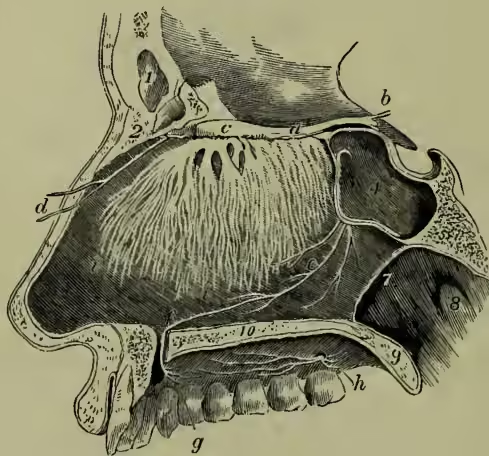
Hemorrhage from the Nostrils, or Epistaxis (Gr., 'a dropping'), is by far the commonest form of bleeding from a mucous membrane. It may be produced by direct injury, as by a blow on the nose, or a scratch in the interior of the nostrils; and by other local conditions, as ulcerations or 1, frontal sinus; 2, nasal bone; 4, sphenoidal sinus of left side; 7, posterior opening of the left nostril; 8, opening of Eustachian tube; 9, section of soft palate; 10, section of hard palate. a, olfactory nerve; b, its three roots; c, its bulb; d, nasal branch from the ophthalmic division of the fifth nerve; e, naso-palatine nerve; g, h, its branches; i, the septum of the nose. is lined by ciliated epithelium. In the upper third of the nose—which, as the proper seat of the sense of smell, may be termed the olfactory region—the mucous membrane is very thick and coloured by a brown pigment. The olfactory nerve, or nerve of morbid growths in the nasal cavity. According to Sir Morell Mackenzie, 'constitutional causes are of four kinds: (1) the blood itself may be diseased; (2) the vessels may be diseased; (3) there may be obstruction to the circulation through the lungs, liver, kidneys, or other organs, causing a sudden tension or strain of the whole system, which gives way at a weak part—viz. the nose . . .; (4) the blood-flow may be a vicarious discharge' (Diseases of the Throat and Nose). It is most common in children and young adults, least so in the prime of life. It is much more often met with in the male sex than the female. The bleeding usually occurs drop by drop, but may be very profuse. Sir Thomas Watson wisely says: 'Sometimes it is a remedy; sometimes a warning; sometimes in itself a disease.' The first question to be considered therefore in any particular case is whether the hemorrhage ought to be arrested. Generally speaking, in plethoric children and young people, in cases of venous obstruction, and in vicarious hemorrhage, it should not be stopped unless the loss of blood prove excessive.
When it is desirable to arrest the hemorrhage the patient should be placed in the sitting posture at an open window, with the head erect or slightly inclined backwards; and amongst the simpler means to be first tried are compression of the nostrils by the fingers, maintained for five or ten minutes, the application of a key or other piece of cold metal to the back of the neck, and the bathing of the face or whole head with cold water, especially if accompanied by a drawing-up of the water into the nostrils; should these means fail, recourse must be had to astringent injections (for example, twenty grains of alum dissolved in an ounce of water) thrown up the nostrils by a syringe, or to astringent powders (as finely-powdered galls, kino, matico, alum, &c.) blown up the nostrils by means of a quill or other tube, or snuffed up by the patient. As a final resource the nostrils must be plugged with strips of lint, absorbent wick, or a piece of sponge. Cases occasionally occur in which it is necessary also to plug the posterior orifices of the nostrils by an operation, into the details of which it is not necessary to enter.
Post-nasal Catarrh is a chronic and very troublesome disease, most common in America, especially the United States; so much so that it is there usually called simply catarrh, and elsewhere is sometimes spoken of as American catarrh. The symptoms are discomfort at the back of the nose, leading to frequent 'hawking' to clear away the tenacious mucus which is formed there, and sometimes indistinctness in articulation. The causes are not well understood: Sir Morell Mackenzie believes that the chief is the inhalation of irritating dust. Treatment must be chiefly directed to the local condition; alkaline sprays or washes should be used to remove the adherent secretion, and then an astringent powder or a thin ointment snuffed up the nostrils: catechu, red (Eucalyptus) gum, or sulphate of iron, diluted with starch, and soft vaseline, either alone or with one-eighth of finely-powdered boracic acid, are among the most useful applications. Health otherwise defective may indicate the importance of constitutional treatment; and change of climate is sometimes useful.
When the nose or a portion of it has been destroyed by disease or accident, the defect may be partly made good by the Rhinoplastic (q.v.) operation.
See Sir Morell Mackenzie, Diseases of Throat and Nose (1884); Cresswell Baber, Guide to Examination of Nose (1886); Greville Macdonald, Diseases of the Nose (1890).