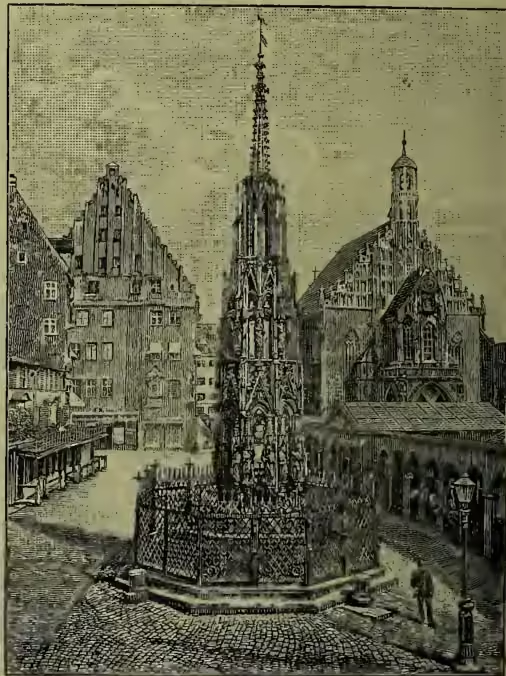
Nuremberg (Ger. Nürnberg), a city in the Bavarian province of Middle Franconia, in a sandy but well-cultivated district, on the little Pegnitz (a sub-affluent of the Main), 95 miles N. by W. of Munich and 145 ESE. of Frankfort. It is the quaintest and most interesting town of Germany, on account of the wealth of mediæval architecture which it presents in its many-towered walls, its gateways, its picturesque streets with their gabled house-fronts, its bridges, and its beautiful Gothic fountains. The Burg or royal palace, built (c. 1024–1158) by Conrad II. and Frederick Barbarossa, commands a glorious view of the surrounding country, and is rich in paintings and wood- carvings; in its courtyard is a coeval linden-tree. Of eight fine churches the two finest are St Lawrence (1274–1477), with two noble towers 233 feet high, exquisite stained glass, the famous stone tabernacle (1495–1500) by Adam Krafft, and the wood-carvings of Veit Stoss; and St Sebald's (c. 1225–1377), with the superb shrine of Peter Vischer. Other noteworthy objects are the Italian Renaissance town-hall (1622); the new law-courts (1877); the gymnasium, founded by Melanchthon (1526); the Germanic museum (1852); an industrial museum (1871); a library of 70,000 volumes; Albert Dürer's house; and the statues of him, Hans Sachs, and Melanchthon, with the 'Victoria' or soldiers' monument (1876). Although the glory of Nuremberg's foreign commerce has long since passed away, the home trade is still of high importance. It includes the specialities of metal, wood, and bone carvings, and children's 'Dutch' toys and dolls, which, known as 'Nuremberg wares,' find a ready sale in every part of Europe, and are largely exported to America and the East. In all there are close on 200 factories, producing also chemicals, ultramarine, type, lead-pencils, beer, &c.; and the town besides does a vast export trade in hops, and import trade in colonial wares from the Netherlands. Pop. (1818) 26,854; (1875) 91,018; (1890) 142,590, of whom about 30,000 were Catholics and 4000 Jews.
First heard of in 1050, Nuremberg was raised to the rank of a free imperial city by Frederick II. in 1219. In 1417 the Hohenzollerns sold all their rights to the magistracy. This put an end to the feuds which had hitherto raged between the burghers and the municipality; and Nuremberg for a time became the chief home in Germany of the arts and of inventions—watches or 'Nuremberg eggs,' air-guns, globes, &c. Simultaneously it grew rich with the fruits of the great commerce which it maintained between the traders of the East and the other European marts. The discovery of the Cape passage to India deprived it of its monopoly, and the Thirty Years' War completed the decay of the city, which a century before had embraced the Reformed doctrines. Still, in 1803 it was allowed to retain its independence, with a territory of 483 sq. m., containing 80,000 inhabitants; but, in consequence of disputes with Prussia, it entered into the Rhenish Confederation, and in 1806 was transferred to Bavaria.
See German works by Voigt (1862), Lachner (4th ed. 1873), Priem (1874), Stockbauer (1879), Roth (1884).