Nutation is a slight oscillatory movement of the earth's axis which disturbs the otherwise circular path described by the pole of the earth round that of the ecliptic, known as the 'precession of the equinoxes.' It is produced by the same causes—viz. the attraction of the sun, moon, and planets (the attraction of the last mentioned being so small as to be quite imperceptible) upon the bulging zone about the earth's equator, though in this case it is the moon alone that is the effective agent. It also, for reasons which need not be given here, depends, for the most part, not upon the position of the moon in her orbit, but of the moon's node.
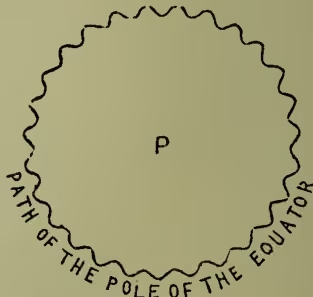
If there was no precession of the equinoxes nutation would appear as a small elliptical motion of the earth's axis performed in the same time as the moon's nodes take to complete a revolution, the axes of the ellipse being respectively 18"5 and 13"7, the longer axes being directed towards the pole of the ecliptic. But this motion, when combined with the more rapid one of precession, causes the pole of the earth's axis to describe a wavy line round P, the pole of the ecliptic.
The effect of nutation, when referred to the equator and ecliptic, is to produce a periodical change in the obliquity of the ecliptic and in the velocity of retrogradation of the equinoctial points.
It thus gives rise to the distinction of 'apparent' from 'mean' right ascension and declination, the former involving and the latter being freed from the fluctuations arising from nutation.