Nux Vomica is the name given to the seed of Strychnos Nux Vomica. The seeds are imported from the East Indies, and are flattish and circular, about an inch in diameter, umbilicated and slightly convex on one side, externally of an ash-gray colour, thickly covered with short satiny hairs, internally translucent, tough and horny, taste intensely bitter, inodorous. The tree is a native of Coromandel, Ceylon, and other parts of the
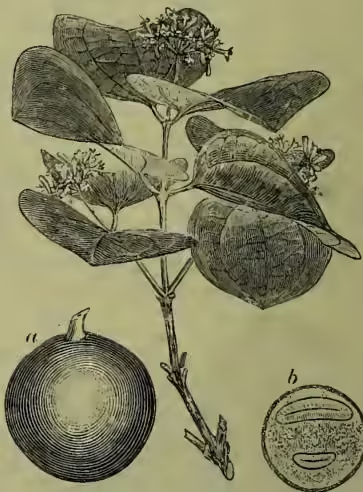
East Indies. It is a tree of moderate size, with roundish-oblong, stalked, smooth leaves, and terminal corymbs. The fruit is a globular berry, about as large as a small orange, one-celled, with a brittle shell, and several seeds lodged in a white gelatinous pulp.—The bark is sometimes known as False Angostura Bark, having been confounded with Angostura Bark, which is non-poisonous, and simply has the action of a bitter. The seeds contain (in addition to inert matters, such as gum, starch, woody fibre, &c.) two alkaloids closely related to each other, which act as powerful poisons on the animal frame, and speedily occasion violent tetanic convulsions and death. These alkaloids are named Strychnine and Brucin, and exist in the seeds in combination with lactic and strychnic (or igasuric) acids. For a method of obtaining strychnine from the seeds, see the British Pharmacopœia; and for the poisons, see BRUCIN and STRYCHNINE.