Oak (Quercus), a genus of trees and shrubs of the natural order Cupuliferae, having monœcious flowers, the male in slender catkins or spikes, the female solitary or clustered; the fruit a nut or acorn, oblong, ovoid, or globular, protruding from a woody cup formed by the enlarged scales of the involucre; the leaves are deciduous or evergreen, alternate, entire, lobed, or sinuate. The species, of which there are about 300, are spread over nearly the whole of the northern hemisphere, except the extreme north. They are more numerous in
America than in Europe; a few are found in Asia, none in tropical Africa, in Australia, or in South America except about the Andes. The Common or English Oak (Q. robur) is the most widely distributed of the species. It extends all over Europe, except the extreme north, and 'penetrates into central Asia by way of the Caucasus. In Britain there are two well-marked 'races,' which in their more extreme forms have been designated and described by some authorities as species, while by others they are, and with better reason, regarded merely as distinct seminal varieties of Q. robur.
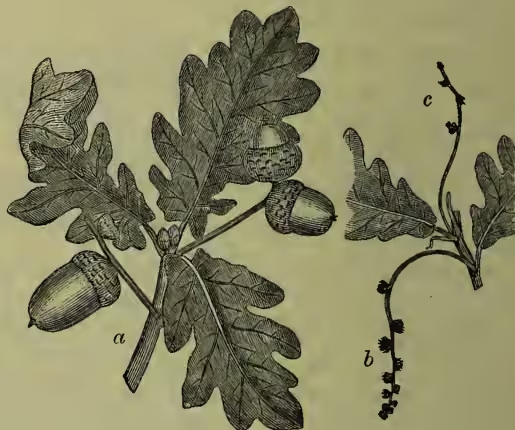
a, branch in fruit; b, male flower; c, female flower.
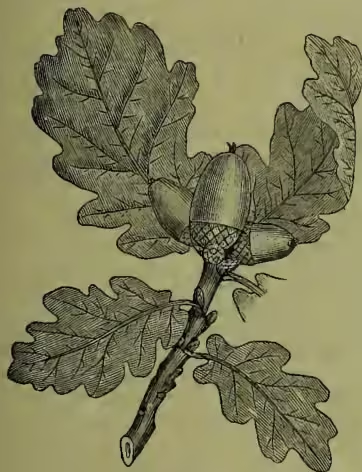
The form that is most common—Q. r. pedunculata—is characterised by having stalkless or nearly stalkless leaves, while the acorns are borne on more or less elongated stalks. The other form—Q. r. sessiliflora—has these features inverted; the leaves are stalked and the acorns stalkless. The former is found most plentifully in the south and midland counties of England, the latter in the west and north, and in Scotland. But though these peculiarities of structure and geographical distribution are more or less true and constant, the two forms are not only found growing together in all districts, but the extremes of structural difference are also linked together by individual trees which exhibit every intermediate gradation of structural disparity. The Durmast Oak (Q. r. sessiliflora pubescens), which is most abundant in the New Forest, Hampshire, differs only from the stalkless fruited variety in having the leaves more or less downy on the under side, and in retaining them longer in winter than either of the others. But this variety is also found in company with the others in different parts of the country.
Prior to the introduction of iron into shipbuilding, when 'hearts of oak were our ships,' the comparative merits of the timber of these several forms of oak were vigorously discussed both in Britain and in France, but with so much contradictoriness of assertion that sound conclusions could not be deduced. So much is the quality of oak timber affected by the soil and other circumstances in which the trees grow, that it is not improbable that the advocates on either side may have unwittingly confounded the wood of one variety with that of the other. The strength and durability of the timber of either kind is as unquestionable as is the extreme longevity of the trees. The timber of no other European tree combines in itself the essential elements of strength and durability, hardness and elasticity, in the same degree as the oak. Longevity is a characteristic of all species of oak, but the British oak is celebrated above all others for the great age to which it attains. In many districts of England, and in a few also of Scotland, there exist huge venerable living remains of giant oaks, whose age cannot be computed with accuracy, but which, when compared with younger trees authentically known to be 300 or 400 years old, may, without improbability, be reckoned to have stood for more than 1000 years. Many of these ancient trees are historical landmarks, being associated with the events and the names of persons of the remote past. Legendary though some of these associations may appear to be when applied to such as the 'King Oak,' in Windsor Forest, which is said to have afforded shade and shelter to William the Conqueror, it is far from improbable that the tree may have been of considerable age at the time of the Conquest. The circumference of the trunk of this tree in 1864, at 3 feet from the ground, was 26 feet. But there are many larger living oaks in other parts of the country. The Cowthorpe Oak, for instance, in the village of that name, 6 miles S.E. of Knaresborough, measured, at 3 feet from the ground, 48 feet in circumference. This tree is simply a wreck of former grandeur, yet lives and puts forth leaves annually. Taking the less favourable character of the climate of the West Riding of Yorkshire, when compared with that of Windsor Forest, into account along with the immensely greater bulk of the Cowthorpe Oak than the King Oak, it is not extravagant to assume that the former may be twice the age of the latter. The oak from remotest antiquity has had a celebrity among trees; it has been regarded as the 'Monarch of the Forest.' It was held sacred by the Greeks and Romans and by the ancient Gauls and Britons. The history of the use of the timber of the oak as material for shipbuilding may be said to date from the time of King Alfred (see NAVY). The timber is also employed in architecture, cabinet-making, carving, mill-work, and coopering; and the sawdust was formerly employed in the dyeing of fustian.
The bark is of great value as furnishing tan for the use of the tanner. It yields a bitter extract named Quercine, which is employed in medicine as a tonic and astringent. Colouring matter is also obtained from it, which is used in dyeing wool. The acorns are excellent food for swine; and their im- portance for this purpose is clearly shown by the pannage laws enacted by Ine, king of Wessex, in the 7th century, for the regulation of rearing and fattening hogs, then, and for centuries afterwards, perhaps the most important agricultural pursuit of the people. Although the fruit of the British oak is neither so palatable nor so easily digested as to recommend itself for human food, that of many other oaks is sweet, wholesome, and nutritious. In Turkey the acorns of several kinds, after being buried in the ground for some time to deprive them of their bitter principle, are dried, washed, and ground to powder along with sugar and aromatics. The compound thus prepared is called palamonte, and a food is made from it named racahout, which is much esteemed by the ladies of the seraglio for maintaining their plumpness and good condition. The Barbary Oak (Q. ballota), the Evergreen Oak (Q. Ilex), the Italian Oak (Q. Aesculus) are European and African species, the fruit of which, especially that of the first named, is sweet and nut-like in flavour and wholesome to eat. The Dwarf Chestnut Oak (Q. prinoides), a North American species, and several others of that country also produce edible acorns. Among other oaks remarkable for the utility of their products are the Cork Oak (Q. suber; see CORK); the Valonia Oak (Q. egilops), native of the Levant, and cups of which are said to contain more tannin per given bulk of substance than any other vegetable; the Black or Quercitron Oak (Q. tinctoria), an abundant native of the United States, the bark of which yields the Quercitron dye of commerce; the Gall Oak (Q. infectoria), a native of Asia Minor, furnishing the gall-nuts of commerce (see GALLS); the Kermes Oak (Q. coccifera), a native of the south of Europe, the Levant, and the north of Africa, which supplies the kermes or scarlet grain of commerce (see DYEING, Vol. IV. p. 139); and the Manna Oak (Q. mannifera), a native of Kurdistan, which secretes on its leaves in warm weather a sweet mucilaginous substance, that is made into highly esteemed sweetmeats. The timber of most of the American oaks is valuable. The following are the most esteemed as timber-trees: the White Oak or Quebec Oak (Q. alba), spread from the Gulf of Mexico to Canada, regarded as only inferior in quality to British oak; the Over-cup Oak (Q. lyrata), native of the southern states, occupying situations liable to inundation; the Chestnut-leaved White Oak (Q. prinus), also a native of the southern states; the Live Oak (Q. virens), extending from the Gulf of Mexico as far north as Virginia, regarded as the most valuable of American oaks for shipbuilding; the Red Oak (Q. rubra), pretty generally distributed in the United States and in Canada, furnishing the Red Oak Staves so much in demand in the West Indies. Of the Turkey Oak (Q. cerris) there are several interesting varieties, as the Fulham Oak (Q. c. Fulhamensis), which is semi-evergreen although the parent is strictly deciduous. The Austrian Oak (Q. Austriaca), the Evergreen or Holm Oak already named, and a number of the American species already noticed are much appreciated ornamental trees in Britain. Green oak is a condition of oak-wood caused by its being impregnated with the spawn of Peziza æruginosa, which communicates a beautiful tint of green, and of which the turners and cabinet-makers of Tunbridge Wells avail themselves for inlaying, bead-making, &c.—The Common Oak and most others cultivated in Britain delight in deep moist loamy soil, in which, however, there should be no stagnant water. Great depth is of more consequence than superior quality of soil. Plantations of oak are slow in coming to marketable value, except in the shape of copsewood, for which the oak is one of the best adapted trees, owing to the facility with which it stools or sends saplings up from its roots on being cut down. Copsewood oak is valuable for firewood, the making of charcoal for cooper work, and the making of crates, &c., while the bark is always marketable for the purpose of the tanner. The acorns of all species of oak supply oil in considerable quantity, which has been used in cookery and for other domestic purposes.
Many other trees bear the name oak popularly applied. Thus, the Poison Oak (Rhus toxicodendron), a shrub or small tree of North America, Indian Oak (Tectona grandis), African Oak (Oldfieldia Africana), and Stone Oak (Lithocarpus javanensis), which belongs to the same natural order with Quercus, are examples of the popular but erroneous use of the name oak.
See Evelyn's Sylva (1664); Strutt's Sylva; Camden's Account of the New Forest; Gilpin's Forest Scenery; Loudon's Arboretum Britannicum; Trans. Highland and Agric. Soc. (1881).