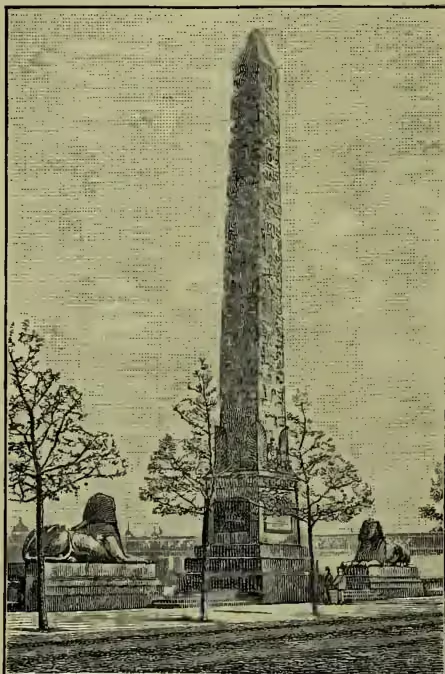
Obelisk (Gr. obelos, obeliskos, 'a spit'), a word applied to four-sided monuments of stone and other materials, terminating with a pyramidal or pointed top. These monuments were placed upon bases before gateways of the principal temples in Egypt, one on each side of the door. They served in Egyptian art for the same purposes as the stelæ of the Greeks and columns of the Romans, and appear to have been erected to record the honours or triumphs of the monarch. They have four faces, are cut out of one piece, and are broader at the base than at the top, at a short distance from which the sides form the base of a pyramidion in which the obelisk terminates. They were placed upon a cubical base of the same material, which slightly surpassed the breadth of their base. Each side of the obelisk at the base measures th of the height of the shaft, from the base line to that where the cap or pyramidion commences. The cap is also th of the same height. Their sides are slightly concave, to increase their apparent height. Their height varies from upwards of 100 feet to a few inches. The sides are generally sculptured with hieroglyphs and representations, recording the names and titles of kings, generally in one line of deeply-cut hieroglyphs down each side. Hewn in the rough out of a solid piece in the quarries, they were transported down the Nile during the inundation, on rafts, to the spot where they were intended to be placed, and raised from their horizontal position by inclined planes, aided by machinery. Some obelisks, before their erection, had their pyramid capped with bronze gilded, or gold, the marks of such covering still being evident on their surfaces. The use of obelisks is as old as the appearance of art itself in Egypt; these grand, simple, and geometric forms being used in the 4th dynasty, and continued till the time of the Romans. Their object is enveloped in great obscurity. At the time of the 18th dynasty it appears that religious ceremonies and oblations were offered to the obelisks, which were treated as divinities. Their sepulchral use is evinced by their discovery in the tombs of the 4th dynasty, and the vignettes of early papyri. The most of them date from the 18th and 19th dynasties. Two which formerly stood at Heliopolis (q.v.) were re-erected by Rameses II. at Alexandria, and have been popularly known as Cleopatra's Needles. One, which long lay prostrate, was, after an adventurous voyage, brought to London in 1878, and erected on the Thames Embankment; it weighs 186 tons, and is 68½ feet high. The other, presented by the Khedive to the United States, was set up in Central Park, New York, in 1881. There are several large ones in Rome (that now at St Peter's having been taken to Rome by Caligula), one in Florence, one in Paris (given by Mehmet Ali in 1837), and Lepsius's in Berlin (the oldest and smallest of all, 2 feet 1½ inch high), besides many others that have found their way into European museums. By far the largest obelisk in the world is the Washington monument (1885), at Washington, D.C. It is of marble, 55 feet square at the base, and 555 feet high.
See Zoëga, De Origine et Usu Obeliscorum (1797); Birch, Notes upon Obelisks (1853); Gorringe, Egyptian Obelisks (1885).