Octopus, a widely distributed genus of eight-armed cuttle-fishes, the members of which (e.g. O. vulgaris in Europe, and O. bairdii in America) usually live near shore, lurking among the rocks, preying upon crustaceans and molluscs. The term is often extended to related genera, such as Eledone, and to other members of the sub-order Octopoda. These differ in many ways from the Decapoda, such as Sepia and Loligo: thus, the suckers on the eight arms are sessile and without a horny ring; the body is more rounded, and there is no internal residue of a shell. Of the half-hundred species some are large: thus, O. vulgaris may have tentacles about 8 feet long, and O. punctatus of the Pacific coasts even twice as much. These are dwarfed, however, by the gigantic ten-armed Architeuthis, of which one specimen exhibited in America had a head and body 9½ feet long and arms of 30 feet, while another had a body twice as big.
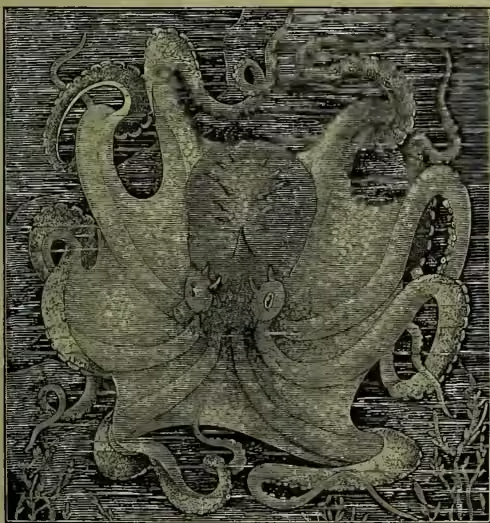
Many fanciful descriptions have been given of the Octopus, notably that by Victor Hugo in his Toilers of the Sea, in which the characters of cephalopod and polyp are dramatically combined. Large specimens may of course act powerfully on the defensive, but by nature they are timid, lurking animals, the conger eel and other voracious fishes being their most formidable foes. They are sometimes caught in sunken pots, into which they creep, and the flesh is used both as food and bait. The predominant colour is reddish, but it changes rapidly with that of the surroundings and with the temper of the animal, which has also the power of discolouring the water by a discharge of inky fluid. The eggs are enclosed in small translucent sacs, and hundreds are attached to a common stalk which is glued to the rock, and protected and kept free of small seaweeds, &c., by the female. For their general structure, see CEPHALPODA, CALAMARY, and CUTTLE-FISH.