Ogam. This word is sometimes written Ogham, but it should then be pronounced with a gh mute, as in modern Irish, to which the spelling Ogham belongs. In English, however, it is preferable to pronounce the g, and to spell the word Ogam, as in older Irish; then there will be the noun Ogam and the adjective Ogmic, for which we have the sanction of such authorities as Whitley Stokes and Nigra.
The term Ogam is associated with Ogma, the champion of the mythic Tuatha Dé Danann—i.e. the tribes of the goddess Danu, or Dón as she is called in the Mabinogion of the Welsh. Ogma's name is, letter for letter, the Irish equivalent of Ogmios, the name of the Gaulish divinity quaintly described by Lucian as a Celtic Heracles, which meant a Heracles who performed his feats by dint of eloquence, not by the force of his arms. So the Gauls pictured him leading crowds of willing captives, bound to him by minute chains connecting their ears with the tip of his tongue. The Irish account of Ogma is not inconsistent with the Gaulish one of Ogmios; for the former, besides being a warrior and the champion of the Tuatha Dé Danann, is represented as eminently skilled in languages; so he is said to have invented two things, a dialect for the learned, and an alphabet or form of writing. Both are called Ogam. The Ogam dialect, on which a learned paper by Dr
Thurneysen should be read in the Revue Celtique (vol. vii. p. 369–374), proves to have been a jargon of artificial and pedantic origin. It is needless to say that the attribution of such an invention to Ogma can have formed no part of early Irish tradition about Ogma; and, as there is no reason to suppose the Ogam alphabet to date till late in the Roman occupation of Britain, much the same remark must apply to the invention of that form of writing. It is not hard, however, to see why both came in the course of time to be ascribed to Ogma: he was, like his Gaulish namesake, probably a hero of words, of speech, and of eloquence, so that any linguistic invention might readily gravitate into association with his name.
Putting aside the Ogam dialect, we shall now confine our remarks to the Ogam alphabet, premising that the key to it was never lost in Irish literature, though little attention was devoted to it by scholars till after the discovery of the bilingual inscription at St Dogmael's, near Cardigan, in South Wales. But in Irish manuscripts the values of the Ogam characters are naturally given as those of the Irish letters in the pronunciation familiar to the writers of those manuscripts; so when we deal with Ogams, let us say, of the 5th or the 6th century, certain corrections have to be made in the equivalents. The following is the Ogam alphabet, with the value of each symbol as it has been ascertained from the most ancient class of the monuments in question:
| b | l | w | s | n | |||||
|---|---|---|---|---|---|---|---|---|---|
On this let us remark that the continuous line represents the edge of the stone on which the digits are cut. Taking an Ogam stone in situ, one most commonly reads upwards, and the scores are placed on either side of the edge. In some instances the vowels are not mere notches in the edge of the stone, but scores of nearly the same length as those of the third group, but differing from them in being cut perpendicular to the edge. This would seem to supply a reason for the slanting of the digits of the third group, but that is not supported by the most ancient class of inscriptions. Turning to the individual characters, the value of h given to the first of them is derived only from Irish tradition, but there is no reason to doubt its accuracy, though the writer has never come upon any good inscriptional evidence in point. The same, till lately, might be said of the case of ng, but he has found in an ancient inscription for the nasal in the borrowed word,
Sancti. The case of
is one of some difficulty, as the letter has never been found in an inscription, while Irish tradition ascribes it the value of z or st. This, however, does not mean two different accounts of the Ogam, as the Irish sometimes treated z and st as equivalents, as, for example, when they wrote steta, Stephyrus, and Elistabeth for zcta, Zephyrus, and Elizabeth. It should be explained that st has long been commonly reduced in Irish words to s or ss. Thus all that Irish tradition respecting this Ogam seems to mean is, that it was z or a certain other sibilant. Now, as to z representing the soft sound corresponding to the sharp sound of ss, it is not to be found in Irish from the 9th century down, and it is doubtful whether it existed in the language late enough to claim a place in the Ogam alphabet. We venture to accept the indication afforded by Irish tradition, that
was a sibilant, or let us say an s, for that is the only sibilant known to the language, except sh, which is written s preceding e or i; we must therefore look for a class of words where the actual or attested s of Irish stands for a consonant which was at one time not an s. We have such probably in borrowed words, like srian, 'a bridle,' from the Latin frenum, or scinistir, 'a window,' from the Latin fenestra. But the change from f to s is not confined to borrowed words, as there is a group of words with s in modern Irish corresponding to Welsh ff, as in Irish sonn, Welsh ffon, 'a staff,' in which the initial combination of consonants seems to have been at first sp or sp-h. This would seem to have been simplified into f or ϕ, and that ultimately changed in Irish into s. We should accordingly be inclined to believe that f or ϕ was the value of the
Ogam ; and the phonetic change afterwards into s would account for the sibilant value ascribed to this Ogam by Irish tradition. Moreover, a genitive Fanoni in a Devonshire inscription, reading in Roman letters FANONI MAQVIRINI, shows that early Irish had the sound of f or ϕ; and as the Ogam alphabet provided no symbol for it, unless it was
, this consideration confirms the conclusion already suggested. It is right here to remark that modern Irish has the consonant f in abundance, but in earlier Irish this was w or v, which between vowels has since been everywhere elided, while initially it has been strengthened into f; thus, in Adamnan's Life of St Columba the name Fergna is Virgous, while the ancient Terra Convaleorum in Louth appears in the Annals of the Four Masters as Tir-Conaille, or rather Tir-Conaille-Cerd, to distinguish it from the district of Tirconnell in Donegal. As to the Ogam
, which we have transliterated qu, that combination, when written in Latin capitals, is found represented by QV, as in the MAQVIRINI, already cited; the exact pronunciation of the u cannot be ascertained, but it was probably not very far from that of the English w, as in one instance the QV is represented in Ogam by qo or
, and in one other by qw or
.
In any case, it is worthy of note that no instance of confounding (qu) with
(c) is known to occur in the more respectable class of Ogam inscriptions. Lastly, a character x occurs, which was, as it were, outside the Ogam alphabet of twenty symbols. In Ireland this x had two values: sometimes it represented one of the sounds of e and sometimes the consonant p; the latter was also its value in South Wales, where it occurs in the Ogmic spelling of the genitive of the Roman name Turpillus. In Goidelic words themselves it cannot have been often wanted, as the p of the Aryan parent speech is nowhere retained in the Celtic languages. It is noticed, however, that in some words the place of Aryan p was occupied in Old Irish by h; e.g. huile, 'all,' from the same stem as the Greek πολλοί, 'many,' and huathad, 'the singular number,' from the same root as Latin paucus, English few.
A word must now be said of the distribution of Ogam monuments. All the Ogam inscriptions, whether still existing or known to have once existed, number not quite 300, most of which consist of epitaphs. Of that number about 250 belong to Ireland, mostly the southern counties, especially Kerry, Cork, and Waterford, though one has been heard of as far north as Londonderry. The Ogams in Britain and the islands make rather less than fifty in all, and of these South Britain has none east of Wales and Devon. Within this area the county which has most specimens to show is Pembrokeshire (including Cady Island), and next in order come the other South Welsh counties and Devon, while Cornwall boasts only a single instance, and that of a somewhat doubtful nature. No Ogams have been found in Mid-Wales, and only one is known in North Wales—to wit, near Ruthin, in the county of Denbigh. The Ogams of Wales, however, and Devon have an importance out of all proportion to their number, owing to the fact that most of them are accompanied by a version in Latin. Proceeding northwards, one comes across a highly interesting group of Ogams in the Isle of Man; but the first Scotch Ogam is a very doubtful one, to be found, as it is supposed, in the island of Gigha, between Cantyre and Islay. There are, however, about fourteen Ogams mentioned as belonging to Scotland, most of which have no doubt attaching to them as to their being Ogams, though more doubt than enough exists as to the import of some of them, or even to the language employed. They occur in the counties of Fife, Aberdeen, Elgin, and Sutherland; also in the islands of Orkney, and more frequently in those of Shetland.
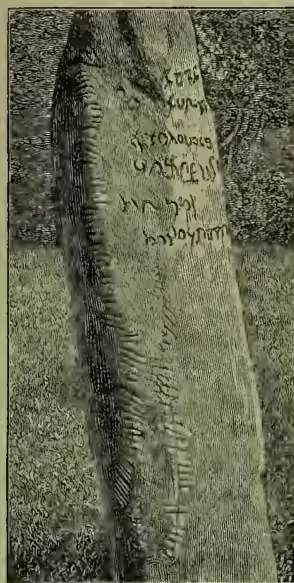
The Ogam inscription, as distinguished from that in alphabetic characters, is thus read by the Earl of Southesk: (A)IDDAI QNEAN FORRERI IBH UA IOSIE, and interpreted as 'Ada, daughter of Forar, of the race of the sons of Huas.'
The writer once thought that Ogmic and Runic writing could be traced to a common origin; but he no longer thinks so. In his opinion the most probable theory is that which regards the Ogam alphabet as invented during the Roman occupation of Britain, by a Goidelic grammarian who had seen the Brythons of the Roman province making use of Latin letters. The Celts were in the habit probably of setting up stones to mark the tombs of their great men, but it was presumably from the Romans they learned to inscribe them. It has been supposed that the inventor of the Ogam alphabet took a hint from a habit of scoring for the purpose of counting, and that his group were the initials of the five first numerals, which in modern Irish are aon, dá, tri, ceathair, cúig, for this only required one to regard aon as if it were haon, with an h prefixed according to a habit by no means uncommon in the case of certain words in Old Irish. Such a theory proves on examination to be substantially tenable, as the early Goidelic forms of the numerals in question were approximately the following: oinos, duō'u, trīs, ectuō'res, quē'gque. The fourth, ectuō'res, represented an earlier quatuō'res, corresponding to the Latin quatuor and its congeners; but its first u, standing as it originally did in an unaccented syllable, was dropped, so that the word became ectuō'res. The case of the initial qu of the fifth numeral was different, as it immediately preceded the accent, which, moving forward as usual in Irish, fixed itself on the u (of qu), made into a pure vowel, so that queqqe became qíeqqe, or rather cíecece, whence the attested forms cóic and craig, 'five.' This is paralleled in Irish by dóiní, 'men,' as contrasted with duine, 'man,' from some such Goidelic stem as duén, so that the word for man has been explained to mean a mortal, and in part equated with the Greek θν-ητός, 'mortal.' Now, Manx Gaelic has not altogether followed Irish in its accentuation, and here the transition from queqqe to qíeqqe never took place, so the Manx for 'five' is queig; compare Manx quci or quoi, 'who.' The case of the first Ogam is more difficult, as we should have to suppose h-aon and h-oinos, where the cognate languages prove that the h cannot have been organic, even though it sometimes crept into the pronunciation of this word. It is possible, however, that the word doing service for the first numeral was one of a different origin—for instance, a word related to huathad, 'the singular number,' and huaitiu, 'lonelier,' 'loneliest;' and it is worthy of notice that one of the names of the Ogam for h was huath. In such words as these the h may be supposed, as already suggested, to have been of ancient standing.
Another circumstance sheds light on the history of the Ogam alphabet: the oldest class of inscriptions contain so many instances of cc and tt where later Irish has ch and th that the former digraphs cannot be the result of accident, but rather a recognised way of representing the spirants ch and th. But as cc and tt do not phonetically become ch and th in the course of phonetic decay in the Goidelic dialects, the question arises, what can have suggested such a spelling? On the other hand, Brythonic speech is given to the change here suggested—viz. the reduction of cc and tt into ch and th, and before the spelling with h was regularly adopted the spirants ch and th must have been historically represented by cc and tt. This, we venture to infer, suggested the digraphs cc and tt for ch and th respectively. Granting that we are so far on fairly firm ground, we may go further, and suggest that the inventor of Ogam writing, acquainted as he was with Roman and Brythonic writing, lived somewhere in what is now South Wales, or had at any rate visited that country: he probably belonged to the race of invaders from the south of Ireland, who made the Severn sea their highway to the heart of South Wales on the one side and Somerset and Devon on the other. The distribution of the Ogams indicate that the connection was close between the districts now represented by the counties of Pembroke and Waterford. The latter is divided by a low ridge of hills into Decies within Drum and Decies without Drum, where the name Decies refers to an ancient people called the Déisi, whom Irish tradition traces across to Pembrokeshire.
The ancient Ogams are all epitaphs on stone, but a few of the later ones occur on lead and on rings and brooches. So far as this goes, it might be gathered that stone was the most common material on which Ogams were cut; this may, however, be doubted, and more use may have been made of pieces of wood. In any case, when a workman had to cut an Ogam inscription on a tombstone, it was probably handed to him on a slip of wood with prepared angles. We can call to mind more than one instance where it can be shown that the cutter, so far from knowing what he was cutting, began the Ogam at the end instead of at the beginning. Had he had the Ogam before him on a piece of skin or any plane surface he might be expected to have cut the scores on the middle of the face of the stone. In fact, some of the specimens of Ogams from Shetland are found to have been so written; and as the edge of the stone would be represented in manuscript by a continuous straight line, we find a groove scratched on the flat part of the stones, and the Ogam scores arranged in connection with it instead of following one of the edges. So it is not improbable that prepared pieces of wood formed the most usual material for cutting Ogams, as they seem to have done for the Runic alphabets of Teutonic nations. It is needless to mention that Ogam is not a species of shorthand: few hands could well be longer; and it ought likewise to be needless to say that there is nothing cryptic about this method of writing. It is a pretty general rule, for example, that a compound word of four syllables in the 5th or 6th century A.D. appears as a word of two in the modern dialects of Goidelic, so that an Ogmic genitive Luguquriti is later met with compressed into Luicrid. Here the changes which have taken place are in harmony with the ascertained rules of Irish accentuation, and no Celtic scholar would think of saying that Luguquriti is a cryptic form of Luicrid: that would be simply to deny the history of the word any phonological perspective, and so in other cases. Lastly, for the study of Goidelic philology the importance of the Ogam inscriptions extant, few comparatively speaking and meagre as they are, is much the same as that of Roman inscriptions would be for Romance philology, supposing all other remains of Latin speech had utterly perished.
The most comprehensive work on Ogams is Brash's Ogam-inscribed Monuments of the Gadhil in the British Islands, with a Dissertation on the Ogam Character (Lond. 1879); and next to it is in point of comprehensiveness must be ranked Sir Samuel Ferguson's Ogham Inscriptions in Ireland, Wales, and Scotland (Edin. 1887), which consists of the Rhind Lectures delivered in Edinburgh in 1884. Papers on Ogams will be found in the Trans. Roy. Irish Acad., especially by the Bishop of Limerick, who has also propounded a theory of the origin of Ogmic writing in the Hermathena. The journal which has above all others kept its pages open for Ogam finds in Ireland is that of the Royal Hist. Archaeo. Assoc. Ireland (originally founded as the Kilkenny Society in the year 1849). Among other things its Journal for 1874 contains tracings made by G. M. Atkinson of old treatises on Ogams, together with explanations, including the theory of the numerical origin of the Ogams for h, d, e, qu, which we find to have been contributed by the Rev. Edmond Barry. The Ogams of Wales and Devon will be found in their places in Hübner's Inscriptiones Britannice Christianæ (Berlin, 1876). Further, those of the Principality have from time to time been noticed and illustrated in the Archæologia Cambrensis, and they will also be found in Westwood's Lapidarium Walliæ (Oxford, 1876-79). The Ogams of the Isle of Man have been described in the Academy and the Manx Note-book; and papers on the Scottish Ogams were read before the Society of Antiquaries of Scotland in the years 1882-84 by the Earl of Southesk after careful examination of the stones. The names in the Ogams of Wales and Devon have been discussed in detail in Rhys's Lectures on Welsh Philology (Lond. 1879), and some Ogmic forms have been used for the purposes of Celtic philology by Dr Whitley Stokes in his Celtic Declension (Gött. 1886). Lastly, the most important Irish tract on Ogams is to be found in the 15th-century manuscript known as the Book of Ballymote: it occupies folios 308-314 of the autotype edition (Dublin, 1887) of that extensive codex.