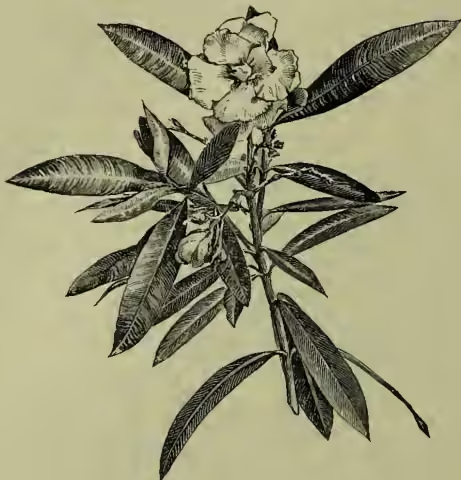
Oleander (Nerium), a genus of plants of the natural order Apocynaceæ. The species are evergreen shrubs with leathery leaves, which are opposite or in threes; the flowers in false umbels, terminal or axillary. The Common Oleander (N. oleander), a native of the south of Europe, the north of Africa, and many of the warmer temperate parts of Asia, is frequently planted in temperate countries as an ornamental shrub, and is not uncommon in Britain as a window-plant. It has beautiful red, or sometimes white flowers. The English call it Rose Bay, and the French Rose Laurel (Laurier Rose). It attains a height of eight or ten feet. Its flowers give a splendid appearance to many ruins in the south of Italy. It delights in moist situations, and is often found near streams. All parts of it contain a bitter and narcotic-acrid juice, poisonous to men and cattle, which flows out as a white milk when young twigs are broken off. Cases of poisoning have occurred by children eating its flowers, and even by the use of the wood for spits or skewers in roasting meat. Its exhalations are injurious to those who remain long under their influence, particularly to those who sleep under it. A decoction of the leaves or bark is much used in the south of France as a wash to cure cutaneous maladies. N. odoratum, an Indian species, has larger flowers, which are very fragrant. N. piscidium (or Eschaltum piscidium), a perennial climber, a native of the Khasia Hills, has a very fibrous bark, the fibre of which is used in India as hemp. The steeping of the stems in ponds kills fish.